Amid union contract negotiations, Temple nurses say the hospital must do more to keep them safe on the job
Temple nurses represented by the Pennsylvania Association of Staff Nurses and Allied Professionals have made increased safety provisions a hallmark of recent contract negotiations.
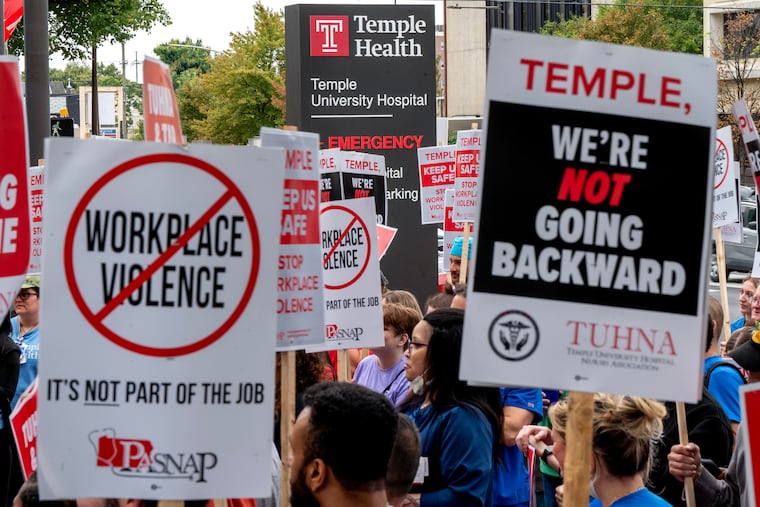
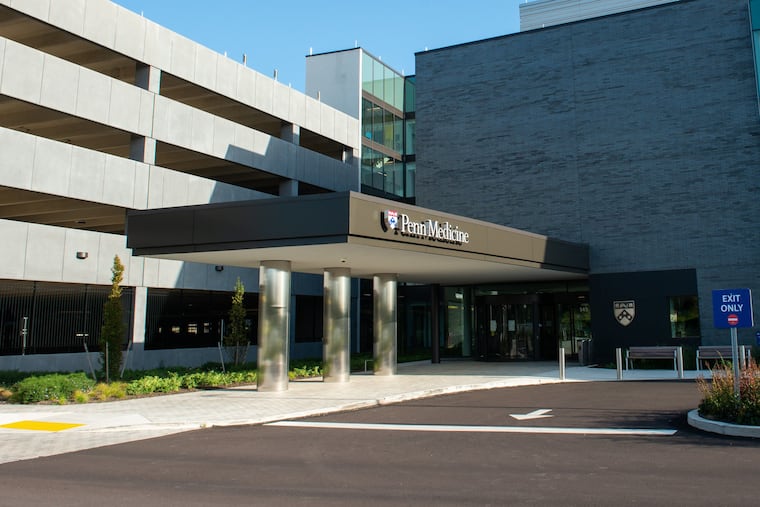
Waving signs reading “We’re not going backward” and “Stop workplace violence,” dozens of nurses and technicians in cobalt blue scrubs picketed Wednesday outside Temple University Hospital.
The Pennsylvania Association of Staff Nurses and Allied Professionals, which represents the health system’s nurses and techs, organized the protest amid negotiations for a new three-year contract.
The current contract for roughly 1,600 nurses and 1,000 other medical professionals represented by the union expires at the end of September.
Temple nurses have made increased safety provisions a hallmark of recent contract negotiations. During Wednesday’s rally, nurses spoke of being kicked and punched. One recalled a patient shoving her down against an exam room bed and threatening to sexually assault her.
After their last contract was signed in 2022, Temple nurses said they were pleased with safety improvements, including debriefings for staff who are involved in or witness violent episodes.
But they now say more can be done. In July, they rallied for stronger security measures and more staff training after a man rushed off the street and barricaded himself in a room in the hospital’s emergency department. (An active shooter alert was declared, but authorities later concluded the man did not have a gun.)
Nurses negotiating their new contract are calling for staff debriefings to be held within 48 hours after a violent incident and allowing union representatives to be present.
They are also asking for security staff to check private vehicles that arrive at the ED before nurses rush out to receive patients — a policy modeled on one instituted at Penn Presbyterian Medical Center after a hit-and-run driver injured three nurses outside that hospital’s emergency department last year.
And they want the hospital to hire specialized behavioral health staff and improve training for other workers, so they are better prepared to handle safety issues involving mental health patients.
Temple officials said they feel they are “having productive discussions on all the issues that the union has raised,” Temple Health spokesperson Jeremy Walter said in an email.
“Just like we’ve done in multiple other labor agreements this year, we’re confident this process will lead to a contract that does right by our employees and Temple Health and allows us to continue doing what we’re all here to do: provide our patients with the high-quality care they deserve,” he said.
Contract negotiations centered on safety
Marty Harrison, president of the Temple University Hospital Nurses Association, said staff safety should be a priority, just like the investments Temple has made to expand access to care by opening a new women’s hospital and buying out Redeemer Health’s share of Chestnut Hill Hospital.
“Every dollar spent on safety is a strategic investment in the future of this institution,” she said.
At Temple’s main hospital, police responded to reports of assaults involving staff 31 times between January 2022 and early December 2023, the second-highest number of any of the four major trauma centers in Philadelphia during that time period, according to an Inquirer analysis.
» READ MORE: ‘I went home with blood all over me’: At Philly hospitals, health-care workers face routine violence
Those individual incidents highlight a larger problem of abuse against healthcare workers, staff say. According to a national survey by National Nurses United, 81% of nurses reported being punched, kicked, spat at, or threatened in the last year.
‘We have every right to be safe here’
At Wednesday’s rally, nurses told stories of violent incidents they had personally experienced.
Carlos Aviles, a tech at Temple and president of Temple Allied Professionals, recalled a recent shift when one of his patients woke up and panicked about the breathing tube in his throat. The man yanked it out — then started hitting at medical staff who responded.
It took campus police 10 minutes to get there, he said, leaving nurses and techs to try to calm the patient.
Aviles said there used to be six Temple police officers assigned to the main campus, but now there are only two, which means it takes longer for help to arrive when there’s a safety emergency in the hospital. “It’s unsafe. And it’s unacceptable,” he said.
In a statement, Walter said that the health system maintains a “robust, multi-layered security protocol” at its main campus, with security officers on duty 24 hours a day.
Temple University’s Health Sciences Campus, which includes the hospital, has “consistent and appropriate staffing” from the school’s public safety department and includes “police officers and a dedicated supervisor,” he said. Philadelphia police also patrol the area.
Walter said the health system is not aware of “any delays in responses to calls or service.”
Erin Pastore, who has worked as a Temple nurse since 2016, described being assaulted by a patient in an exam room last fall.
As she went to apply a blood pressure cuff, the man twisted her arm behind her back, shoved her face into the bed in the room, and threatened to sexually assault her, she recalled.
She said she was lucky to be in a room where others heard her scream and came quickly.
Pastore said she has considered looking for a new job, but has wanted to work at Temple since nursing school.
“We have every right to be safe here and go home to our families,” Pastore said. “I shouldn’t have to look for a new job because they can’t keep me safe.”