Spain begins probe in bid to unearth wartime truths
Thousands went missing. Mass graves are to be opened.
MADRID, Spain - Former dictator Francisco Franco waged a systematic campaign to kill off political opponents during and after the Spanish Civil War, a judge said yesterday as he opened the first formal probe into that divisive time.
Judge Baltasar Garzon of the National Court ordered the urgent exhumation of at least 19 mass graves, which are believed to hold the remains of some of the tens of thousands of people who went missing during the 1936-39 war and the early stages of Franco's subsequent right-wing rule.
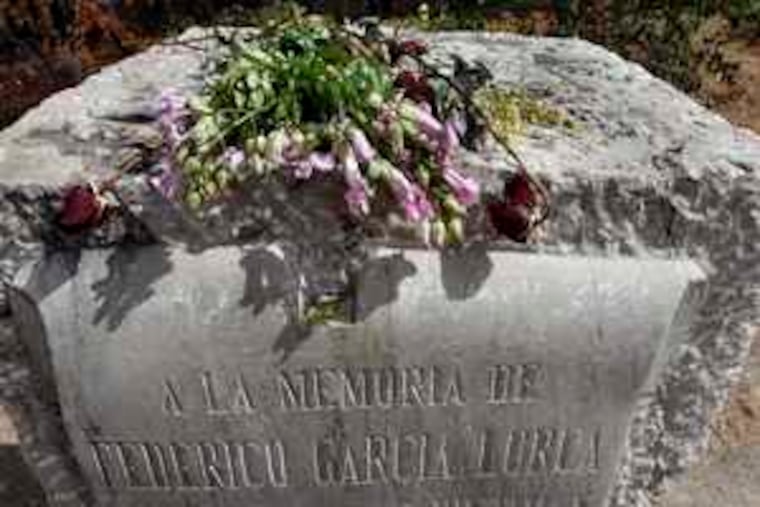
One grave is believed to contain the body of Federico Garcia Lorca, Spain's most acclaimed 20th-century poet, who was executed in the early days of the war.
Garzon's criminal probe, ordered in a 68-page writ, is the culmination of a decade-old movement for Spain to come to grips with its past atrocities, as Argentina and South Africa have done.
"For relatives of the missing, the torment has been permanent because they did not know if the victims were executed, missing, or if they were alive or dead, which turned them into victims as well," the judge wrote.
It is unclear if Garzon will ever find anyone to charge. Franco died in 1975. But the judge ordered the Interior Ministry to help him identify former senior members of the Falange Espanola, the powerful political party that backed the regime, to see if any are still alive and can be charged.
About 500,000 people died in the Spanish Civil War, and both sides committed atrocities against civilians. Franco rose up against an elected, leftist republican government and ultimately ousted it, fighting against Spaniards who backed that government.
The judge said he respected the victims on both sides.
Still, Garzon is essentially focusing on people killed by the pro-Franco side. In his writ, he noted that the Franco regime did a thorough accounting of pro-Franco civilians killed by the republican side and gave them proper burials. British historian Paul Preston, an acknowledged authority, puts this figure at about 55,000 people.
Garzon said more than 114,000 people were reported as having gone missing from the start of the war until 1952, when the Franco regime's repression largely eased.
Franco's wartime forces and the regime "induced and ordered . . . systematic and generalized killings, torture and illegal detention of political opponents," Garzon wrote.
Garzon is famous for bringing terrorism and crimes-against-humanity cases against figures such as the former Chilean dictator Augusto Pinochet, in 1998, and al-Qaeda leader Osama bin Laden, in 2003.
In those cases, he acted under the principle of universal justice, under which crimes against humanity can be prosecuted in Spain even if they are alleged to have been committed in another country.
Today's Spanish conservatives vehemently oppose the effort to address the country's wartime era and voted against a law passed last year that paid symbolic amends to the country's civilian victims.