Celebrating Jimmy Buffett in his hometown (no, not Key West)
The permanent exhibition traces the arc of Buffett’s life from his boyhood in the Mobile, Ala., region to his worldwide success as a live entertainer.
I make no claim to journalistic objectivity when it comes to Jimmy Buffett. I saw my first Buffett show at Foellinger Auditorium in Champaign-Urbana, Ill., in 1974 as he promoted his third album, A White Sport Coat and a Pink Crustacean. I attended many more over the years.
I ran into him during Florida’s 1986 Senate race, when he campaigned for the Democrat, Bob Graham, and the state’s endangered manatees. Then, through our mutual friend (and my colleague) Maureen Dowd, we became friends for the last decade of his life, regularly chewing over national political developments and, later, his health issues. We had a lot in common as former altar boys, writers, and musicians, with one of us being considerably more successful than the other.
His death, in 2023, left an immense void in Parrothead Nation, as his fans are known. But the newly opened “Jimmy Buffett Son of a Son of a Sailor Experience” at the National Maritime Museum of the Gulf, in Mobile, Ala., will provide some solace and bright memories. While Buffett will be forever linked to Key West, Fla., he is truly a son of Alabama’s Gulf Coast, the region that nurtured him and instilled in him a love of the sea and sand.
“The fact that it is sitting there on the same water he grew up on deepens the meaning I get from it, and I don’t think I’m the only one,” said Mac McAnally, Buffett’s longtime collaborator and a key member of his Coral Reefer Band. “I don’t think the connection will be wasted.”
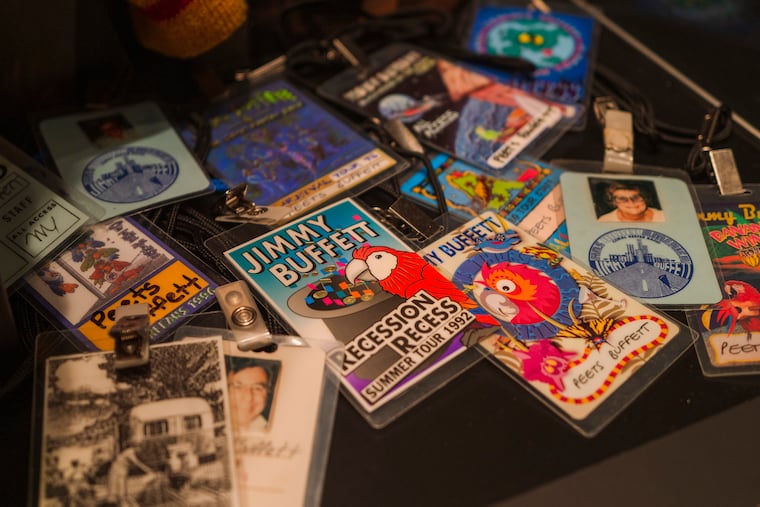
The two-story, 6,000-square-foot permanent exhibition opened in early October. It traces the arc of Buffett’s life from his boyhood in the region to his success as a live entertainer who popularized a new style of music and had millions of people yearning for a margarita and a tropical breeze. It includes childhood memorabilia along with guitars, clothing, handwritten lyrics, gold records, rare video footage, the wooden telephone booth from the cover of Coconut Telegraph, and a replica of his Key West recording studio, Shrimp Boat Sound.
And there is a taste of the concerts that defined Buffett for the public and his die-hard fans.
“After touring with Jimmy for 35 years, it was hands down the best year-round summer job anyone could ever imagine,” said Mike Ramos, Buffett’s tour manager.
The museum pays particular homage to Buffett’s grandfather, Captain James Delaney Buffett, a career merchant mariner and the titular captain in the song “The Captain and the Kid,” the family figure who stoked the young guitar player’s wanderlust. The grandfather was an adventurer who, as another of Buffett’s other canonical songs goes, switched from sails to steam. His dress blues share exhibit space with the Martin 12-string guitar his grandson employed to (perhaps) write and definitely play “Son of a Son of a Sailor” at hundreds of shows.
Buffett was born in Pascagoula, Miss., but his family moved to Mobile when he was a toddler. He described his coastal childhood in the song, “Life Is Just a Tire Swing,” noting that in his idyllic adolescence he had never been “west of New Orleans or east of Pensacola.” His parents worked at the Alabama Dry Dock and Shipbuilding Co., just across the Mobile River from where the museum now stands.
The exhibition chronicles his early attempt to break in, busking around New Orleans. It, of course, covers the Key West years with a directional sign that points out his famous haunts there. There is a section on his Save the Manatees campaign started with Graham, who was then serving as governor. But the exhibition treads lightly on Buffett’s deep interest in politics. He never injected his political views into his shows, though they were never far from the surface.
Attention is paid to his status as a bestselling author and his love of flying on his odd assortment of planes. You can listen in on a phone conversation with Buffett as he discusses the fishing prospects off Islamorada in the Keys. The exhibit nods to the trippy preconcert Bing and Bong Show that Buffett and his band leader, Michael Utley, hosted on Radio Margaritaville, his internet radio station. It was a Parrothead version of Face the Nation.
Overseeing the exhibition is a 7.5-foot-tall bronze statue that captures a smiling Buffett in stride as he appeared at a televised 2010 concert in nearby Gulf Shores to drum up business after the tourism-destroying Deepwater Horizon oil spill. The statue shows Buffett, as always, performing barefoot but includes a pair of discarded bronze flip-flops from the Margaritaville line. Ever the businessperson, he would definitely approve of the branding.
During that concert, he noted that he was a child of U.S. 90, the highway that runs along the Gulf between Florida and Texas. In the months ahead, the museum hopes to encourage a sort of Buffett legacy trail that would take people between New Orleans, Pascagoula, and Mobile
The museum’s purpose, his sister Lucy Buffett said at a preview for friends and family, “is not to glorify him.”
“But it is to celebrate the Gulf waters that inspired him to venture past the horizon to find adventures, stories, lessons, and successes,” she added.
The exhibition and its locale also comport with a sentiment Jimmy Buffett regularly expressed in “Back Where I Come From,” a song written by McAnally that was a standard at Buffett shows and remains one for the Coral Reefers.
“Back where I come from, where I’ll be when it’s said and done,” the song goes. “I’m proud as anyone, that’s where I come from.”
This article originally appeared in the New York Times.