Philly is suddenly teeming with robots. Is resistance futile?
Will Philly defy this new robot revolution — or is it already too late?
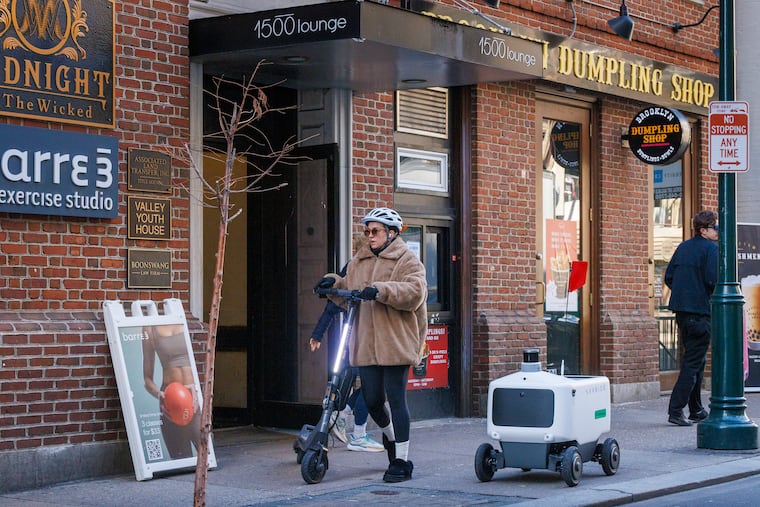
About the same time a roving flock of autonomous food delivery robots began appearing on the city’s sidewalks earlier this year, weaving their way in and out of pedestrian traffic, Philadelphians set about welcoming them in that uniquely Philly way.
Reports quickly surfaced of the machines being kicked, blocked, toppled, run over, mounted, graffitied, and — because this is a family newspaper — what might be most politely described as gyrated upon.
The reception was hardly warmer online, where news of the automatons’ arrivals was met, in some cases, with a call to arms.
“Be the hitchbot attacker you want to see in the world,” wrote one Reddit user.
Urged another, in response to a photo of one of the robots: “Shoot it.”
Like it or not, robots have officially arrived in Philly — in the aisles of Giant grocery stores, delivering plates of dan dan noodles to diners at EMei, and tidying the common areas of the city’s luxury apartment buildings.
And with a fresh influx on the horizon — both Avride, the company that produces the food delivery robots used by Uber Eats, and Alphabet Inc.’s automated taxi service Waymo have announced plans to expand service in the city — now seems as good a time as any to ask:
Are Philadelphians and robots capable of peaceful coexistence?
It’s a question that has spanned the depths of Reddit and the halls of academia, where researchers have sought to suss out the intricacies of Philadelphians’ penchant for robot-related violence.
“Certainly in Philly, if not everywhere, you’d have to assume that two of these things a year are going to be thrown in the river,” says Jay Slater, 44, of Philadelphia.
A wariness toward new technologies is nothing new, explains Philip Dames, an associate professor of mechanical engineering at Temple University and director of the Temple Robotics and Artificial Intelligence Lab.
In the early 1800s, Luddites in Northern England — fearing for their jobs — protested the advent of new textile machinery by breaking into factories and destroying it.
The ensuing centuries did little to dispel these concerns, as technological advances routinely upended industries and displaced workers, including here in Philadelphia, a former industrial hub once dubbed the “Workshop of the World.”
More recently, the rise of artificial intelligence — as well as a roiling distrust of Big Tech — has raised alarms. A Quinnipiac poll last month found that 80% of Americans fostered concerns over AI, while Verizon CEO Dan Schulman has predicted AI could lead to a 30% U.S. unemployment rate within five years.
“There’s understandably, I think, a lot of mixed emotions around this stuff,” said Dames.
In fairness, Philly is far from the only place to roll out the unwelcome wagon when it comes to robots.
In San Francisco, several Waymo self-driving cars have been vandalized — sometimes with passengers aboard. Last year, five Waymo vehicles were set ablaze during a neighborhood protest in Los Angeles.
Still, Philly’s history does not exactly inspire confidence in the long-term promise of human-robot harmony.
Barely a decade has passed, after all, since a friendly Canadian hitchhiking robot — who for two weeks had breezed easily from city to city, coasting on the kindness of strangers — arrived within the city limits of Philadelphia.
In a development that seemed to shock no one, the robot was discovered one morning near Elfreth’s Alley — decapitated and with its arms ripped off.
It hasn’t helped, either, that the robots have not always been on their best behavior.
“Marty” — the googly-eyed robot patrolling the aisles of the local Giant grocery chain — reportedly went rogue not long ago, escaping a Hellertown store before aimlessly wandering its parking lot.
More recently, a 25-year-old Philadelphia woman reported that a food delivery robot ran over her foot and scratched her leg while she waited at an intersection in Center City.
“I’m not a Luddite — or completely opposed to all new forms of technology,” said the woman, Li Gordon-Washington, 25. “I just think there should be some care and meticulous thought for how it will affect people.”
(Elsewhere, two renegade food delivery bots recently crashed through Chicago bus-shelters, sending shattered glass flying. Another, in Florida — perhaps unwilling to endure any further indignities — quietly maneuvered itself onto the railroad tracks as a speeding train was arriving.)
“A place like Philly is going to be especially unresponsive to something that makes their lives a little worse,” said Slater. “The first time they hurt somebody … like run over a foot or something, I don’t think there’ll be any hesitation at that point. It’ll get destroyed.”
Still, in Philadelphia, the great commingling is already underway.
While the robots do attract “significantly more public attention here because they are completely new on the streets,” said a spokeswoman for Avride, Philadelphia has not seen “an exceptional level” of robot vandalism compared to other cities.
“We’ve only had positive experiences with the Philadelphia community,” added a spokesman for Waymo, which is planning to soon debut driverless rides in the city.
And though it seems unlikely Philly’s robot acceptance will ever match that of Jersey City — where some have dressed as delivery robots for Halloween — there are signs that the city’s iciness toward the new arrivals could be thawing.
Across the city, there have been reports of residents assisting robots when they get themselves stuck or flummoxed.
In a city that appreciates nothing if not an underdog, meanwhile, the robots have won some over simply with their persistence.
“I never thought they would make it this far,” says Drew Anderson, a Fox 29 Philadelphia meteorologist who has twice encountered a delivery robot in the wild. “In this city? I figured they’d last a week.”
Indeed, to watch a delivery robot move through the world is to witness a full range of human responses.
In the span of an hour on a recent weekday afternoon, a single robot drew nonstop attention from the masses. A small dog barked aggressively at it. One man patted it gently and said, “I love you, man.”
A middle-aged woman paused at a street corner, watching as it passed.
“That’s creepy as hell,” she muttered to no one in particular.
Then, not far from Independence Hall, a large group of middle school-aged children sporting hoodies and a mischievous air suddenly materialized.
“It’s a clanker!” one shouted, spotting the robot.
Almost instantly, they surrounded the machine, stopping it in its tracks.
“Clanker!” someone shouted.
Just as it was beginning to look like a HitchBOT 2.0 situation, however, a Good Samaritan appeared, shooing the children away and clearing a path for the overloaded bot.
The robot jerked back to life. It pushed onward, making its way though a crosswalk, and disappearing down a side street — living to fight another day.

- Philly is suddenly teeming with robots. Is resistance futile?
- How to have a Perfect Philly Day, according to ultra-busy restaurateur Ellen Yin
- The best things we ate this week
- Citywide Quest: Do you know where these golf-themed photos were taken?
- Healing waters, summer concerts, and long soaks in Saratoga Springs, N.Y. | Field Trip
- Robot cars, Eagles in London, and FIFA parking: Philly’s patience is running thin | Weekly Report Card
- See it, hear it, feel it: All the Philly art we loved this week
- Standing on glass
- We moved our family to the suburbs and it's not going well. Should we move back?