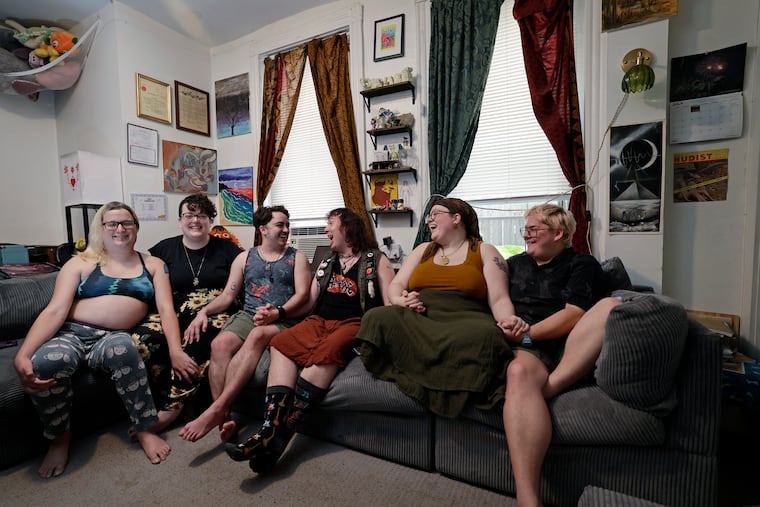

inden Curhart describes his home as a “spider web of connections.”
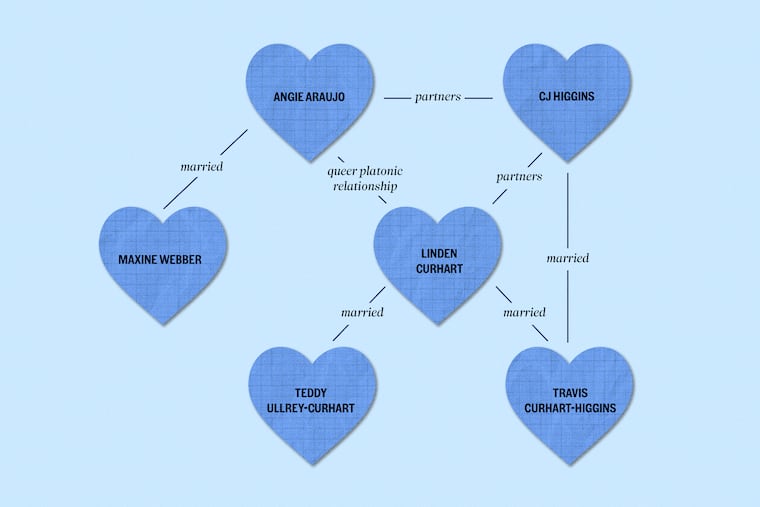
There’s his husband, Teddy Ullrey-Curhart, whom Curhart met when he was an isolated teenager growing up in a conservative town in Virginia. The two always dreamed of getting married, and in June they celebrated their 13-year commitment in a big pink ceremony at Pastorius Park in Northwest Philadelphia.
There’s Curhart’s wife, Travis Rosemarie Curhart-Higgins. They bonded as the two most sober people at a friend’s birthday bar crawl in 2019, and got married in 2023. (Curhart wears two stacked wedding rings on his left hand, one for each spouse.)
Then there’s Curhart’s partner, CJ Higgins, who asked prospective dates to fill out a short Google Form expressing their interest, which Curhart did. Rounding out the group is Curhart’s best friend and “queer platonic partner,” Angie Araujo, who is married to Maxine Webber, and dating CJ. Travis and CJ are also married.
“It’s a whole constellation,” Curhart, 28, said. Ullrey-Curhart is also in his late 20s; the rest of the crew are in their early 30s.
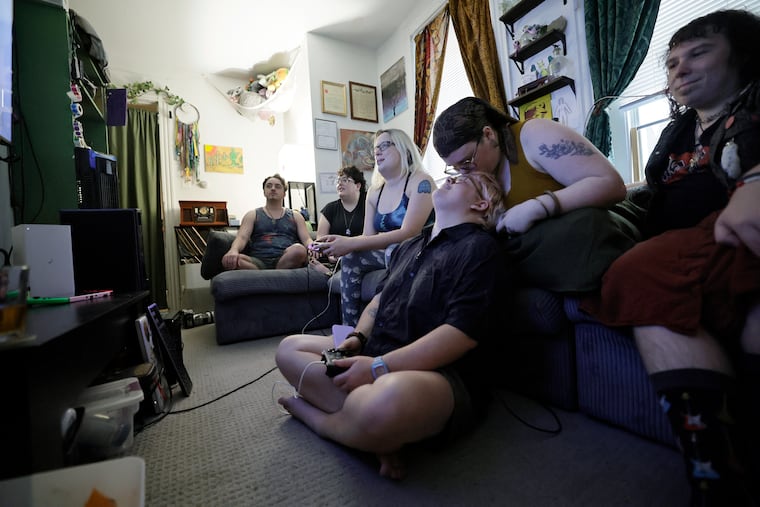
The six live together as one family in a narrow, rented rowhouse near Drexel. They each have their own room.
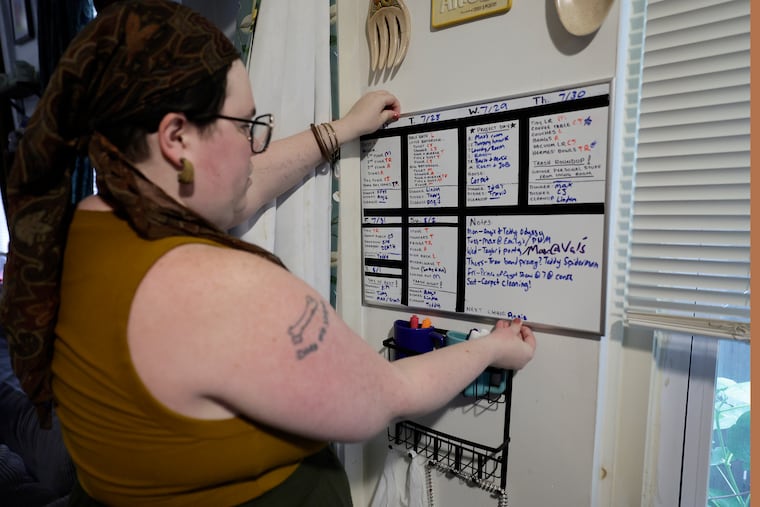
The polycule — the textbook term for a group involved in polyamory together — shares costs, and meets weekly to discuss chores and meals (usually each person cooks one night a week). They also collectively care for three cats and a hermit crab named Linda.
“Honestly, the biggest daily challenges that we deal with are just things like, ‘please rinse your mug before you put it in the sink,’” said Curhart.
The household is Jewish and everyone is an anarchist, Curhart said. They keep the closets stacked with street medic supplies to bring to protests and homeless encampments.
Some of the members work in theater and some in tech; some don’t work. (Curhart is disabled and relies on the polycule to support him; Ullrey-Curhart is looking for work.) They’ve lived collectively for two years.
“As a species, humans are pack animals,” said Curhart. “That isn’t to say that everybody should be polyamorous, but I think everybody should live in community.”
The following, as told to Zoe Greenberg by Linden Curhart, has been edited for length and clarity.
On proposing marriage
I had planned a big romantic public proposal for Travis, and then COVID lockdown hit. So instead I got flowers and made dinner at home. I set it up really romantically, with candles, and proposed. We both cried.
Teddy proposed to me while the whole polycule was apple picking. He got down on one knee and did that dramatic thing where he said my whole name in front of everybody. He talked about how long we’ve been together and how much change we’ve been through.
Travis and I got married on the winter solstice, so Teddy and I got married on the summer solstice.
On what marriage means
When I’m talking to people who are not in the polyamorous world, I’ll describe it as a “commitment ceremony.” Because I’m not legally married to anybody. But within our own communities, we just say that we’re married.
There’s this sense of security that comes with making that decision and having it witnessed by all of the people that you love.
On leaving the state out of the polycule
The way that I see it is that our personal relationship, who we share our lives with, who we have sex with, who we choose to raise our kids with, that’s not the government’s business.
But even if you’re not getting the state involved, it’s a big decision to permanently entangle your life with another person. It’s not something that I am actively seeking to do again.
On moving in together
All of us were living in various apartments that we hated, scattered around West Philly. We all had landlords that were crappy.
The pitch was: all of us are broke and we all love each other, and we’re already making dinner together three times a week. We might as well just all do that in the same place. So we came together and pooled our resources and found the rowhouse.
All of us understood that this is a family commitment. I really want to have kids someday, and these are the people who will help me raise my kids.
On sharing money
We haven’t officially pooled our finances because it’s important for all of us to have financial independence and some financial privacy.
Somebody will go grocery shopping for the whole house and then calculate an even split. If somebody can’t contribute that amount, they’ll just say, “Hey, I can’t cover mine this week,” and that’s not usually a big deal. Somebody else will step up.
Generally speaking, we try not to give each other loans. You don’t give somebody money unless that is money that you can afford to lose.

- She left the dating parlors and courting buggies of Lancaster behind. Now she’s learning to date from scratch.
- ‘Sex to me is like having anchovies — yeah, I suppose I could, but I’d really rather not.’
- They became ‘chosen brothers’ in a maximum-security prison. Then one got out.
- They’ve been happily married for nearly 20 years. They just live 3,000 miles apart.
- He lives with his wife — and his husband, and his partner, in a 6-person polycule
On distributing labor
We try to split the work: the financial labor, the actual physical labor, and the emotional labor, so that everybody’s contributing whatever they have the most of.
Because I contribute less money, I try to make sure that I’m doing things like making big lunches that people can have during the week. I run a garden so we can grow some of our own food.
On potential breakups
Because we’ve been together for so long, we don’t really worry about that. We don’t have concrete contingency plans, but our overarching philosophy of how we treat each other doesn’t stop if we break up.
Fun fact: Travis and Angie are exes. They broke up before we chose to live in a house together. They had dated for a few months and then decided they didn’t have romantic feelings for each other.
On the most important house rules
I was worried about us getting on each other’s nerves in close quarters.
We have a rule that we don’t have serious emotional conversations in the living room. That’s a bedroom conversation. If a conversation starts in the living room and gets tense, one of us will be like, “Oh, I don’t think this is a living room conversation.”
Don’t gossip. If somebody tells you something emotional, you assume that it’s for your ears only.
You try not to drag everybody in the polycule into conflicts that are just between two people.
On a future spare bedroom
My 10-year vision is a house with a big vegetable garden and kids and maybe a dog. And hopefully a spare bedroom where we can host people who need a place to crash.
This story is part of a new series about life partners across the Philadelphia area.
If you want to share your story about who you’re navigating life with, romantically or otherwise, write to lifepartners@inquirer.com. We won’t publish anything without speaking to you first.
