Encampment residents along Delaware River Trail want ‘safe sleep sites’ where they can legally camp
The group of about 20 residents faces another disbandment Friday.
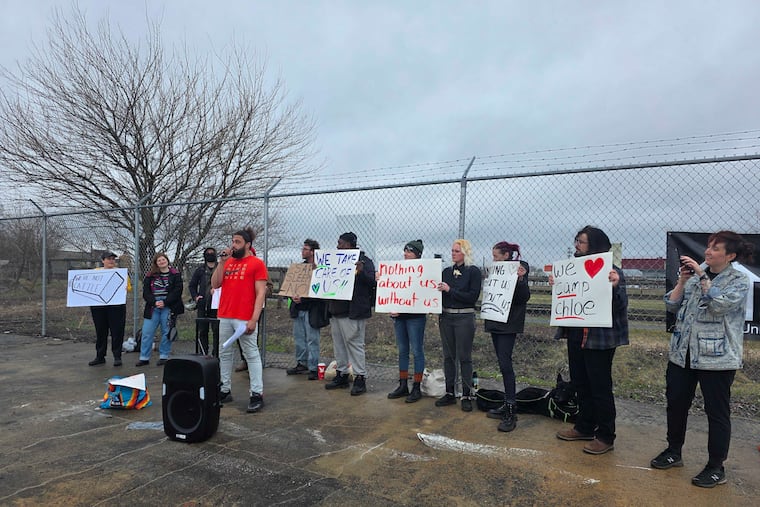
About 20 homeless residents living in tents on a half-mile stretch of the Delaware River in South Philadelphia woke up to a cowbell last Wednesday.
It was another encampment clearing.
Residents and homeless outreach volunteers said contractors, a handful carrying machetes and wearing hazmat suits, razed four tents before an agreement could be reached with police and the property manager for 1525 S. Christopher Columbus Blvd. The agreement gives residents until Friday to leave, though the extension offers little comfort to the group.
This marked one of several disbandments residents have experienced in the last several years along that stretch of the Delaware River Trail. These self-described tight-knit communities salvage what they can and move up or down the trail each time, only to undergo the removal process all over again.
“The constant displacement is too disruptive to build something that is meant to offer safety and solace while those living here are trying to reach a new chapter for themselves,” said Colleen Stepanian with South Philly Food Not Bombs, who has been providing encampment residents with food for about three years.
Stepanian, other homeless advocates, and residents are demanding Mayor Cherelle L. Parker and other city leaders do more to help some of the most shelter-resistant in Philadelphia. Their main ask is for the city to create “safe sleep sites,” areas where people could legally camp as they wait for permanent housing. These spaces would have bathrooms, showers, 24/7 security, and a fixed address so people could be easily found by outreach workers.
These provisions would address some of the biggest complaints homeless people have regarding shelters: theft, violence, curfews that make it hard to do gig work, and separation from partners and pets.
“We don’t want to leave our significant other or our dog or cat, they’re part of our family,” an encampment resident who identified himself as Chris said at a news conference Monday.
Residents said they ultimately want to be offered permanent supportive housing directly from the street, a proposition that puts the city in a tough predicament as tens of thousands remain on the housing choice voucher and public housing waitlists.
In the absence of immediate housing, they’d like a better system for disbandments. One that doesn’t rely on police and helps preserve people’s possessions during these disbandments. Ideally, storage and property receipts, so people can move easily.
Finally, the group wants an oversight board, made up of people who’ve experienced homelessness, to review encampment resolution plans and ensure they’re humane.
‘We’re not cattle’
In October, excavators and dumpster trucks lined up along 1341 S. Christopher Columbus Blvd., which city records show stretches across two piers along the Delaware River Trail. The parcels are privately owned and slated to break ground on a 620-unit apartment tower early next year.
As the razing of tents and makeshift cooking areas began, most of the roughly 40 encampment members took what they could and left, but not before losing identification, legal documents, and priceless personal items, such as family photographs.
The city’s Office of Homeless Services was there with medical aid, housing, behavioral health, addiction treatment, and animal care and control services. The city said only five people accepted some form of support at the time.
Many others did what they’ve done time and time again. They reset camp. This time at 1525 S. Christopher Columbus Blvd. They named the community Camp Chloe, after a dog that they said protects the space.
Months later, they’re being forced to move once more.
Tower Investments Inc., which owns the parcels in question, declined to comment for this story. But Camp Chloe members said the introduction of a cowbell and use of machetes during the first disbandment attempt felt particularly dehumanizing.
“We’re not cattle,” said one 56-year-old encampment resident, who declined to give her name because she’s hiding from an abusive ex-partner.
Kelsey Leon, a harm reductionist who works with Camp Chloe members, said, “Residents aren’t trying to steal anyone’s land.”
“Residents have said if a property owner asked them to leave, they would, but there has to be dignity in that process, and people need somewhere to go,” she said.
The city said it was ready to offer Camp Chloe residents social services, including shelter beds, as it has done for past encampments.
“The City has been in contact with many of these individuals over an extended period of time, and we are committed to working with our partners to address these challenging situations and will continue to do all we can for our fellow Philadelphians,” said a statement from the Office of Public Safety.
As for how a private property owner manages the disbandment process, the city has long maintained that its hands are tied. It’s up to the owner on how to clean and secure their parcels.
The city said a 2021 Managing Directors Office directive that laid out the notice required before an encampment resolution and established a system for the city to store personal property for at least 30 days applied only to public property.
Leon said residents were offered private storage in the October sweep, but it was for a box’s worth of items to be stored in Kensington, which was of little help.
The city did not address Camp Chloe’s demands otherwise.
Camping as temporary shelter
Sleeping outdoors has come under increased scrutiny in recent years as the opioid crisis, disruptions from the pandemic, and high cost of living have driven more people into homelessness across the country. Even as other cities reported a drop in homelessness between 2024 and 2025, city data from its annual point-in-time count suggests an increase in the number of people sleeping on Philadelphia streets and in shelters during that period.
The issue of whether cities could arrest and fine people for sleeping in public spaces reached the U.S. Supreme Court in 2024, which held that these penalties were not forms of cruel and unusual punishment. In the first six months after the ruling, an NPR analysis found more than 100 cities imposed bans on sleeping outside and encampments.
Philadelphia’s Office of Homeless Services condemned the decision at the time, saying people experiencing homelessness “need and deserve more.”
“This is why OHS and our City partners work together to offer people who’ve gathered in one location on the sidewalk, or a park or other outdoor venue services from emergency and temporary shelter to substance use treatment,” said the statement.
Even so, plenty of people remain out of reach for a number of reasons. They can’t connect to proper treatment, don’t want a shelter bed, or are on a waitlist for permanent housing.
As Camp Chloe faces disbandment, residents and their advocates want the city to think of creative ways to address the constant shuffling of people.
Safe sleep sites have been implemented in cities like San Diego, which has adopted it as a “low-barrier” alternative to a traditional shelter — two of these sites are now the subject of a federal lawsuit citing inhumane conditions. Vancouver, Wash., had its own twist on the idea, erecting modular shelters on a property that had previously been the site of an encampment.
The 56-year-old encampment resident said a legal outdoor camping space would offer people like her a bit of stability as she gets back on her feet. It would address the constant moving, which often means acquiring new tents and other gear, while keeping people living on the street in one place and out of sight.
“Or they’ll be on your streets or on your blocks in front of you, every day when you go to work,” said the former business owner, who remembered how she thought it was unpleasant to see homeless people living outdoors before it happened to her a year and a half ago.
“I’m being honest, I know what they must say.”
Staff writer Jake Blumgart contributed to this article.