A ‘blue moon’ is coming to the skies over Philly this month
The moon turns out to be more colorful than we thought.
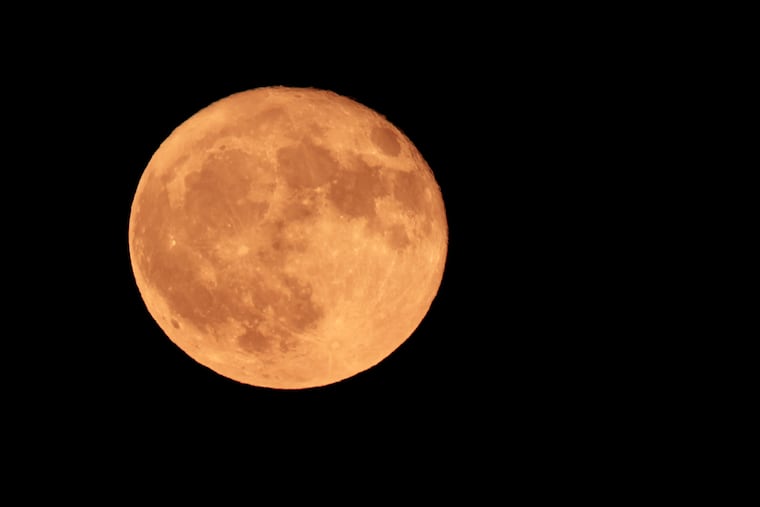
The world now knows, courtesy of the NASA Artemis crew, that the moon is far more colorful than earthlings imagined, and in May it will turn completely blue, at least figuratively.
The month will be bookended by instants of lunar fullness at 1:23 p.m. Philadelphia time on Friday and 4:45 a.m. on May 31.
The first is notable in that it will be lavishing silvery light on fresh, green leaves that were not evident during April’s full moon. The latter is notable in that it will be the second full moon of the month, thus qualifying as a “blue moon,” something that occurs every 20 to 30 months. After this, the next one is due in May 2027.
Just how it earned that distinction is a muddled saga and perhaps a lesson in how folklore and science are not always on the same website.
When the enduringly popular song “Blue Moon” was written — about 30 years before a Pittsburgh group called the Marcels made it a doo-wop sensation — it almost certainly had nothing to do with a second full moon of any month.
When and how the moon became ‘blue’
The term “once in a blue moon” has been around since the 16th century, by NASA’s reckoning, but in those days it had no astronomical significance. It referred to something that was an absurdity (think “the moon is made of green cheese” … wait, now we know it does have some green) or occurred with a frequency between never and rarely.
The astronomical connection is a relatively modern phenomenon, and various sources attribute the latest iteration to an error appearing in the venerable astronomy magazine Sky & Telescope. Those sources include Sky & Telescope.
Starting in the 1800s, The Maine Farmers’ Almanac charted “blue moons,” but not quite with the current meaning. Rather than using the standard calendar, the almanac defined the year as beginning and ending with the winter solstices, what it called the “tropical year.” A blue moon occurred when 13 full moons occurred within that year. The system had other wrinkles that complicated the calculation.
A Sky & Telescope article in 1946 misrepresented the almanac’s account and concluded that a blue moon simply was the second one in a month.
In this case, a misinterpretation became the new reality, solidified when it was referenced on Jan. 31, 1980, on the popular public radio feature Star Date, and solidified in the public consciousness by appearing as a Trivial Pursuit game answer in 1986.
The moon really has shades of blue, and has appeared completely blue
Thanks to the NASA Artemis mission, we know that the lunar surface is more than a colorless pockmarked sphere but has mineral shades of blue, brown, and even greenish olivine (not cheese) over perhaps 30% to 40% of the surface, said Villanova University astrophysics professor Scott Engle.
“It’s a complex body, just like the Earth is,” he said. “It has geology. It’s made up of different materials, different minerals.” The earthbound cannot discern the colors with their limited, color-challenged night vision, he said.
At times and in various locations on the planet, the moon has appeared almost all blue, said Harry J. Augensen, Widener University physics and astronomy professor emeritus.
He notes that Percy Shelley’s poem “Alastor” references a “blue moon low in the west.” Notably, the poem is dated 1816, the year after the climate-changing volcanic explosion of Mount Tambora in Indonesia. Blue moon sightings were reported “for the next couple of years worldwide,” Augensen said. Similar reports followed eruptions of Krakatoa in Java in 1883, El Chichon in Mexico in 1983, Mount St. Helens in Washington state in 1980, and Pinatubo in the Philippines in 1991.
“Particles released by volcanoes or forest fires are of the right size to scatter out red light, leaving the more bluish light to continue through the atmosphere,” he said.
About the song ‘Blue Moon’
Rather than volcanic ash or anything visual, the song “Blue Moon,” credited to the famous songwriting team of Richard Rodgers and Lorenz Hart, evokes a once-in-a-blue-moon romantic encounter. (Rodgers would later partner with Bucks County native Oscar Hammerstein II.)
The song, first performed in 1934, has been a subject of litigation and dispute. An upstate New York woman has assembled documents that back her contention that her father, the late Edward W. Roman, an amateur musician, wrote the song in 1931. The blue moon was a reference to the bluish reflection of the moon upon the ice on which he was skating.
But his sister-in-law Dorothy Hart offers an extensive explanation in her biography, Thou Swell, Thou Witty: The Life and Lyrics of Lorenz Hart, published in 1976, of how the song evolved from concept to final form. It makes no mention of Roman.
While it may have had nothing to do with the popular concept of a blue moon, the song has been performed by more than 20 artists from Ella Fitzgerald to Bob Dylan.
Like the moon in the song’s lyrics, the Marcels’ version, released 65 years ago this month, really did “turn to gold,” becoming a million-seller.