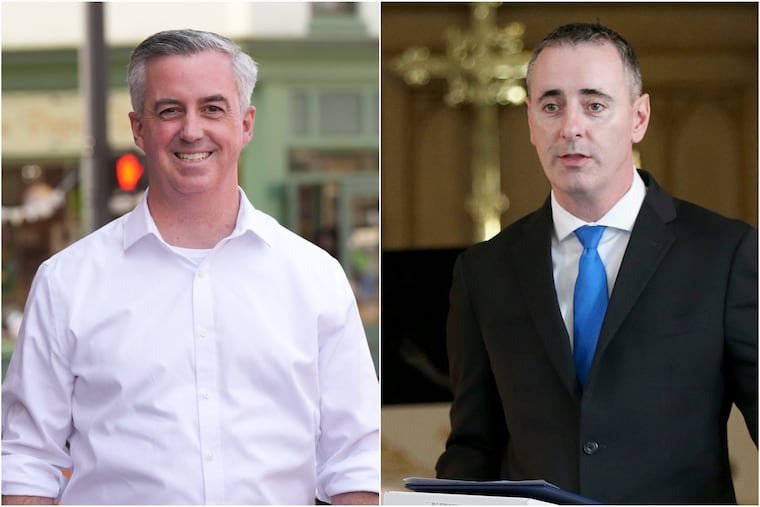
A settlement over ICE in Bucks? Judge pushes lawyers on the sheriff’s plan to have deputies enforce immigration laws
Agreements with ICE enable local authorities to help the agency identify, arrest, and deport immigrants.

Bucks County Court Judge Jeffrey Trauger was an hour into what would become a marathon hearing on a controversial police-ICE alliance. But he was already frustrated by the attorneys talking over one another and interrupting a key witness, Sheriff Fred Harran.
“Stop!” Trauger burst out, his voice just below a shout. “Everyone stop! Let him answer the question.”
They did.
What’s more, after hours of the judge’s prodding, by evening the sides appeared open to discussing a settlement on an issue that has split county residents and driven protesters into the streets: the sheriff’s decision to partner his office with ICE and have deputies enforce federal immigration laws.
That Tuesday development marked a potentially significant step in a case that has shown little room for compromise, even as the likelihood of a settlement remains uncertain.
Harran, who is up for reelection in November, insists the ICE alliance will prevent crime and keep people safe, while taking little of his deputies’ time. A coalition of civil rights groups asserts that the sheriff is inviting racial profiling, taxpayer liability, and a ruinous loss of trust between police and citizens.
Trauger made no ruling Tuesday on the groups’ request for a preliminary injunction to stop Harran from going forward. He ordered all parties back to court on Sept. 26 to finish testimony, and urged the attorneys to use the intervening week to discuss a settlement.
That request comes against a backdrop of months of name-calling and rancorous debate outside the courtroom. The ICE issue is central to Democrats’ effort to oust Harran, a Republican, while the sheriff says his intentions have been misconstrued by political opponents and the news media.
Asked about the possibility of an agreement, the sides this week pointed at one another.
“We’ve never received a settlement proposal from the plaintiffs, so you’d have to ask them,” said the sheriff’s attorney, Wally Zimolong.
He said in court Tuesday that he thought an agreement might be reached with the county government, but doubted the civil rights groups would go along. That prompted Stephen Loney Jr. of the ACLU of Pennsylvania to shoot back: “We can’t agree to an agreement on spec.”
ACLU attorney Keith Armstrong said Wednesday that he could not comment since no settlement was on the table.
“We’ll have to see the substance of what actually is proposed, if anything,” he said.
A spokesperson for Bucks County, where the board of commissioners has disavowed the sheriff’s actions, declined to comment, citing the litigation.
A key issue in any accord: the difference between what Harran says he intends to do and the much broader powers conferred in the agreement itself.
The document signed by Harran and ICE in the spring is what’s known as a 287(g) agreement, a controversial program named for a section of a 1996 immigration act.
It enables local police to undergo ICE training, then assist the agency in identifying, arresting, and deporting immigrants. The number of police agencies participating in the program has soared to 1,000 under President Donald Trump.
Seven states, including New Jersey and Delaware, bar the agreements by law or policy.
Harran signed up for the “Task Force Model,” the most far-reaching of the three types of 287(g) agreements. It allows local police to challenge people on the streets about their immigration status and arrest them for violations if warranted.
Harran ― closely watched by about 120 people who filled most of the fourth-floor courtroom ― testified that his deputies will not do that.
His staff will electronically check the immigration status of people who have contact with the sheriff’s office because of alleged criminal offenses. Those found to be in the country illegally will be turned over or transported to Immigration and Customs Enforcement, if the federal agency desires, he said.
In court, attorney Marielle Macher of the Community Justice Project demanded to know why Harran needed stop-and-arrest powers in the agreement if he did not plan to use them.
Her questioning led the sheriff to acknowledge that he had not excised that section of the document, or substituted a more limited description.
“This agreement, I can do parts of it,” Harran said. “You’re trying to paint that I have to accept the whole agreement, and that’s not the case.”
Harran’s attorney asked him: “Do you intend to snatch people off the streets?”
“Absolutely not,” the sheriff responded.
Harran said he planned to create a sheriff’s office policy to specify the limits of his deputies’ powers, but had not yet done so.
The ACLU and organizations including Make the Road Pennsylvania argued that Harran entered into the agreement without the authorization of county commissioners. Harran said he didn’t need that.
He said his goal is to prevent crime, and if that is achieved by deportation, “sign me up.”
Studies show that legal and undocumented immigrants are less likely to commit crimes than U.S.-born residents. A 2024 National Institute of Justice analysis found that undocumented immigrants are arrested at less than half the rate of native-born citizens for violent and drug crimes, and a quarter of the rate for property crimes.
However, high-profile assaults and killings by immigrants with no permission to be in the country have helped fuel Trump’s plan to deport millions of people, including those he depicts as “the worst of the worst.”
Harran said 17 deputies were ICE-trained and ready to go, awaiting only computer equipment and Homeland Security guidance before starting their work.
As Harran testified, the judge asked whether having the sheriff put his plans in writing would settle the case.
“It’s interesting that there’s a distinct possibility of an agreement here,” the judge said. “I like that.”
Plaintiff witnesses testified that they feared Harran would move to conduct overt immigration arrests. And they said his alliance with ICE already was affecting the community in negative ways.
A pastor said congregants were raising concerns. The head of the Bucks County chapter of the NAACP said resources were being diverted to educate people about the ICE program. A county resident denounced the potential cost to taxpayers.
“We’re paying for our sheriffs to do the work of Immigration and Customs Enforcement,” said Juan Navia, a Cuba-born plaintiff in the case. “That’s not something we as voters signed up for.”
As the hearing neared 6:45 p.m., the judge asked the attorneys to talk about the prospect of the sheriff putting a policy in writing, describing precisely what his deputies would and would not do for ICE.
“They’re not out on the road, breaking down doors,” the judge said. “They’re not out there running people down …”
A voice came from the courtroom crowd, finishing the sentence: “… yet.”
This suburban content is produced with support from the Leslie Miller and Richard Worley Foundation and The Lenfest Institute for Journalism. Editorial content is created independently of the project donors. Gifts to support The Inquirer’s high-impact journalism can be made at inquirer.com/donate. A list of Lenfest Institute donors can be found at lenfestinstitute.org/supporters.