Here’s how to fix U.S. immigration enforcement, in four not-so-easy steps, says the American Immigration Council
Right now, the American Immigration Council says, enforcement is a blunt tool, and people either survive in the shadows or can suffer life-shattering consequences.
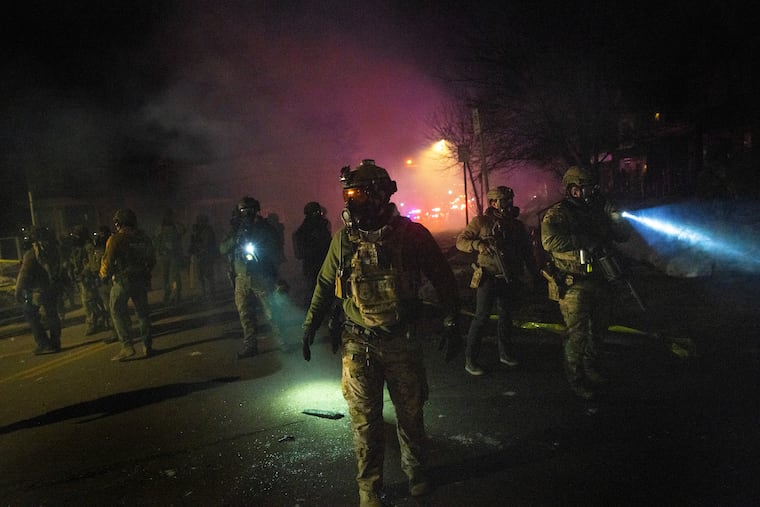
The nation’s immigration-enforcement apparatus faces particular scrutiny and criticism. But fixing it, and doing so in a way that most people and both major political parties could support, has become a challenge of the age.
Now the American Immigration Council has taken a crack at it, asking if it is possible to craft a fair, credible, and humane enforcement system. What would that look like? And where to start?
In a report published this month, the council said a reformed system must distinguish between immigrants who truly threaten public safety and those whose civil transgressions could be settled short of deportation. It must deliver consequences, but it should not impose the same consequence on every violator. And it should offer pathways to compliance for at least some people who want to follow the law.
The council cited four key areas as a framework for change:
Compliance
The government must make rules that people can follow, and encourage people to follow the rules.
Immigration regulations must offer both rewards and consequences. But that is hardly the only challenge. The system must account not only for people entering the country without permission, but also for those who are already here — estimated at an all-time high of 14 million.
Democrats and Republicans diverge on how those people should be treated.
The Trump administration sees all who live here without permission as lawbreakers, and the solution as deportation. It is trying to deport a Berks County man who actively assisted police in the investigation of the shooting death of his daughter, and its use of extended detention has forced out others with desperately sick children.
Democrats have generally sought more nuance, recognizing that many undocumented people have American-citizen spouses and children ― and that their work and taxes are integral to American society.
In Philadelphia, for instance, the city’s economic vitality depends more and more on foreign-born residents, whose growth has provided population stability.
Yet even undocumented migrants with sterling records have no path to legal status, unable to “get in line” for residency because, for most, there is no line.
The Immigration Council suggested the creation of a new, diversionary system, where people who have roots in the United States ― and no criminal convictions ― could enter a process that metes out proportionate civil penalties while offering a chance to gain lawful permanent status.
Safety
Law enforcement should protect communities from threats, not treat the community as a threat.
The Trump administration views undocumented immigrants as a danger. But even as it pledges to concentrate on deporting “the worst of the worst,” the percentage of arrests of immigrants who have convictions or face criminal charges has gone down, not up.
An Inquirer analysis showed that while overall arrests have soared, the proportion of those with criminal backgrounds has dropped significantly.
The solution? Congress must revise out-of-date 1980s and 1990s laws, the council said, and focus enforcement on true threats. And it must ensure that local police are seen as protectors, not as extensions of ICE. The council recommended that Congress repeal the law that lets police partner with Immigration and Customs Enforcement.
The number of police agencies aligning with ICE grows by the day. In Pennsylvania, for example, the number of sheriffs’ and police departments that have signed up to help ICE has surged more than 70% since the end of last year.
Proportionality
Consequences for violating immigration laws should be reasonable and individually tailored.
Imposing scaled consequences can strengthen the rule of law by delivering punishment without tearing people away from their families and communities. Right now, the council said, immigration enforcement is a blunt tool, and people either survive in the shadows or face life-shattering consequences. A one-size, deportation-for-all system lacks measure. A better one would apply its harshest tools to the worst cases, and create some form of compliance mechanism for everyone else.
The council urged Congress to reduce the number of people held in detention.
Today detentions are down from their 70,000-plus peak in January, possibly because detainees are being deported more quickly.
As of early April, 60,311 immigrants were held in ICE detention across the county. Of those, 71% had no criminal convictions.
Accountability
Agencies and agents that abuse their power must be reined in.
Having a credible enforcement system means frontline agencies must be accountable to other branches of government and to the public. That is not happening now, the council said. Immigration officers whose actions drive national protest ― including the shooting deaths of two U.S. citizens in Minnesota ― seem to face no consequences. The administration, the council said, has gutted three internal oversight bodies at the Department of Homeland Security, and denied access to members of Congress seeking to visit detention centers ― visits to which members are entitled by law.
The council recommended expanding the authority of federal courts and Congress to act against abusive federal agencies and agents, including via the creation of an independent, bipartisan body to conduct oversight.
A plea for political action
Neither party has offered a comprehensive plan for change and improvement, the council noted. It urged that “Congress return to the drawing board” ― not easy at a time when Trump’s mass-deportation agenda helped propel him to the presidency and Americans remain deeply split on immigration.
This month the Pew Research Center found that about half of U.S. adults, 52%, believe the Trump administration is doing too much to deport immigrants. That is about the same percentage as in October 2025.
What has changed, Pew noted, is that more Americans say the administration is doing “too little” to deport undocumented immigrants, up to 15% from 10%.
That increase is driven by Republicans and Republican-leaning independents, 28% of whom say the administration is doing too little. That is the highest share since Pew first asked the question in February 2025, after Trump began his second term.
“Immigration law and policy are enormously complex,” the council said. But “the present crisis requires immediate effort to rehabilitate the federal government’s immigration enforcement system, and restore the link between enforcement of federal law, the rule of law, and community trust and legitimacy.”