‘No help’: Aid arrived too late as Ebola spread in a Congolese town
“With an epidemic, the slower the response, the bigger it grows,” said Julien Harneis, a senior Ebola response coordinator for the United Nations.
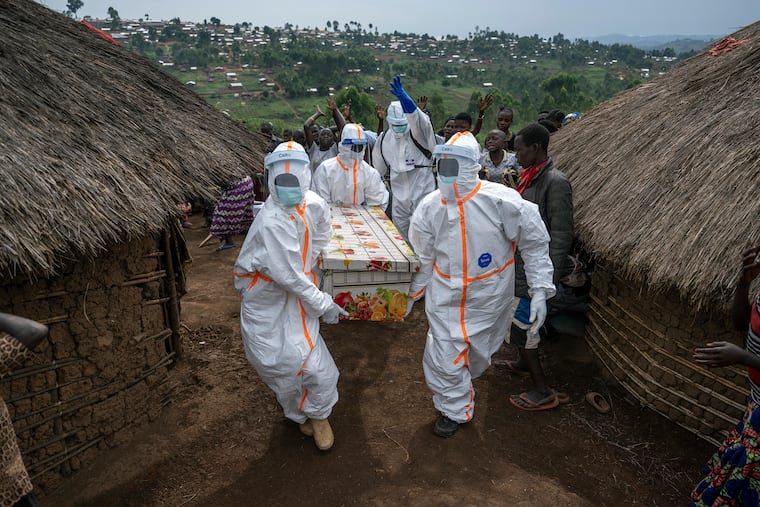
MANGALA, Congo — On a hilltop town in eastern Congo, work has started on a new Ebola center. When completed, it will anchor an effort to contain the virus in the town and its surrounding villages.
Local health workers say the center is too late.
Many lives could have been saved, the health workers say, had a sustained effort to combat the virus started in the town of Mangala in June.
In other towns in Ituri province, the epicenter of the outbreak, Ebola treatment centers were set up weeks after the World Health Organization declared a health emergency in May. In Mangala, the Ebola response only started ramping up in August.
This outbreak, already the second largest on record, has reached seven different provinces in Congo and likely began spreading as early as January. More than 3,900 people have died of Ebola in Congo since May, according to the latest data from the government.
There is tentative evidence to suggest that the response is making progress. The number of new cases reported each week appears to have reached a peak in August, according to recent figures from Africa Centers for Disease Control and Prevention. Outside aid organizations typically play a major role in African Ebola outbreaks, supplementing often weak government capacity.
But health workers in Mangala say fewer lives would have been lost had help arrived sooner.
“There was no help, not even a bit,” said Godefroy Banzani, a senior nurse in Mangala, recalling how the town felt abandoned in the early weeks of the outbreak.
Experts say that what happened in Mangala underscores how this Ebola outbreak became the largest and fastest-growing that Congo has ever seen.
“With an epidemic, the slower the response, the bigger it grows,” said Julien Harneis, a senior Ebola response coordinator for the United Nations.
Health workers offered several explanations as to why the response lagged in Mangala. One issue: the town has few hotels, forcing aid workers to make a three-hour trip each day from Bunia, the regional capital. The rutted road is so dusty that drivers sometimes have to stop because they cannot see, while after rains it can become too muddy to navigate.
Violent insurgents sometimes impose checkpoints along the dirt road leading into town. Foreign aid cuts have forced health workers to make painful choices about already scarce resources, including where to build Ebola centers, said Luca Fontana, a senior WHO official with years of experience fighting the virus.
Privately, however, some international health workers said that Mangala was simply overlooked. Wessam Mankoula, head of emergencies at Africa CDC, acknowledged the concern in Mangala and said that it was difficult to establish treatment centers in every health zone affected by the virus.
When the WHO declared an outbreak in mid-May, there were already hundreds of Ebola cases in Ituri province, setting the overall response on the back foot from the start. But health teams in towns such as Mongbwalu, Bunia, and Nizi were quickly mobilized to educate communities on infection.
As those efforts were underway, Mangala remained on its own, officials say.
When the New York Times visited the town in September, signs of the struggle to contain the virus were everywhere. The coming treatment center, which will be run by the international humanitarian medical charity Alima, was just a patch of flattened red earth.
In the meantime, Mangala relies on the district hospital, where in the early months of the outbreak, Ebola patients were treated in a mud house with no windows, an earthen floor, and little ventilation.
One afternoon in September, health workers set fire to their protective clothing after use, sending dark smoke skyward as the synthetic material burst into flames.
The fire burned yards from an area accessible to villagers.
Most treatment centers in Ituri province are strictly divided into green and red zones. Patients and suspected Ebola cases are kept in the red zone, and anyone entering must wear protective clothing. In the separate green zone, medical staff members and visitors can enter safely, talking with patients at a distance or through plastic screens.
But at the regional hospital in Mangala, staff members said people with signs of the virus circulated freely across a central, grassy courtyard.
Mave Liripa, 26, came to the hospital with her mother and 1-year-old daughter, Justine Ngabusi, in September. All three showed signs of Ebola, including fever and vomiting, Liripa said.
Liripa’s 8-year-old son had died with Ebola symptoms the previous week, and the family buried him at home, she said.
Nurses wearing protective gear took blood samples from the family to be sent for testing. Nurses told the family to sit on a bench, which was near patients with unrelated illnesses.
“Everywhere is a red zone here,” said Jacques Savo Bamuhiga, the medical director in Mangala. Five nurses and a doctor have contracted Ebola at the hospital already, and one nurse has died, Bamuhiga said.
The government stopped paying Mangala’s hospital staff at the start of the crisis. It gave no reason for the suspension, but the decision damaged morale and hindered efforts to organize a response, doctors said.
Some heath workers quit, while others staged a brief strike. Though they have since returned to work, some said that they had still not received their salaries. Bamuhiga praised the staff who had worked unpaid through the crisis.
Congo’s health minister, Roger Kamba, acknowledged that some health workers had not been paid. The government was working to resolve the problem quickly and would add a bonus to health worker salaries, he said.
Hospital treatment increases the chances of patient recovery, which helps to convince residents of the benefits of disclosing to medical workers when someone is ill. Ebola patients are most infectious in the final days of the illness and just after death, making safe burials essential.
All this reduces community transmission. But people must first be persuaded to allow sick relatives to be treated in hospitals rather than at home.
In Mangala, a fledgling outreach team was only established in August. As a result, fears spread unchecked through the town that the hospital was injecting its patients with Ebola, staff members said.
Residents boycotted the hospital and, even as late as early September, treatment rooms that were usually packed with patients before the outbreak remained empty.
On top of the elevated community transmission caused by home treatment and unsafe burials, more people have died of conditions unrelated to the virus because they were too afraid to go to the hospital, Bamuhiga said.
A single ambulance was recently assigned to the Ebola response team in Mangala and nearby villages, but several residents said they have sometimes waited days for its arrival.
The ambulance, a four-wheel drive, picked up six patients on a recent afternoon. The patients scrambled into the car’s bench seats. Nurses had no choice but to cram three suspected Ebola patients next to patients with unrelated illnesses.
How many people could have been saved in Mangala had help arrived sooner is difficult to determine. Bamuhiga put the official Ebola death toll in the town at 165, but said that number failed to reflect the many deaths at home.
This article originally appeared in the New York Times.