Trapped in a kill zone, a Ukrainian city is beginning to starve
Russia and Ukraine remain so far from any truce that even a humanitarian corridor to save civilian lives has been impossible to organize.
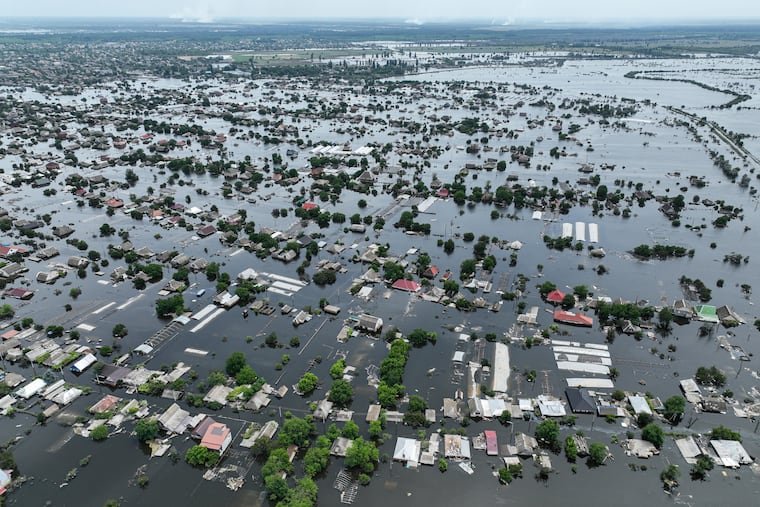
KYIV, Ukraine — Little news trickles out from the besieged city of Oleshky, a front-line wasteland severed by mines and drones from the rest of Russian-occupied Ukraine.
But one thing is clear from what has emerged: A humanitarian calamity is unfolding. There is no food, no safety, and no escape.
“In the autumn, we will definitely die,” one resident wrote this summer. “I am already dying. I am getting weaker with each day.”
“We’re cooking our last borscht,” wrote another, “with one beet, five potatoes, one onion, a zucchini, a tomato and a little barley groats to make it thicker. There are no carrots.”
A third said: “There are no supplies of any kind. It’s a complete blockade. And endless drones and fires. Like in a horror movie.”
These messages, from some of the roughly 2,000 civilians, including about 40 children, who remain in Oleshky, were shared with the New York Times by Tetiana Hasanenko, the city’s exiled leader. They offer a glimpse into the deteriorating conditions as the Russian-held city is cut off from food and medical aid, prompting calls in Ukraine for an urgent evacuation before the population starves.
Oleshky’s fate epitomizes the intractable nature of the war. The two sides remain so far from any truce that even a humanitarian corridor to save civilian lives has been impossible to organize.
Oleshky sits directly in the line of fire along the war’s southern front. It is separated by the Dnieper River from the larger city of Kherson, which Russia captured in early 2022 and surrendered later that year. Russian forces strike Kherson from across the river in Oleshky, and Ukrainian forces strike Oleshky from Kherson.
The circumstances are among the worst anywhere in Ukraine. Swarms of drones, ubiquitous mines, and destroyed infrastructure make it exceedingly difficult for residents to leave or for help to arrive.
Ukraine says Russia is responsible for the crisis. Moscow’s forces, officials in Ukraine say, have attacked Ukrainian drones trying to drop aid, intimidated residents who collected supplies that did get through, and confiscated food as their own troops’ stocks ran low. Hunger, Ukraine says, is being wielded as a tool of coercion.
Rather than let them leave, Russia is using residents as human shields, according to Ukrainian officials and people who have made it out of Oleshky. Moscow fears that once civilians are out of the way, Ukrainian troops say, the remaining Russian forces will be routed and lose the city.
“Humanitarian aid should not have to be delivered under fire by drones,” said Andrii Sybiha, the Ukrainian foreign minister. He demanded that the United Nations and the International Committee of the Red Cross find a way to safely move civilians out.
The Kremlin, in a statement to the Times, acknowledged that a “genuine humanitarian catastrophe” was taking place in Oleshky. It said Ukraine was to blame.
“The Ukrainian Armed Forces are preventing people from leaving the city and are using drones to disrupt food and drinking water deliveries,” Kremlin spokesperson Dmitry Peskov said in the statement.
With no solution in sight, the remaining residents, many of them older people, are left with little or no clean water, healthcare, electricity, gas, or heat. The last food delivery by road, said Hasanenko, the exiled city leader, was May 26. Such drop-offs ended, she said, after several drivers were killed.
Ukraine says it has tried to deliver thousands of pounds of supplies, including food and medicine, by drone. But Russia has intercepted some of the drops, Ukrainian troops say.
This weekend, Ukraine’s human rights ombudsman, Dmytro Lubinets, shared footage he said showed residents trying to leave Oleshky by foot and on bicycles and motorbikes despite the risks. “These are our people. They are still alive. Help us save them while there is still someone to save,” he wrote.
Residents are losing hope that they will survive the winter, according to people who have had contact with them.
“It’s simply a humanitarian catastrophe,” said Volodymyr Kostian, 49, who managed to flee the city earlier this year. He said he had decided to leave after his neighbor was killed by a drone. “An apocalypse,” he said. “There’s nothing to eat.”
Drone footage and witness testimonies paint a picture of a once-thriving tourist city of more than 20,000 people reduced to a hellscape.
Apartment blocks and houses are destroyed. Rows of cars burned by exploding drones, shells, and mines are abandoned by the roadside. Bodies lie on the streets, waiting for burial. Starving dogs have been seen eating the remains, residents say.
Oleshky residents and their relatives contact Hasanenko to plead for help in evacuating themselves or their loved ones, or in burying the dead.
“Some people are screaming and hysterically crying, some people are emotionless, some are blaming us and asking, ‘Why are you not making deals with the Red Cross, why are you not helping us?’” Hasanenko said.
Russian forces captured Oleshky on Feb. 24, 2022, the first day of the war. That November, after Ukrainian troops pushed Russia out of the city of Kherson, Moscow’s forces fled across the river to Oleshky. There, they reinforced their positions by mining the riverbank and establishing artillery and drone positions to attack Kherson.
The river, once the region’s source of life and prosperity, became its new front line.
For years, Oleshky’s residents survived on preserves, local harvests, and food deliveries organized informally by people who traveled there to sell goods at inflated prices.
Leaving the city for supplies or healthcare — or evacuation — became more complicated when Russian soldiers started demanding Russian documents at checkpoints, residents said. But deliveries still arrived, and while food was never abundant and prices were high, people traded vegetables and grains to stay alive, according to residents.
Over time, evacuation by foot or car became riskier. It was impossible to know who had dropped the mines lining the routes out: Ukrainian forces to stop Russian troop movements or Russian forces to keep civilians from leaving — or both. Either way, residents became largely stuck in Oleshky.
They would endure some of the worst conditions of the war, including a catastrophic flood in 2023 after an explosion at a nearby dam.
Ukrainian troops based just across the river kept watch as conditions worsened. Seeing desperate civilians search for food, said Mykola Stavytskyi, a commander in Ukraine’s 34th Marine Brigade, “is a tragedy for all of us.”
“Those are our people, it’s Ukrainians,” he added.
This year, life in Oleshky has gotten only worse. Drones now fly constantly, making any step outside a deadly gamble.
As spring progressed, the road out became even more treacherous, residents who fled before summer said in interviews. Deliveries and evacuations were often delayed or canceled when cars struck mines or came under drone attack. Little food was arriving, and preserves were running out. Locals dug through collapsed basements searching for scraps of food. Sometimes they saw Russian soldiers doing the same.
Russia has blamed Ukraine for attacks on the road. Ukrainian troops say they take extensive measures not to target civilians.
In late spring, two city residents, Oleksandr and his wife, who are both 60, decided that they were ready to leave. The couple, who have relatives still living under Russian occupation, spoke on the condition that only Oleksandr’s first name be used to avoid retaliation.
Their son, who was living in Ukrainian-controlled territory, helped organize the move. They packed three bags and walked out with their cat and dog and met a driver near a city hospital.
The journey would be dangerous, the driver warned. They should carry white cloths and be ready to jump out, even though they were weak from prolonged hunger.
Oleksandr recalled, “We were immediately warned: ‘People, we are not responsible for your safety at all, because for these 24 kilometers we will be somewhere between life and death.’”
When armed drones swooped overhead, they jumped from the vehicle and raised their white handkerchiefs, he said. The weapons hovered over them as they begged for their lives.
The drones flew on.
Weeks later, friends of the couple were killed when their vehicle struck a mine as they tried to deliver food to the city. That was the end of supplies by road. Anyone left in Oleshky would have to make do with what little food they still had.
This article originally appeared in the New York Times.