Atlantic City is ending the year in crisis. Its mayor is on trial, New York casinos are coming, Peanut World caught fire. There are more worries.
Atlantic City, a place of historic mayoral misdeeds, multi-millionaire overreach and chronic unwanted attention, has managed a new plot twist.
ATLANTIC CITY — The journey through Atlantic City is bumpy these days, and not only because Atlantic Avenue is desperately in need of paving.
Ducktown Tavern owner John “Johnny X” Exadaktilos has one wish for Atlantic City that has nothing to do with the gut-jarring avenue that runs in front of his bar.
“Just normal,” says Exadaktilos. “I just want things to be normal.”
Atlantic City, a place of historic mayoral misdeeds, multimillionaire overreach, and chronic unwanted attention, has managed in this waning year, even as its workers string up holiday decorations, to come up with a new plot twist: Its newly reelected Democratic Mayor Marty Small Sr. is on trial for alleged physical abuse of his teenage daughter.
The trial has left Small untethered from his cell phone as new casinos have been green lit in New York City, and the state moves to tighten its authority over the town. Another trial, of Small’s wife, La’Quetta Small, who is the superintendent of schools, is set for Jan. 12.
With Small reporting to an Atlantic County courthouse each day to face his daughter, who spent seven hours testifying against him on Tuesday, a bit of a hush has fallen on the city as it awaits the outcome, which could come this week.
The sentiment in City Hall, where many employees owe their jobs to Small, leaned toward the assumption that Small would beat this charge like he’s beaten two previous indictments on voter fraud charges.
But will the city emerge unscathed?
“Every day, people who live in Atlantic City want to know what those of us are elected are doing to make their lives better and respond to their issues and concerns,” said council member Kaleem Shabazz, who was going from a planning board meeting to a mayor-less City Hall last week. “Whatever will happen will happen. The city still has to function. People have to be responsible.”
On Dec. 1, as Small readied for jury selection in Mays Landing, New York City approved three casinos, two for Queens and one for the Bronx, a development long feared in Atlantic City.
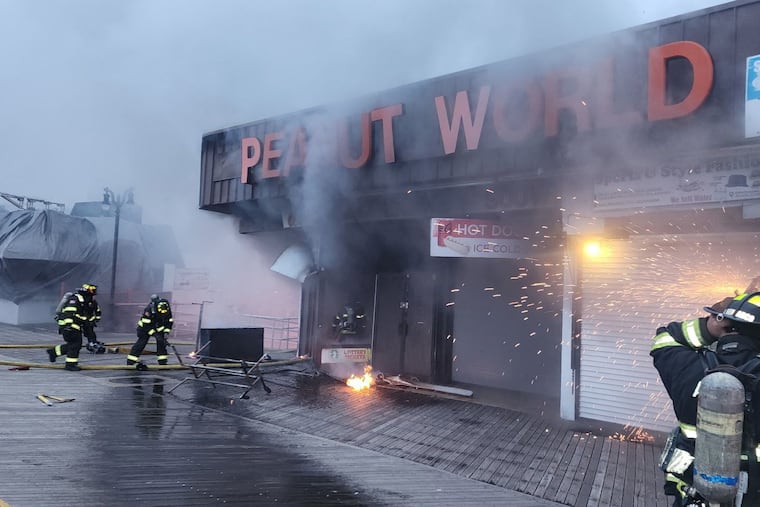
On Dec. 5, with the jury picked, the iconic Peanut World on the Boardwalk erupted in flames. On Dec. 9, with the mayor listening to his daughter, legislators in Trenton were proposing more state oversight of A.C. including a surprise provision that would give the state the power to pick developers for major projects.
The biggest threat may come from the New York casinos, which some in the industry estimate could threaten as much as 30% of A.C.’s business and lead to the shuttering of one casino, if not more.
Small, meanwhile, took the stand took the stand in his own defense on Friday, testifying that his daughter was his “best friend,” until becoming involved with a boy the family disapproved of, and denied he had abused her. The same day, community group El Pueblo Unido Of Atlantic City posted photos of ICE agents making car stops in city neighborhoods.
Small could face jail time and be forced to step down as mayor under New Jersey law, if convicted. He and his wife, who has been attending her husband’s trial, taking notes in the back, have resisted calls to relinquish their powerful roles as mayor and superintendent.
“It’s not ideal obviously,” said Shabazz. “If you had to pick a multiple choice question what would you want to be happening in your public schools, that wouldn’t be something you would pick, if you’re a parent or a taxpayer.”
‘A wake-up call’
Early one morning last week, having just come from a planning board meeting, Shabazz said the city was going about its business. “I’m not at the trial, I’m on my way to City Hall,” he said. “The work of government has to go on.”
Shabazz, who’s been focused for years, even decades, on some of the same intractable problems of the resort, remains optimistic. It’s a city where it can be hard to read the scorecard: progress seems to be there, but not there, at the same time.
The city’s only full-size supermarket, the beleaguered Save A Lot is under new management, and the adjacent nuisance liquor store is expected to close. High-profile developers like Jared Kushner and K. Hovnanian appear to be going forward with residential projects in the city’s Inlet section. There are new restaurants, like the Byrdcage in Chelsea and Simpson’s, relocating next month to Atlantic Avenue.
Shabazz is hoping the state will return zoning authority back to the city after years of the Casino Reinvestment Control Authority overseeing planning and zoning in the city’s tourism district.
But last week, as the mayor listened to his daughter testifying that he struck her in the head with a broom, after she threw detergent at him and refused to go to a community march, the state went in the opposite direction: a bill to renew the state’s takeover of Atlantic City for another six years that would allow the state to pick a “master developer” to oversee big projects, the Press of Atlantic City reported.
“We have to be competitive,” Shabazz said. “We have to let people know that we’re open for business and we’re safe and secure. Crime is down significantly.”
Like others interviewed, he believes Atlantic City can sell itself as a safe and affordable seaside destination. “We still have a free beach,” he said. “We have to let people know what we have.”
What the city has, chronically, is mayors under indictment. Small is the fifth mayor since 1981 to face indictment, following in the dubious footsteps of Michael Matthews (taking bribes), James Usry (accepting bribes, a charge later dropped), Bob Levy (defrauding the Veterans Administration), and Frank Gilliam (wire fraud).
Small has defended himself by describing this latest situation as a private family problem, not related to his job performance. He has called the prosecution politically motivated and an overreaction. A jury will now weigh in.
John Boyd Jr., a principal in the Boyd Co., which advises companies on where to locate, said many developers (and homeowners) continue to balk at Atlantic City, despite the upward pressure on Jersey Shore real estate that has left the city as arguably the last affordable seashore town in the entire Northeast.
He called the three New York City casino licenses “a wake-up call” for New Jersey, and advocates a plan where the state allows casinos at the Meadowlands and/or Monmouth Park but shares the revenue with Atlantic City.
“If you ask national developers their opinion of Atlantic City, it wouldn’t be a very positive one for a myriad of reasons,” he said.
“Good governance is fundamental to economic development success. Companies want to minimize risk. It’s more than the mayor being on trial. It’s the uncertainty.”
Meanwhile at the slots
Inside Hard Rock casino during a blustery stretch last week, people were three deep at the holiday-branded Mistletoe Bar in the lobby, and nine guitars had become a menorah in the atrium.
Gamblers were locked in as names were called for a random spin-the-wheel drawing every half hour. A convention of real estate agents brought lines to the check-in desk. The trial was off in the distance, invisible to most.
“I do love coming to Atlantic City,” said Adam Druck, 33, a Realtor from York, Pa. “I hope the trial doesn’t make too much difference to what’s going on here.”
Asked about New York casinos, Joe Pendle, 71, a retired police officer from North Jersey, said he was comfortable with his routines at Hard Rock, where free rooms and meals anchored his pleasant stays. (Hard Rock itself has one of the three licenses in New York City, an $8.1 billion project near Citi Field in Queens, which it projects will result in $1 billion a year in tax revenue.)
“I have a three-room suite upstairs,” noted Pendle. “I like the beach.”
Arthur Austin, 70, of Old Bridge, said he had worked for decades on Wall Street and had no desire to travel to New York for a casino weekend.
“I worked in the city for 20 years,” he said. “I only go into the city if I have to.”
Out-of-towners like Austin hadn’t heard about Small’s trial, but the local gamblers at Hard Rock sure had.
“Atlantic City is a crooked place, and it’s always gonna be crooked because of what everybody’s into,” said a 57-year-old woman who lives locally and was playing the slots. She did not want her name used so that she could speak her mind in a small town.
“People want their guy to stay in there,” said the woman. “He gives everybody a job. You could flourish, but only if you are with the right people.”
“I don’t think that it hurts Atlantic City,” said Seng Bethia, 40, of Atlantic City, who was at the slots. “His daughter is such a sweet girl. It was bad, just the whole thing.”
‘Are you kidding me right now?’
Exadaktilos, the Ducktown Tavern owner who is Small’s loudest detractor, said he had taken things down a notch of late, putting aside his popular weekly Facebook live rants that he said had started consuming him.
Still, last week, as the prosecution wound up its case, the city sent out a contractor to do some temporary filling in of cracks on Atlantic Avenue in advance of the city’s holiday parade, and Exadaktilos found himself back on Facebook live.
“Are you kidding me right now?” he said over footage of the roadway. “What happened to Atlantic Avenue is going to be paved? Horrible.”
Boyd, the location consultant, points to bright spots. The national developers are a vote of confidence, as is the September opening of the SeaHaus boutique hotel on the Boardwalk, a Marriott property. Showboat and the Sheraton near the Convention Center are converting rooms to residences.
Boyd sees potential for Atlantic City to follow the likes of Coney Island, which has seen a renaissance, to attract film business, to market itself as a live-work-play destination.
Outgoing council member George Tibbitt looks at the Kushner plan, a 180-unit apartment complex, as another missed opportunity. “No vision there,” he said. “That’s desperate development.”
The property is on the inlet near Gardner’s Basin and at one point was viewed as a potential spot for an ambitious mixed-use development similar to the Inner Harbor in Baltimore.
“New York City definitely makes me afraid,” said Tibbitt. “There’s only so many gambling dollars to go around. Adding more casinos is going to be devastating. We have to clean the city up. We have to get the neighborhoods filled back up.”
One industry the city bet heavily on was cannabis: Its midtown quickly filled with 16 dispensaries. But after complaints from the cannabis entrepreneurs themselves, city council capped the number at 16, leaving many that have been approved but have yet to open (including one that necessitated the demolishing of a historic church) in limbo.
Atlantic City is a place where things can seem to be finally coming together, while simultaneously unraveling. Big plans vaporize, like the highly touted gym and nightclub outside Showboat, where last summer, the owner set up couches, DJ booths, and exercise machines, got stalled by permitting issues, and quietly dismantled them.
Miguel Lugo, general manager at AC Leef, which held out for a strategic spot on Albany Avenue, said his cannabis business has been good. He looks forward to the dispensary running financial literacy classes for the community, and getting its cultivation license.
“On this side of the town, everything’s been phenomenal,” Lugo said. “I’m super focused on AC Leef. I don’t know what’s going on with the mayor.”

- From Instagram jokes to a suburban car chase: Inside the FBI’s hunt for a Philly armored truck-heist crew
- Atlantic City is ending the year in crisis. Its mayor is on trial, New York casinos are coming, Peanut World caught fire. There are more worries.
- What’s the etiquette when someone is blasting music on the El with no headphones?
- What, exactly, is the Eagles “positivity bunny”? | Weekly Report Card
- Meet the couple who claim to have the best lit Christmas tree in all of Pennsylvania
- How to have a perfect Philly day, according to indie rocker Golden Apples
- The best things we ate this week
- Citywide Quest: Do you know where in Philly these Hanukkah-themed photos were taken?
- A winter getaway with chocolate, caverns, and holiday lights in Hershey, Pa. | Field Trip
- Her Brewerytown home search spanned just four blocks. It was enough. | How I Bought This House
- From Gen. Washington to SEPTA’s Festibuses, timing is everything
