Thousands turn out in Philly for the ‘No Kings’ protest
The demonstrators joined others across the country to push back against many of President Donald Trump's actions.
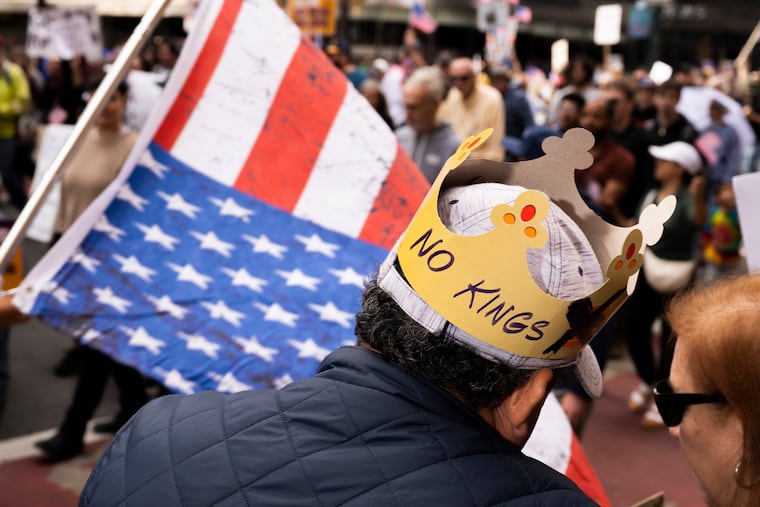
Joining demonstrators around the country, thousands gathered Saturday in Philadelphia to protest President Donald Trump’s actions that they contend are threatening to undermine 250 years of the nation’s democratic traditions.
“I think everybody needs to know that we’re not going to just sit back,” said Sherri King, who arrived at the “No Kings” rally in Center City wearing an inflatable chicken costume.
On a mild October afternoon when the weather was drawing no protests, the event began in a festive atmosphere with the sounds of clanking bells as participants gathered at City Hall — some, like King, wearing pre-Halloween regalia — and marched to Independence Mall.
“It’s a very large, orderly crowd,” said Police Capt. Frank Palumbo. The three-hour march and rally, which began at noon, actually ended on time.
Said Thomas Bacon, a 72-year-old Vietnam veteran from North Philadelphia: “It’s peaceful. No division. Just opposition.”
Under Trump, he said, “the whole world is turned upside down.”
In what was the third mass anti-Trump protest this year, several organizers were taking credit, including Indivisible, MoveOn, and the 50501 Movement.
The demonstrators’ menu of grievances included aggressive raids by Immigration and Customs Enforcement, Trump’s budget and efforts to limit free speech, and the government shutdown that began Oct 1.
Organizers of the more than 2,500 demonstrations nationwide say the shutdown in particular is a dangerous move toward authoritarianism.
Trump and congressional Republicans are blaming Democrats for refusing to vote on a reopening.
For his part, Trump spent the day of what fellow Republicans were calling “Hate America” rallies at his Florida mansion.
At the Philadelphia protest, Laura Murphy, a 74-year-old retiree, said she was struggling with the “Hate America” concept. “It’s ridiculous,” she said. “What could be more American than being against kings?”
Along with demonstrators, Democratic politicians were evident at events in Philly and elsewhere.
With Democrats hoping to make significant gains in the 2026 election, the presence of party elected officials was evident at rallies in Philly and elsewhere. Among those who showed up in Philadelphia were area U.S. Reps. Mary Gay Scanlon, Madeleine Dean, and Brendan Boyle, along with U.S. Rep. Jamie Raskin of Maryland.
Rallies were being held all over New Jersey, Pennsylvania, the region, the nation — even Spain, where a few hundred gathered in Madrid. About 5,000 people jammed the streets of West Chester.
In Philly, Jerry Lopresti, who said he never had attended a protest in his 64 years, said: “There has to be a show of numbers. It’s important to show up.”
Among those who showed up conspicuously was Michael Noonan, 48, of Northern Liberties. He was wearing a Tinky-Winky Teletubby costume as he walked off a Market-Frankford Line subway car.
He said his outfit was a counterpoint to suggestions that the demonstrations might turn violent. “Nobody’s here to fight anyone,” he said, “nobody’s here to kill anyone.”
Not everyone who showed up had issues with Trump.
Patrick Ladrie, 20, who lives in Camden County, stood out in his Trump hat and “ultra MAGA” T-shirt that proclaimed “I love our king.”
He said he crossed the Delaware River to “get a good viewpoint of what the American left is.”
After engaging in debate with three protesters on matters that included Christianity and conservatism, Ladrie reported that the environment was not so bad.
In fact, he said, it was one of the “most peaceful” debates he could recall. As one of his adversaries jogged away to meet up with his friends, Ladrie said, “Keep out of trouble.”
The protest was a decidedly intergenerational affair, with some parents describing the event as a teachable moment, while others said it was their progeny who came up with the idea to attend. Danielle Pisechko, 38, carried her youngest, who wore orange butterfly wings, on her shoulders.
Their sign read: “The only monarchs we want are butterflies.”
The participants included Center City resident Reed Oxman, 66. Although his disability limited his movement, he and his husband sat on a ledge near City Hall as evidence of the diversity of the crowd. “It’s [about] representation and clearing all the lies about who is coming to this,” Oxman said.
Lana Reckeweg, who lives at a North Philly women’s shelter, said her resources were seriously limited, but that didn’t stop her from finding cardboard and getting markers to make signs to give to other demonstrators.
She said that over the last several months a handful of undocumented women have found sanctuary in the place she calls home, and seeing their struggles made her want to attend the protest on their behalf.
“I have done a lot of crying. I see how it’s affecting them every day,” said Reckeweg, trying to keep her handwriting steady on a moving bus.
“I am here because they can’t be. People need to wake up and realize it’s getting a lot more serious more quickly than expected.”
As for what effect the rallies might have, “I would tend to doubt that the protests will have any immediate direct impact on the administration’s policies,” said David Redlawsk, chair of the political science and international relations department at the University of Delaware, but “they may work to embolden those who are opposed to Trump’s actions to continue to organize and respond.”
Sam Daveiga, 15, attended her first protest, the Women’s March, when she was 7 years old. This time, she brought along her father, Ed. “Every voice counts,” the Philly teen said.
“You can have a small voice, but the second you put it with everyone else who’s come out, it amplifies.”
Staff writers Emily Bloch, Scott Sturgis, and Rob Tornoe contributed to this article, which contains information from the Associated Press.