How the 3 Pennsylvania Supreme Court justices on the ballot have ruled in major cases
A look at how Pennsylvania Supreme Court Justices Kevin Dougherty, Christine Donohue, and David Wecht have ruled in some of the major cases of their tenure on the state's highest court.
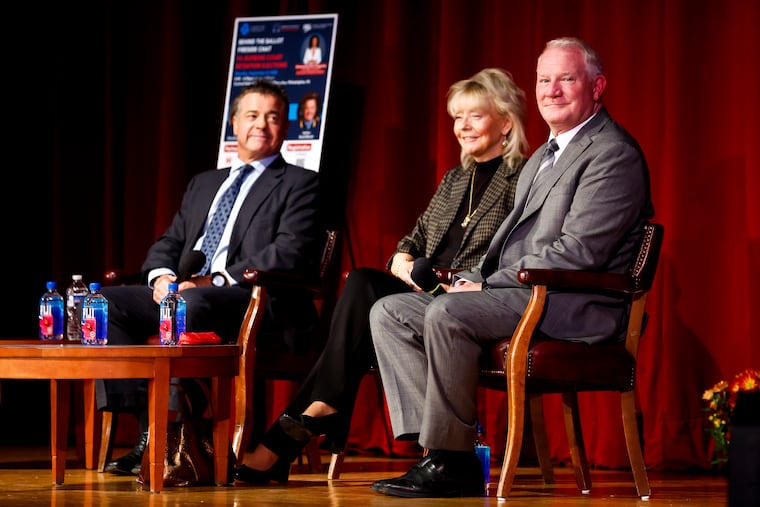
Three Pennsylvania Supreme Court justices are on the ballot this November, when voters will decide whether to extend each of their tenures for another 10-year term.
There are currently five justices who were elected as Democrats and two who were elected as Republicans on the bench.
This year’s retention race has drawn heightened attention, as Republicans have launched a campaign to sink the retention bids of Justices Kevin Dougherty, Christine Donohue, and David Wecht — all elected as Democrats in 2015 — in hopes of flipping the court’s balance.
Once on the bench, judges are expected to shed their partisan label, which is why Pennsylvania extends judicial terms through retention elections instead of head-to-head races.
» READ MORE: Why Pa. voters are asked to choose ‘yes’ or ‘no’ for some judges on Election Day
Still, advocacy groups on both sides of the aisle are trying to make the case that control of the judicial seats is critical, if not existential, to their causes.
The Inquirer reviewed the cases that have come before the Pennsylvania Supreme Court over the last decade, and how Dougherty, Donohue, and Wecht voted.
Here are some of the most significant cases of their tenure.
Abortion
Pennsylvania’s highest court stopped just short of recognizing a constitutional right to abortion access in January 2024.
The ruling came in a case challenging a state law limiting Medicaid funding for abortions except in cases involving rape, incest, or danger to the life of the mother.
The 219-page majority opinion included language that strongly endorsed access to abortion as a right derived from the Pennsylvania Constitution, but the judges could not agree on whether they were ready to make the call in this case.
» READ MORE: Pa. Supreme Court sets up a showdown over whether abortion is a right protected by the state constitution
The majority sent questions about a specific funding limit and broader constitutional protection for abortion access back to a lower court — setting up another round of legal battles that will likely, again, make it before the state Supreme Court.
How the three justices ruled: Donohue wrote and Wecht joined the majority opinion. The two justices said they believed Pennsylvania’s 1971 Equal Rights Amendment clearly established a right to abortion access. Dougherty wrote a separate opinion saying this case did not call on the court to opine on the right to an abortion. “At least, not yet,” he wrote.
Voting rights and elections
The Pennsylvania Supreme Court has ruled on a litany of challenges to Pennsylvania’s election rules, many of them focused on the state’s mail voting law.
In 2018, the justices threw out the state’s GOP-drawn congressional maps as unconstitutionally gerrymandered.
In 2020, the court issued a major ruling ahead of the presidential election allowing for ballot drop boxes and allowing local election offices to accept ballots for up to three days after the election as long as those ballots were postmarked by 8 p.m. on Election Day.
How the three justices ruled: Donohue, Dougherty, and Wecht each joined the majority opinion in the redistricting case. On the 2020 election ruling, Dougherty and Wecht joined the majority opinion. Donohue joined the majority opinion but dissented from the decision to extend the ballot deadline.

Education
A Delaware County school district had the right to challenge Pennsylvania’s school-funding system, the Supreme Court ruled in 2017.
The decision affirmed the role of courts in ensuring that state funding leads to equitable education and sent the case back to Commonwealth Court to proceed with litigation.
In 2023, Commonwealth Court ruled, as part of the same case, that the state’s funding system for school districts led to disparities that prohibit quality education for all students, rendering it unconstitutional.
How the three justices ruled: Wecht wrote the majority opinion, which Dougherty and Donohue joined.
Environment
Pennsylvania, which partly sits on the natural gas-rich Marcellus Shale, found itself in the midst of the fracking boom of the early 2000s.
The state sold leases to oil and gas companies to drill wells. The practice raised questions, and legal challenges, as to how the state should use the revenues in the context of the Pennsylvania Constitution’s Environmental Rights Amendment.
The court ruled in 2017 that it is unconstitutional for the state to use revenue from the royalties of oil and gas leases on public land to pay for anything but conservation and maintenance of the environment.
How the three justices ruled: Donohue wrote the majority opinion, which Dougherty and Wecht joined.
Criminal justice
Pennsylvania has had the nation’s largest population of juvenile lifers: people sentenced as minors to life in prison without the possibility of parole.
In 2017, the Supreme Court made it harder to sentence a juvenile to life. The majority opinion says there is a “presumption” against life without parole for juveniles who are found guilty of murder, and prosecutors must show that the offender is “unable to be rehabilitated” when seeking the sentence.
How the three justices ruled: Donohue wrote the majority opinion, which Dougherty and Wecht joined.
Second Amendment
In 2024, for the first time, the Pennsylvania Supreme Court issued an opinion that interpreted the wording in the U.S. Constitution that gives Pennsylvanians the right to bear arms.
In Stroud Township, a zoning ordinance that prohibited the discharge of a firearm within the township’s borders limited the possible locations for shooting ranges. The ordinance barred a resident from having a personal outdoor shooting range on his property, and he sued the township for violating his Second Amendment rights.
The court ruled that the ordinance was constitutional.
How the three justices ruled: Dougherty wrote the majority opinion, which Wecht joined. Donohue wrote her own opinion, reaching the same conclusion as the majority but disagreeing with the analysis.
Larry Krasner
Did Republican lawmakers make a procedural error in their 2022 effort to impeach Philadelphia District Attorney Larry Krasner? The Supreme Court in 2024 said they did, effectively ending a campaign in Harrisburg to oust the progressive prosecutor.
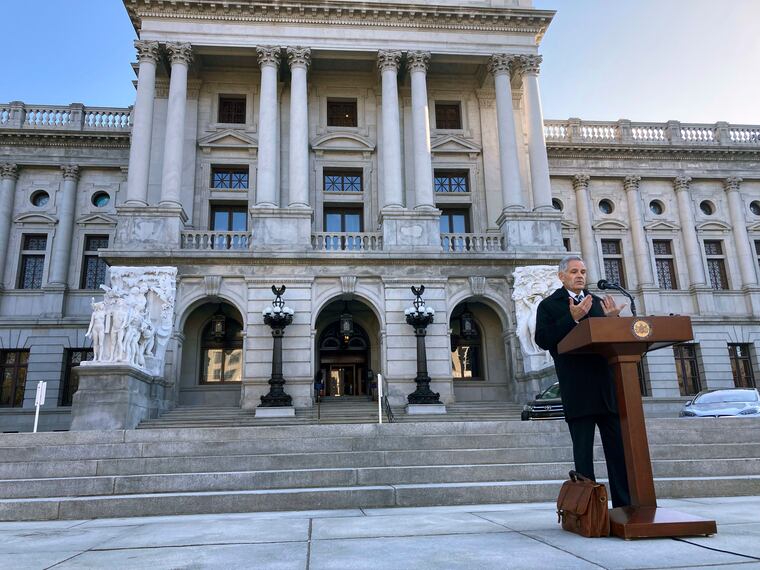
The decision said that the articles of impeachment approved by the state House in late 2022 were “null and void” because they were sent to the Pennsylvania Senate on the last day of that year’s legislative session, and the upper chamber did not complete its work on the matter before the next session began. The attempt to carry the process from one two-year session to the next was unlawful, the court said.
The majority also agreed with a lower court that none of the articles of impeachment met the required legal standard of “misbehavior in office.”
How the three justices ruled: Donohue and Wecht joined the majority opinion. Dougherty did not participate in the deliberations.
Bill Cosby
Disgraced actor and comedian Bill Cosby walked out of prison a free man in 2021 after the state Supreme Court reversed his sexual assault conviction.
The court did not weigh in on the facts of the case or whether Cosby was guilty. Instead, it focused on a former Montgomery County prosecutor’s decade-old promise that Cosby would never be charged with drugging and assaulting Andrea Constand if he gave incriminating testimony in a civil case filed by his accuser. The justices found that the testimony was improperly used years later against Cosby at his criminal trial, calling it a “unconstitutional coercive bait-and-switch.”
How the three justices ruled: Wecht wrote the majority opinion, which Donohue joined. Dougherty wrote a separate opinion, saying he would allow for Cosby to be retried, but would order his testimony from the civil case to be suppressed.

In November, voters will be asked whether three Pennsylvania Supreme Court justices should be retained for another 10-year term. Read The Inquirer’s coverage of the races before heading to the polls:
- Republicans are attempting to boot three Democratic justices from the Pa. Supreme Court — and for the first time, Dems are worried
- A ‘brazen’ Jeffrey Yass-backed mailer suggests the Pa. Supreme Court created the congressional map it actually threw out
- At Philly event, Pa. Supreme Court justices ask for 10 more years amid GOP campaign to oust them
- More than $7 million has poured into the Pa. Supreme Court judicial retention election so far
- The future of redistricting in Pa. could be at stake in November’s Supreme Court race