THE BLUE DIVIDE
Funerals, flowers and a Chevy Tahoe: How financial questions have turned the FOP election ugly
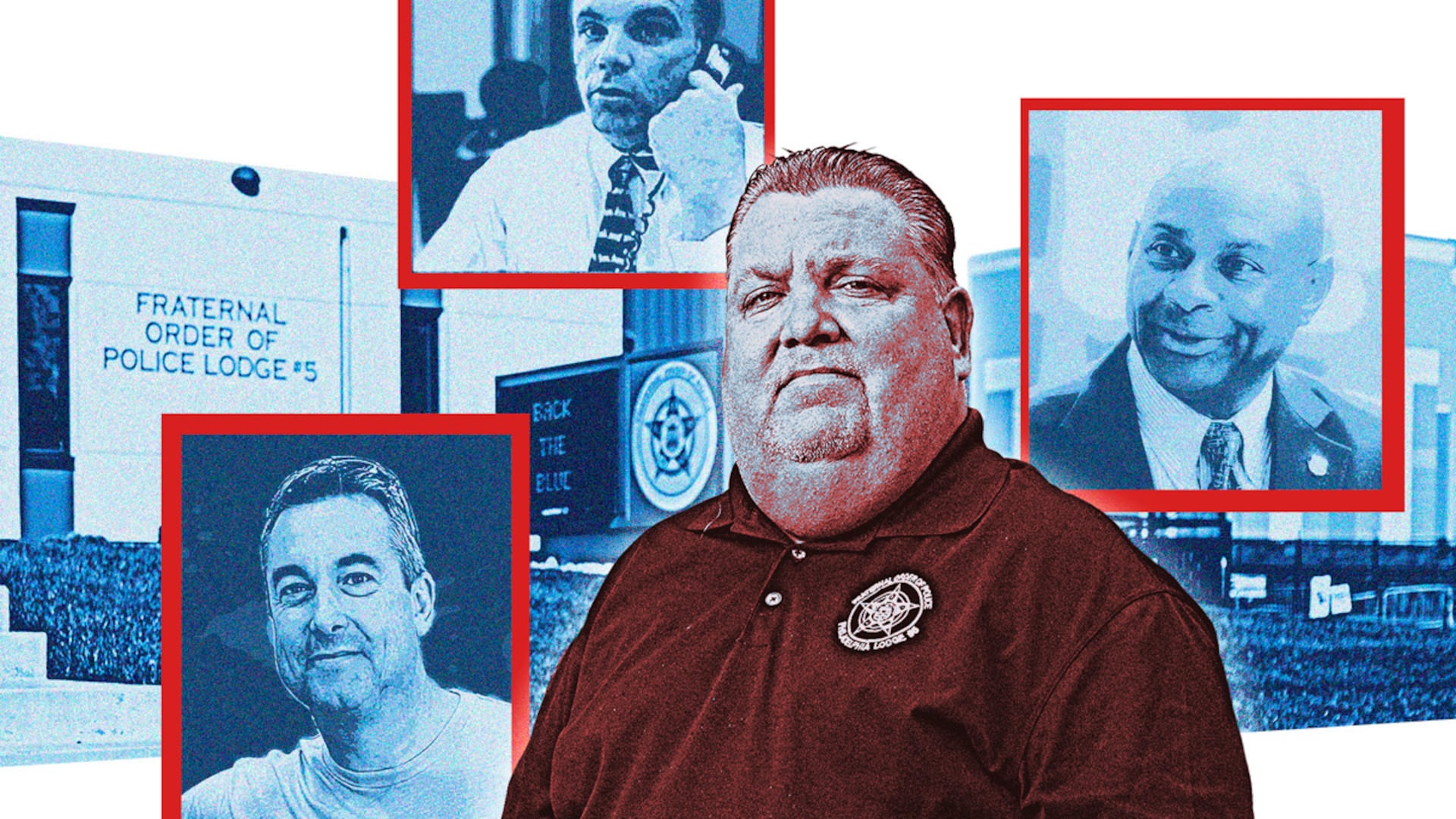
John McNesby had his audience — dozens of white-haired retired cops and younger officers in light blue uniforms — in the palm of his hand.
He’d summoned them, on a September morning in 2015, to the headquarters of the Fraternal Order of Police Lodge 5, where he warned of a city policy that would make public the names of police officers who shot civilians.
The idea was “insane and absurd,” the longtime FOP president fumed, methodically working the crowd into a frenzy. His rant was answered with thunderous cries of “Amen!”
McNesby vowed to fight for them. And his members had no reason to doubt him.
As the FOP’s president since 2007, McNesby secured for police officers wage and benefit increases that other city union workers could only envy. He publicly supported many disgraced officers who had been fired, vowed to get them rehired and, more often than not, succeeded.
He fought police reform efforts, including the identification policy, and made the union a political force by endorsing candidates that bolstered his Back the Blue agenda.
It’s a track record that earned him unquestioned loyalty — best illustrated by the fact that he faced no official challenge to his leadership for nearly 15 years.
But McNesby’s once-sacrosanct legacy is now under intense scrutiny from a surprising source: FOP members themselves.
McNesby unexpectedly resigned in 2023 after one of his top officials was accused of swindling a police widow out of more than $20,000. Union members who argue that the FOP has much deeper problems have launched a wave of accusations this year of financial mismanagement as they work to unseat McNesby’s handpicked successor in an October election, which will determine who runs the union’s executive board.
In near-daily social media posts and during contentious union meetings, candidates for the FOP’s executive board have accused McNesby and current union leaders of racking up millions in questionable credit card charges and lacking transparency about the union’s profits and expenses. A particularly notable complaint has been the union’s decision to purchase a Chevrolet Tahoe Z71 for McNesby.
McNesby declined to comment for this article.
The finger-pointing has grown so intense that current members of the FOP’s leadership team nearly got into a physical altercation with the candidate running against current president Roosevelt Poplar, according to a May social media post.
In an effort to separate facts from campaign rhetoric, The Inquirer obtained and reviewed hundreds of pages of publicly available FOP tax records and audits, as well as internal financial documents that have never been made public. Reporters also interviewed tax and labor experts, and retired and active police officers familiar with McNesby’s tenure as Lodge 5 president.
The Inquirer examination found FOP expenditures that raise questions about the union’s financial practices, particularly given the limited oversight, missing records, and lack of transparency surrounding its spending. The concerns are most notable within the Survivors’ Fund, a charitable foundation created to support families of officers who lost their lives or were gravely wounded in the line of duty.
In the fiscal year that ended September 2023, the union reported that the fund and the FOP collectively spent nearly $660,000 on survivor events, funerals, flowers, and gifts. Although fundraisers and luncheons for survivor families are held annually, no police officers died in the line of duty that year. A similar pattern occurred in fiscal year 2018, when the city reported no line of duty police deaths, yet the Survivors’ Fund recorded more than $500,000 in total expenses. Some of the spending may reflect support or gifts for family members of officers who died in prior years, as such expenses aren’t necessarily limited to the year of an officer’s death.
Meanwhile, during the 2021 fiscal year, six police officers died from COVID-19, and funerals or memorial services were held for at least four of them. Records show the Survivors’ Fund reported spending roughly $105,000 for funerals and special events, while Lodge 5 spent an additional $240,000. The combined total was significantly less than in years when no officers died in the line of duty.
The documents are an incomplete and opaque window into the finances for the Survivors’ Fund and Lodge 5, which are both 501(c) nonprofits. Another FOP nonprofit, the Home Association, operates the 7C Lounge, an expansive bar decorated in gleaming dark wood in the union’s 50,000-square-foot headquarters.
A comprehensive financial picture of the nonprofits would be possible only by examining all credit card statements, receipts, and records. Those records are not publicly available, and even union members say FOP leaders have only allowed them to view a limited selection of documents.
The Inquirer asked FOP leaders to share records that could provide a clearer perspective of its finances, but the union did not respond to that request.
‘I’m disappointed’
On a website that solicits donations to the Survivors’ Fund, the FOP writes that the charity is meant to not only “remember the sacrifice of each officer that we have lost, but to acknowledge the sacrifice made by each of the surviving families.”
But one expenditure from the fund seems to violate that purpose.
The Inquirer obtained internal FOP documents showing that in November 2023, the fund wrote a $2,500 check to the mother of Officer Edsaul Mendoza, who a year earlier fatally shot an unarmed 12-year-old boy in South Philadelphia. Mendoza pleaded guilty to third-degree murder in July 2024 and was sentenced to serve eight to 20 years in prison. (City officials in June agreed to pay the boy’s family a $3 million settlement.)
The Survivors’ Fund request form, submitted by vice president Nicholas Denofa and treasurer William Sierra, notes: “Donation to the family of p/0 Edsaul Mendoza #292110 to offset the financial burden of his apartment, bills, etc.”
Eloy Mendoza, Edsaul’s older brother, told The Inquirer that he and his mother drove from New York to FOP headquarters to ask for money while his brother was in jail.
“My brother had stuff he gotta pay — like his apartment, his credit card,” he said. “And we needed help to pay for tolls and gas. We were driving almost every weekend to see him.”
Denofa and Sierra did not respond to requests for comment.
The payment to Mendoza’s mother “doesn’t sound appropriate for a labor union or any tax-exempt organization,” Marc Owens, a former director of the Internal Revenue Service’s Exempt Organizations Division, told The Inquirer.
My brother had stuff he gotta pay — like his apartment, his credit card.
Owens, one of four independent tax, labor union, and nonprofit experts who agreed to inspect some of the FOP’s financial records at The Inquirer’s request, said the union’s network of nonprofits and businesses are unusually complex and potentially vulnerable to abuse.
“It’s impenetrable,” Owens said. “It’s not clear what the expenditures are, what the linkage is between the tax-exempt purpose of the labor union and the expenditures.”
Owens singled out for concern the large amount of cash that runs through the various FOP nonprofits in the form of donations, purchases at the bar, and its catering operation.
“Cash is always hard to track,” he said.
Poplar initially agreed through a spokesperson to be interviewed for this story. But after The Inquirer provided the FOP with specific information about its investigation, Poplar declined to meet with a reporter.
He instead sent a written statement defending the union’s expenditures and said their critics’ accusations are “political, unsubstantiated, and lack total merit.”
“All expenditures at FOP Lodge 5 are approved by elected trustees and the FOP Appropriations Committee,” Poplar wrote. “And during our membership meetings, our Treasurer and Appropriations Committee report our expenditures to the membership.”
Between 2013 and 2023, McNesby’s compensation — which would have been approved by the FOP’s board — soared from $129,622 to $240,818, tax records show. (Poplar earns $238,145 in total compensation.)
McNesby was paid more than Gov. Josh Shapiro in 2023, and his compensation was 119% higher than the City of New York’s Police Benevolent Association president, who was paid $109,912 in 2023 to represent nearly 50,000 active and retired officers. The FOP represents 12,500 active and retired members.
McNesby’s family also hold positions at the FOP. His wife, Patty, is an FOP catering associate, though her salary is not listed on tax documents. Their 26-year-old daughter, Caitlyn, a rookie Philadelphia police officer, is a trustee on the union’s Legal Services Trust Fund, with a reported compensation of $1,750.
The union purchased the Tahoe for McNesby in 2022, but after he resigned, the FOP sold the vehicle and wrote McNesby a check for $64,500, according to three union members who said they have seen the records. There was not a membership vote to approve the gift, angering some FOP members who learned of it after the fact.
That was greedy [of McNesby] and I’m disappointed that it happened.
“That was greedy, and I’m disappointed that it happened,” said Lt. John McGinley, a 25-year veteran who is part of the team trying to unseat Poplar. “Retirees, men and women who are living off scraps, are not happy about it, and they shouldn’t be.”
Mark Carter, a member of the U.S. Chamber of Commerce’s Labor Relations Committee, said giving McNesby an SUV — or the proceeds from its sale — might have been an improper use of union funds.
“But that is something that law enforcement, oddly enough, should be made aware of, and make a determination as to whether it’s appropriate or not,” Carter said.
McNesby, who has largely refrained from engaging in the social media sniping, addressed criticism about the gifted Tahoe in May in a thread of Facebook comments.
“Sure. Put a nice spin on it,” he wrote. “Every president who left office since the 70’s were given the car from the membership I believe there was 7 previous.”
‘Our guys’
McNesby, 59, was raised in the Byberry section of Northeast Philadelphia. He joined the Philadelphia Police Department in 1989 and became a union delegate, following in the footsteps of his father, George McNesby, an FOP board member.
The younger McNesby spent more than a decade working narcotics in the city’s East Division, primarily the Kensington neighborhood. Several narcotics teams would later become embroiled in corruption scandals, but McNesby emerged from his time in the unit without a public blemish on his record. In 1995 and 1999, he was named the police department’s “Officer of the Year.”
McNesby rose to FOP vice president in 2002 and, five years later, defeated fellow union member Frank Zampogna for the presidency. Zampogna failed to unseat McNesby during a rematch in 2010. It was the last time McNesby faced an election challenge.
[McNesby] was king. No one wanted to go against him, because you’d get thrown out of the FOP.
McNesby’s tenure as president began during a pivotal era for both the union and the police department. The city had a new mayor, Michael Nutter, and a new police commissioner, Charles H. Ramsey, each of whom was fixated on weeding out corruption and adopting accountability reforms.
McNesby’s first big test as FOP president came in 2008, when a news helicopter filmed eight police officers in North Philadelphia as they appeared to beat and kick three suspects. The footage became national news.
Ramsey swiftly fired four of the officers and suspended three others. “We have an obligation,” he explained at the time, “to do things the right way.”
McNesby countered that Ramsey had deprived the cops of due process. “We’ll back these officers 150 percent,” he said.
Separate grand juries later acquitted the cops and the men they’d arrested of any wrongdoing. An arbitrator reinstated the fired officers with back pay, and the FOP celebrated with a free happy-hour party at its headquarters.
A flier advertising the party proclaimed: “Our Guys Are BACK!”
McNesby also earned respect from union members by boosting their bottom line. While the city was hobbling from a global financial crisis, McNesby in 2009 negotiated a 7% raise for officers over the course of three years. He also secured a partial rollback of the residency requirement for officers, and by 2012, all officers with five years on the job could live outside the city.
Richard Ross, who succeeded Ramsey as police commissioner in 2016 — and had been part of McNesby’s 1989 police academy class — once acknowledged that McNesby was an effective union president. But he added a caveat: “Is John sometimes ready, fire, aim? Yeah,” Ross said. “Sometimes does his rhetoric match what we need? No.”
Others described McNesby’s stewardship of the union in harsher terms.
McNesby sought to expel Ray Lewis from the union in 2012 because the retired captain had worn his old police uniform while supporting Occupy Wall Street demonstrators in New York. But Lewis said McNesby’s efforts to punish him were more about his outspoken stance against police corruption during his 24 years on the force.
“He was a king,” Lewis, 73, said in a recent interview. “No one wanted to go against him, because you’d get thrown out of the FOP.”
‘They call me Santa Claus’
The FOP, which receives almost $6.8 million annually in union dues, moved its headquarters in 2013 from Broad and Spring Garden Streets to a sprawling property in Northeast Philadelphia. It includes a catering business, halls available to rent for special occasions, and the often-bustling 7C Lounge.
During a recent visit, the FOP’s national president referred to the headquarters as “Lodge Mahal.”
Earlier this year, McNesby explained in an issue of Peace Officer, Lodge 5’s magazine, that he had run the union like a business.
“Close to 120 million dollars a year flows through the FOP,” he wrote. “With the organization growing and the success of the catering, lounge, and fundraisers, it now employs over one hundred individuals, both full and part-time.”
Yet, Lodge 5’s nonprofit home association, which manages 7C Lounge, often reports operating in the red, federal tax records show. In the 2024 fiscal year, it reported $1,003,936 in total revenue and $1,071,399 in expenses — a loss of $67,463.
A year earlier, its deficit was even worse: nearly $330,000.
Tax records offer little insight into the specifics of how the bar and catering businesses operate, the employees they hire, or whether proceeds from their sales are reinvested in the union and its members.
“A 50,000-square foot union hall that has its own catering business, and 100 employees, I just haven’t seen that at a local union before,” said Carter, who has worked as a labor attorney across the U.S. for 39 years.
There’s an opportunity for potential conflict any time a union owns and runs a business.
“There’s an opportunity for potential conflict any time a union owns and runs a business,” he said. “There are going to be legitimate questions about how the business is funded and to whom the profits and losses are attributed to.”
Fliers for past FOP fundraisers show that many of the events request tickets be paid in cash, making profits especially difficult to track.
On a Saturday in May, Lodge 5 hosted a survivors’ benefit at its headquarters, where about 500 attendees paid a $45 cover charge, in cash or through Venmo. The union’s catering business provided soda, Miller Lite on draft, hot dogs, burgers, kielbasa, soft pretzels, and barbecue chicken.
The 7C Lounge sold an “FOP Special” — Orange Crush, orange vodka, freshly squeezed orange juice, a splash of seltzer — for $7. Bartenders accepted credit cards, but most sales appeared to be in cash, according to an Inquirer reporter who observed the activity over a two-hour period.
An array of items were available for auction, including two baskets filled with sex toys, and autographed Eagles, Phillies, 76ers, and Donald Trump jerseys. For $20, guests could take one spin at a 50-50 raffle.
Such events are meant to fill the coffers of the Police Survivors’ Fund, which held $363,531 in assets in 2023.
The Inquirer spoke with family members of six officers who have died in the line of duty since 2016. Each said the FOP paid for the officers’ funerals and for luncheons, and provided ongoing emotional support.
“I’m not sure I could have done it without them,” said Vita Walker, whose husband, Capt. James Walker, died from COVID-19 in April 2020.
Walker said she attends many FOP survivor events, including an annual luncheon at Vie, a North Philadelphia restaurant.
“I am so grateful for everything they have done and continue to do,” she said.
Maureen Faulkner, whose husband, Officer Daniel Faulkner, was fatally shot by Mumia Abu-Jamal in 1981, has also praised McNesby for his support.
“I think no one understands, when you are the president of the Fraternal Order of Police, all the time and effort you have to put into taking care of people,” she said in 2023.
McNesby told the Inquirer in 2023 that the Survivors’ Fund exists for when “families request help with their houses, or issues with their cars,” and not just to pay for funerals.
“Or we have officers who are shot in the line of duty, and they want to go to dinner with their wives. And we have families of officers who were killed who have a request to go on a trip. There’s a litany of things that we do,” he said. “They call me Santa Claus.”
I think no one understands, when you are the president of the Fraternal Order of Police, all the time and effort you have to put into taking care of people.
Nonprofit reporting rules don’t require the FOP’s various charitable organizations to include detailed breakdowns of its spending. But the figures reported in available tax records illustrate the kinds of inconsistencies that some union members say can only be explained with greater transparency.
The Inquirer found that, in some instances, both the Survivors’ Fund and Lodge 5 reported paying for what appeared to be the same events.
In a filing for the 2023 fiscal year — when no officers died in the line of duty — the Survivors’ Fund reported expenditures of $94,803 for “funeral expense,” $187,880 for “survivor events,” $84,504 for “donations” and $14,330 for “survivor gifts.”
That same year, Lodge 5 reported that it also spent $361,132 for “funerals and special events,” the records show. However, it’s unclear from the filings and Poplar’s statement whether any of that went toward funerals for officers who died of natural causes while off duty or long after retirement.
The incomplete view of the Survivors’ Fund’s operations during McNesby’s tenure is due in part to the fund’s failure to file required reports with Pennsylvania’s Bureau of Corporations and Charitable Organizations for three years.
In fiscal year 2016, the FOP’s charitable foundation filed a one-page form indicating it was not renewing its registration, even though it reported on federal tax records that it had more than $494,000 in total revenue.
It also did not submit audits to the state agency for 2017 and 2018, yet records show it was still in operation.
‘Nothing was questioned’
During McNesby’s final years as president, a volatile political landscape — and a union official’s disturbing betrayal — set the stage for the election that is now roiling the FOP.
George Floyd’s 2020 death, under the knee of a white Minneapolis police officer, triggered a wave of protests across the U.S. and renewed demands for meaningful police accountability. McNesby expressed a newfound willingness to discuss reforms, after observing that some of the FOP’s longtime allies had grown wary of supporting law enforcement.
“Some of the ones who were our friends,” he said, “now their phone is off the hook.”
His political influence in Philadelphia had also dwindled.
In 2021, the FOP endorsed Carlos Vega, a former prosecutor who was running against the city’s progressive district attorney, Larry Krasner, in a Democratic primary race.
To call attention to what McNesby said were Krasner’s “soft on crime” policies, the union stationed a Mister Softee ice cream truck outside the DA’s Office. The culinary stunt had little effect: Krasner easily defeated Vega and was reelected to another four-year term.
Then came a scandal that infuriated rank-and-file union members and called into question whether the union’s finances were in trusted hands.
Terry Reid, a longtime member of McNesby’s executive team, often met with the families of cops who had died in the line of duty and helped them navigate funerals, memorials, and paperwork for benefits.
In 2023, the family of a late police officer told McNesby that Reid had borrowed at least $20,000 from the officer’s widow, and then ignored the woman’s requests to be repaid.
McNesby fired Reid and assured members that the FOP had controls in place to ensure that money meant for police survivor families was never abused. But he seemed incensed that Reid had brought a cloud of suspicion upon the union.
“If you were having [financial] issues, there are other ways to get money,” he told The Inquirer at the time. “You don’t take it from a dead cop’s f— widow.”
Three months after The Inquirer wrote about the Reid scandal, McNesby resigned, taking even members of his inner circle by surprise. Publicly, McNesby explained that he wanted to step away “when members would ask, ‘Why is he leaving?’ not, ‘When is he leaving?’”
The FOP’s executive board said that it voted unanimously to have Poplar assume the job of president. McNesby wrote in the FOP’s magazine that he was the one who had decided that Poplar was the best person to succeed him.
Poplar, the union’s first Black president, had been part of the FOP’s executive board for two decades, and McNesby credited him with managing much of the union’s day-to-day operations. He’s also less bombastic and confrontational than McNesby, a possible asset in an era where police misconduct is under a microscope.
After leaving the FOP, McNesby began working for the state in January 2024, taking on a newly created role in Gov. Josh Shapiro’s administration as Director of Local Public Safety Outreach for the Pennsylvania Emergency Management Agency.
A PEMA spokesperson said it hired McNesby to “strengthen communication” between federal, state, and local agencies. The role came with a $120,450 salary.
After six months, McNesby resigned. Neither PEMA nor McNesby have explained why he left the position, which remains vacant.
McNesby now works as a business manager and public information officer for Lodge 92, a union representing state inspection, investigation, and safety professionals.
In the wake of the Reid scandal and McNesby’s sudden exit — and with a contested union presidential election on the horizon — FOP members began publicly demanding details about the union’s financial management for the first time in February.
David Osborne, a senior director of labor policy at the Commonwealth Foundation, said that in Pennsylvania, public-sector union members have no explicit right to obtain a detailed breakdown of their union’s assets.
But when members are stonewalled after asking how money is being spent, it’s a red flag that “something isn’t right,” said Danielle Acker Susanj, executive vice president at the Fairness Center, a nonprofit law firm that offers free legal help to people hurt by public-sector union officials.
They have a right to ask for this stuff to try to get answers and understand how their money is being used.
“They have a right to ask for this stuff to try to get answers and understand how their money is being used,” she said.
Kenneth Rossiter, a former homicide detective backing Charles “Knute” Mellon’s candidacy for FOP president, has been one of the most vocal members campaigning to replace Poplar’s team.
In a May 10 Facebook post, Rossiter wrote that he, along with three other union members, met with four members of the FOP’s executive board at the union’s headquarters to inspect five years of Survivors’ Fund records.
Rossiter told The Inquirer he “received a spreadsheet with very vague information about the money received and disbursed,” and that he and other members reviewed statements for more than 10 union credit cards. The charges totaled between $2 million and $3 million over a three-to five-year period and included up to $90,000 a month on alcohol alone, he said.
Rossiter said he wasn’t allowed to photograph or copy the documents.
“It made me want to dig deeper as to why: Why were they so concerned?” Rossiter said.
Rossiter raised concerns about the alcohol charges — along with expenses for plane tickets, hotels, and restaurant tabs — in a Facebook post. McNesby responded only to the alcohol expenditures, saying that the union was required to have credit cards on file with the state’s Liquor Control Board for the 7C Lounge and its catering service. “[P]rob a couple million in liquor over a dozen years,” McNesby wrote.
The ongoing attacks and rumors should be viewed in the context of an FOP election by members who are untested and desperate for attention.
Poplar, meanwhile, has insisted in social media posts that his opponents have simply misunderstood the records they reviewed and are spreading misinformation at a critical time for the union. In addition to its looming election, the union is in the middle of negotiations with the city over a new contract. (Among the FOP’s proposals: preventing the police department from identifying officers who are involved in shootings.)
“The ongoing attacks and rumors should be viewed in the context of an FOP election by members who are untested and desperate for attention,” he wrote in his statement to The Inquirer.
The back-and-forth almost turned physical on a mid-May day, when Mellon, a longtime member of the police department’s aviation unit, visited the 7C Lounge.
At the FOP’s bar, Mellon was approached by two members of Poplar’s executive team about the questions he’s raised about the union’s finances, he recounted in a video he posted on Facebook.
Mellon alleged that Poplar’s team got in his face and said they “wanted a piece” of Mellon, and then tried to prevent him from leaving.
“Should not be going on,” Mellon sighed in the video. “You can ask yourself why it’s happening. We’ve asked ourselves why. But listen, we’re running. No matter what they throw at us, we’re running.”
Mellon later posted what appeared to be an AI-generated image of a black Chevrolet SUV, with a large red bow planted on its hood. If elected, he said, “the misuse of gifted vehicles ends immediately — no exceptions, no delays.”
In comments beneath the image, some FOP members seethed.
“My dues were used to give someone a car?” one wrote. “Is there an investigation going on?”
Staff writer Max Marin contributed to this report.

The Inquirer’s journalism is supported, in part, by the Lenfest Institute for Journalism and readers like you. News and editorial content are created independently of The Inquirer’s donors. Gifts to support The Inquirer’s high-impact journalism can be made at inquirer.com/donate. A list of Lenfest Institute donors can be found at lenfestinstitute.org/supporters.