Carpet cleaning, cash, and bar tabs: FOP bills taxpayers for questionable funeral expenses
An Inquirer investigation found that the Fraternal Order of Police Lodge 5 has billed the city for an array of expenses that are far outside the scope of funeral home and cemetery costs.
After a tragic and unprecedented spike in officer deaths, Philadelphia’s police union made an emotional plea for help: Its charitable organization was running low on funds and struggling to give fallen officers the respectful burials they deserved.
City officials stepped up, agreeing in 2014 to significantly boost how much they would pay to cover funeral expenses. Since then, for each officer who died in the line of duty, the city has contributed up to $75,000 in tax dollars, up from $15,000.
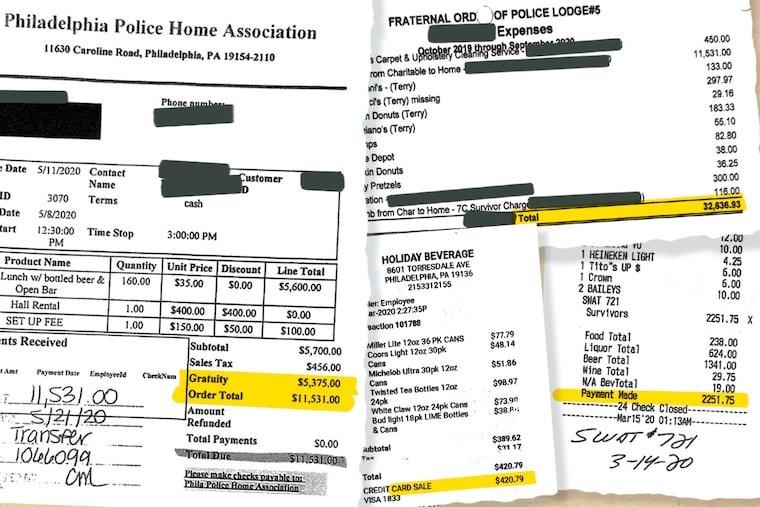
But an Inquirer investigation found that the Fraternal Order of Police Lodge 5 has billed the city for an array of expenses that are far outside the scope of funeral home and cemetery costs. The union has asked to be reimbursed tens of thousands of dollars for bar and restaurant tabs, alcohol, catering costs, car repairs, carpet and upholstery cleaning, socks and underwear, garbage bags, and paper towels.
The FOP has submitted receipts from businesses such as Target, Home Depot, Walmart, Acme, 7-Eleven, and CVS that include no explanation for why they qualify as funeral expenses.
The union has also forwarded monthly statements of corporate credit cards held by various members of the FOP leadership team, circling bill totals mostly for restaurants, bars, and beer stores. Other reimbursement requests lack any receipt or itemized breakdown, or are simply requests for cash, making it practically impossible to judge their merits at face value.
Records show the FOP has billed the city for food and alcohol for at least eight events at its own bar, 7C Lounge, located within the union’s 50,000-square-foot headquarters in Northeast Philadelphia.
One of the 7C events resulted in a $5,700 bill, plus an additional $5,375 for a “gratuity.”
And in one handwritten memo, an FOP official asked the city to reimburse the union $3,500 in cash for a survivor’s family, with no explanation except that it was “per John McNesby,” then the FOP’s president.
Current FOP president Roosevelt Poplar and McNesby, who served as the union’s president for 16 years before stepping down in 2023, did not respond to requests for comment.
The city’s $75,000 contributions for officer funeral expenses, which have not been previously reported, prompt new questions about the FOP’s Survivors’ Fund, the union’s charitable organization that raises money to pay for funerals and support the families of officers who were killed or seriously injured in the line of duty.
A 2025 Inquirer investigation found that the FOP reported spending hundreds of thousands of dollars on “funerals and special events” in years when no officers died in the line of duty, and that its expenditures and cash donations had been loosely documented and were difficult to track.
The Inquirer sought further insight by examining more than 1,000 pages of invoices, bills, emails, and other documents obtained in Right-to-Know requests for public records concerning 17 police line-of-duty deaths since 2014. Eight of the deaths were attributed to COVID-19.
The FOP publicly criticized The Inquirer for requesting the records.
The city’s risk management team is primarily responsible for deciding which costs the city should reimburse. A third-party administrator, with expertise in workers’ compensation laws, offers guidance.
Emails, memos, and copies of checks show the city has covered the bulk of the FOP’s requests, although in almost every case, the city’s documents do not indicate which specific reimbursement requests were approved. An FOP request for $1,870 to cover two bar tabs and pipes and drums after a dinner is the only explicit denial in the records.
Mayor Cherelle L. Parker and Sharolyn Murphy, the city’s risk manager, declined to be interviewed.
The Inquirer sent Murphy and Parker’s office a list of the FOP’s expenses that did not appear to be directly related to funeral costs. In an email response, Murphy said that the city did not reimburse the FOP for the 7C event with the $5,375 gratuity and that the city does not reimburse for alcohol. She did not include explanations for the other expenses.
Barry Scott, who headed risk management for 21 years before retiring in 2024, said the city would deny beer runs and State Store bills, but would approve restaurant bills if they appeared to be tied to a funeral.
“Frequently the bills were not specific enough that it was difficult to discern whether or not there was alcohol involved,” he said. “We tried to make the best decision that we could with regard to how we approached the particular bill and the funeral-relatedness of the expense. Where we did not feel we had sufficient justification or documentation in order to make a determination, we would not pay the bill.”
Scott acknowledged that once the city increased its maximum contribution, the FOP started asking for more and more expenses to be reimbursed.
“It’s hard to know exactly what happened and why we saw such a precipitous increase in invoices from the FOP,” he said. “But the sharp increase to $75,000 did leave an opportunity for it to be abused.”
Separate from the city’s contribution, the FOP’s Survivors’ Fund raises money by hosting benefits, often at the 7C Lounge, in which it charges around $45 a person in cash at the door for food, soda, and beer. Most attendees donate money, participate in raffles or auctions, or buy memorial T-shirts.
McNesby has previously described himself as the “Santa Claus” of the Survivors’ Fund, which exists not just to pay for funerals but also for when “families request help with their houses, or issues with their cars,” he told The Inquirer in 2023.
Meanwhile, the FOP’s arrangement with the city does not appear to be widely understood, and rank-and-file cops may assume that the Survivors’ Fund takes care of funerals and assorted costs for families of officers killed in the line of duty.
The Inquirer interviewed a dozen active and retired police officers about the city’s financial contribution in the wake of an officer’s death, and all said they did not know the city was paying as much as $75,000. Half said they believed the city covers some of the funeral costs, while the FOP pays for luncheons and bar tabs. The other six said they had no idea the city contributed anything.
“It was always my understanding that the FOP, through its Survivors’ Fund, paid for any and all funeral expenses for an officer killed in the line of duty,” said a retired veteran with more than 30 years on the job, who was granted anonymity in order to speak openly.
“The fact that the fund deals in cash and is untraceable is extremely disturbing,” the retired officer added. “There is no accounting of any kind as to how these funds are distributed.”
‘Public money requires public eyes’
The FOP’s contract with the city calls for the union to be reimbursed for “reasonable and necessary funeral expenses.”
There is no clarification on what would qualify under either standard, and it does not explain how reimbursement requests will be processed. The records the city provided seem to reflect a haphazard system in which the FOP submits incomplete expenses to the Philadelphia Office of Risk Management and then follows up by email several times to ask when payment could be expected.
Murphy wrote that although there is not a list of allowed expenses, the city typically will not cover luxury caskets, large floral arrangements, catering or reception costs, and travel expenses for family members.
Experts say both the FOP and the city should have clear policies for which expenses are considered funeral-related, what documentation is required, and who should have authority to approve reimbursements.
“Public money requires public eyes,” said Andrew McGinley, vice president of policy for the Committee of Seventy, a civic leadership organization that works to promote effective and ethical government. “We want the union to be able to support families who are grieving and provide whatever support they can in this horrible, tragic circumstance. But that doesn’t mean we shouldn’t also make sure that the public money spent is accountable and appropriate.”
McGinley suggested the city’s controller’s office or City Council require proper recordkeeping. “As stewards of public dollars, we have to be able to ensure that the money is being spent for things that it’s allocated for, and right now it doesn’t sound like we’re able to track it.”
Joseph H. Thompson, a former federal prosecutor who served as acting U.S. attorney for the district of Minnesota until 2025, said tax dollars require transparency and extra scrutiny, particularly when public confidence is strained.
“Those entrusted with public resources, especially in law enforcement, must remain above not only impropriety, but even the appearance of it,” he said.
The money that the FOP receives from the city is not required to be itemized — or even mentioned — in federal tax filings, making it even more difficult to reconcile the money moving in and out of the Survivors’ Fund.
For example, Police Officers Richard Mendez and Jaime Roman were shot to death in 2023 and 2024, respectively. The city paid for both funerals, totaling nearly $76,000. The FOP submitted to the city additional expenses of more than $20,000, including a catering bill and two bar tabs, one of which was at 7C Lounge.
But in federal tax documents that cover that time frame, both FOP Lodge 5 and its Survivors’ Fund reported spending a total of $745,000 for funerals, memorials and events, or help for survivors.
In 2024, 10 years after the city bumped its funeral expense contribution for the police to $75,000, the union representing Philadelphia firefighters reached a similar agreement. (There are no reimbursement requests from firefighters because none have died in the line of duty since. But roughly the same number of police officers and firefighters have lost their lives in the line of duty over the last decade.)
Unlike the FOP, the International Association of Fire Fighters, Local 22, does not act as a go-between to handle the city’s money. The Philadelphia Fire Department, not the union, sends the funeral home and cemetery bills to the city’s risk management office, which then reimburses the vendors directly.
The union has previously contributed $5,000 of its own funds to the family of a deceased firefighter to help cover the costs of a memorial reception and meal, according to Tommy McKiernan, Local 22’s first vice president.
Going forward, he said, he would submit that bill to the city so the family did not have to pay out of pocket.
“Our intent is to keep the cost to the family as minimal as possible,” McKiernan said.
Unanswered questions
On March 13, 2020, members of the Philadelphia Police Department’s SWAT team climbed a flight of stairs to the second floor of a stash house crammed with guns and drugs on Bridge Street in Frankford to serve a murder warrant.
A gang member fired a semiautomatic assault rifle 16 times through a bedroom door, striking Cpl. James O’Connor IV in the neck and arm.
O’Connor, a 23-year veteran and married father of two, was declared dead at the hospital not long after at the age of 46. It was a tragedy that was amplified due to his family’s multigenerational roots in law enforcement: His father was a police officer, his son is a current officer, and his cousin was a homicide detective. O’Connor was posthumously promoted to sergeant and awarded the department’s Medal of Honor, a Purple Heart, and the Medal of Valor.
Because of the COVID pandemic, his funeral was delayed for eight weeks, and a limited number of people were permitted inside Our Lady of Calvary Church for the memorial. Most mourners had to sit on opposite ends of the pews, and all had to wear masks.
“The city has not, and the city will not, forget Cpl. James O’Connor,” then-Mayor Jim Kenney said at the funeral ceremony. “We won’t forget the sacrifices he made, or the sacrifices your family has made.”
The city reimbursed the FOP $30,075 to cover O’Connor’s funeral home and cemetery costs.
But additional requests for money kept coming in, totaling 108 pages.
The city had imposed restrictions on restaurants and bars, limiting them to takeout and delivery service to prevent the spread of COVID. After the funeral, the FOP held a 2½-hour lunch for O’Connor at its own bar.
The FOP billed the city for $5,700 worth of bottled beer, an open bar, and food for 160 people at the 7C Lounge, then added a 94% gratuity, for a total bill of more than $11,500.
The one-page reimbursement document for the luncheon does not include an itemized receipt and describes the terms of the lunch as “cash.” At the bottom of the page is a typed request: “Please make checks payable to: Phila Police Home Association,” the charitable organization that manages the 7C Lounge.
Although the records do not indicate it, Murphy said the city did not reimburse the FOP for the O’Connor luncheon.
Additional reimbursement requests included more than $1,600 at beer distributors, $450 for carpet and upholstery cleaning, and a $2,375 invoice from Dunphy Ford to make repairs on a F150 truck.
The records also include a handwritten note on FOP pension chairman Michael Shellenberger’s stationary that requests “$3,500 in cash given to Mrs. O’Connor per [then FOP president] John McNesby.” The records include no further explanation.
In July 2020, an FOP treasurer sent then-Deputy Mayor Richard Lazer a $32,600 reimbursement request for “expenses associated with services provided and caring for the O’Connor family during their mourning.” The amount was separate from the previous bill for funeral costs.
The city approved $20,256 of that amount and sent a check to the FOP’s Survivors’ Fund. The documents do not indicate which specific expenses the city approved and denied.
One tragedy after another
Beginning in 2006, Philadelphia police suffered through a brutal three-year stretch.
Seven officers were killed in the line of duty, more than in any other law enforcement agency in the country during that 33-month span. Five were shot to death. The other two were struck and killed by other drivers while in their patrol cars.
The tragic ritual of honoring fallen officers became too familiar. Hundreds of police officers in dress blues and glossy black shoes, their white-gloved hands raised in salute as the flag-draped coffin is hoisted into the church. Motorcades of blue- and red-flashing squad cars and motorcycles escorted the funeral procession to the cemetery.
At the grave site, Taps is played on a bugle and then “Amazing Grace” on bagpipes. The flag on the coffin is neatly folded and given to the widow. And a police radio calls out the officer’s name and badge number for the last time, acknowledging a job well done.
The city paid for all seven funerals, totaling almost $200,000, exceeding the $15,000 limit for each at the time, according to city records.
But by 2008, McNesby and other FOP leaders said the Survivors’ Fund was seriously depleted. FOP vice president John McGrody told The Inquirer that the fund may be called on to spend up to $50,000 for each burial, meals for the bereaved, and school expenses for the fallen officer’s children. These expenses can occur even in years when no officer has died.
The spate of fatalities paved the way for the city to honor the FOP’s request for help during contract negotiations. A three-member panel — one person appointed by the city, one by the union, and the other from the American Arbitration Association — agreed to contribute more taxpayer money toward the cost of burying fallen officers, beginning in 2014.
“At that point it was much easier to go into excess just because there was so much money potentially on the table,” Scott said. “But at some point when we reach the $75,000 number, I think we are beyond what is absolutely directly related to the funeral of the officers.”
If Scott and his staffers had questions, their point person at the FOP was Terry Reid, a member of the union’s executive board and its disability coordinator.
Records show she sent the majority of the emails and requests for reimbursement to the city, as well as American Express charges for food establishments ranging from Dunkin’ Donuts to Maggiano’s. A nearly $300 reimbursement request for the restaurant Santucci’s that Reid sent in 2020 includes the notation “missing,” presumably indicating there was no receipt.
In July 2023, McNesby fired Reid when the family of a late police officer alleged that she had borrowed at least $20,000 from the officer’s widow and then ignored the woman’s requests to be repaid.
Reid did not respond to requests for comment.
City officials balk
In most cases, the records are unclear as to which specific items the city denied. A few, however, spell them out.
The FOP sent the city a list of expenses after the death of Mendez, who was a 22-year veteran when he was killed in 2023 while interrupting a car theft at Philadelphia International Airport.
The reimbursement requests were not for the funeral home, which was covered in a separate invoice for $33,576.
The list included payment for two 60-passenger buses, food, catering, ceremonial pipes and drums, two bar tabs, and the cost to detail three cars. The total amount was nearly $21,000.
This time, city officials balked.
In an October 2024 email, Raashida Fleetwood, Philadelphia’s risk management counsel and employee disability manager, wrote to PMA Management Corp, a third-party company the city paid to help manage claims for workers injured or killed, explaining what the city declined.
“Here is the updated expense sheet,” she wrote. “We are not paying for Bar Tab- $667.00, Pipes and Drums after dinner- $839.44 or Bar Tab- $363.60.”
PMA issued a check on behalf of the city to the FOP’s Survivors’ Fund for $18,651, about $1,900 less than what the FOP had requested.
The COVID pandemic created an additional complication in that it required city officials to determine whether an officer who died of COVID had gotten sick while at work. That would make it a line-of-duty death and entitle the officer’s family to additional benefits.
Risk management officials determined that in a single year, six officers who succumbed to the virus had contracted it on the job, including Officer Vladimir Nikolaev Maleev, 39, who died Aug. 6, 2021.
A native of Karlovo, Bulgaria, Maleev had come to America at the age of 19, and his parents and extended family wanted his remains flown home. The FOP asked the city to pay the $7,115 bill for the international flight. The city agreed.
When Officer Tab T. Ali — a former Marine and a 25-year veteran of the department — died in November 2020 from COVID complications, his aunt paid $7,056 to the funeral home. The city reimbursed her.
The FOP subsequently forwarded an additional invoice totaling $6,708 for Ali’s headstone and foundation. Emails between city risk management officials and PMA questioned whether this should be covered.
“Have we paid up to $75k already,” the city’s employee disability manager wrote. “If not, you can process for payment.”
“Not even close. We only paid $7056.00. We get the additional payment processed. Grand total increases to $13,764.00,” a PMA regional claims supervisor replied.
The most recent Philadelphia police officer to die in the line of duty was Highway Patrol Officer Andy Chan, 55, a married father of three. He died in December, almost seven years after he was struck while riding his motorcycle in Northeast Philadelphia.
On Dec. 16, a horse-drawn carriage took Chan’s body in a cherrywood coffin draped in an American flag to the Cathedral Basilica of SS. Peter and Paul in Philadelphia. Officers towed Chan’s motorcycle, still bearing his name, in the procession.
On that frigid, windy Tuesday, hundreds of police officers joined city leaders to memorialize the man who had wanted to be a cop since childhood.
By the time of Chan’s death, The Inquirer had already filed Right-to-Know requests with the city asking for records of city payments or reimbursements to FOP Lodge 5 for all funeral-related expenses for officers killed in the line of duty. FOP leadership publicly criticized the records request on social media, contending that The Inquirer was seeking “private financial information” to “put a price tag on our heroes.”
The reimbursement requests for Chan’s funeral show the FOP was unusually restrained.
The city received two documents, this time from the Philadelphia Police Department instead of the FOP: a bill for the funeral home and one for the carriage service. The total was $48,983.
The FOP did not submit any invoice, bill, or credit card statement for items unrelated to a funeral.

The Inquirer’s journalism is supported, in part, by the Lenfest Institute for Journalism and readers like you. News and editorial content are created independently of The Inquirer’s donors. Gifts to support The Inquirer’s high-impact journalism can be made at inquirer.com/donate. A list of Lenfest Institute donors can be found at lenfestinstitute.org/supporters.