Why a Boston-based appeals court ruling matters for President’s House
The First Circuit Court of Appeals ruled the National Park Service doesn’t have to reinstate exhibits it had removed as part of its "restoring sanity to American history" push before July Fourth.
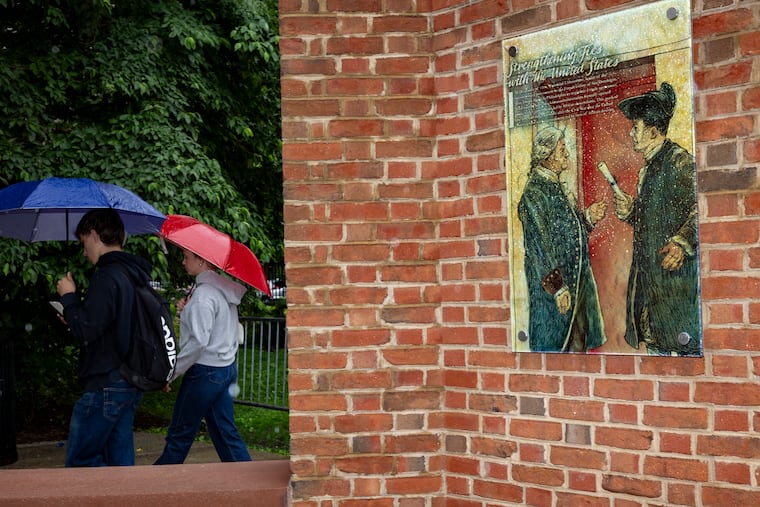
President Donald Trump’s administration is closer to getting its way after a Boston-based appeals court said it doesn’t have to restore exhibits it removed — at least for now.
The Boston-based U.S. Court of Appeals for the First Circuit ruled the National Park Service does not have to restore all exhibits it removed as part of its “restoring sanity to American history” push before the nation’s 250th anniversary celebration, issuing an administrative stay on a lower court’s order.
That order protected the historic site of George Washington’s Philadelphia residence on Sixth and Market Streets from further changes after the U.S. Court of Appeals for the Third Circuit ruled last week that Philadelphia does not have the right to dictate the content of exhibits at the President’s House. The exhibits were dismantled by the Trump administration earlier this year.
But it remains to be seen whether the stay allows the Trump administration to install the newly proposed panels, which historians say whitewash Washington’s culpability in enslaving nine people at his Philadelphia home.
In a statement, the Department of the Interior responded: “We are confident that as this inferior ruling from an activist lower court judge receives further scrutiny, they will be further restrained.”
Administrative stays are common steps federal courts take to buy time while judges assess the arguments.
The First Circuit judges intend to rule “promptly” on a request for a more permanent stay during the appeal, the order says.
Either way, the ruling marks a second blow in a week to the City of Philadelphia and stakeholders who developed the President’s House Site.
Michael Coard, attorney and founder of Avenging the Ancestors Coalition, which is leading efforts to protect the President’s House, emphasized that the First Circuit action was not a final decision.
“The stories of enslaved African descendants and other historically marginalized communities are American history and deserve to be preserved and told truthfully,” he said.
Here is what you need to know about the status of the President’s House exhibits.
What do Boston-based courts have to do with the President’s House?
Earlier this year, conservation groups sued the Trump administration in federal court in Massachusetts challenging Interior Secretary Doug Burgum’s 2025 order implementing the president’s directive to ensure that no displays at national parks “inappropriately disparage Americans past or living.”
U.S. District Judge Angel Kelley this month temporarily blocked the National Park Service from removing or altering content at parks across the country, and required the agency to restore before July 4 all exhibits that had been removed.
The Trump administration’s changes to exhibits “seek to rewrite the Nation’s history with a white-out pen,” wrote Kelley, a nominee of former President Joe Biden.
At least 50 exhibits were removed from more than 30 sites nationwide, according to court records.
Justice Department attorneys appealed the ruling to the First Circuit and asked the higher court to issue an administrative stay or a stay for the duration of the appeal.
The three judges assigned to the case — Chief Judge David J. Barron, appointed by Barack Obama, and Biden appointees Gustavo A. Gelpí Jr. and Julie Rikelman — issued the administrative stay Tuesday pausing the majority of Kelley’s order, including the directive to restore sites such as the President’s House.
The order is not explicit on whether the National Park Service can make changes to sites, but administrative stays are viewed as a way to preserve the status quo while the appeals court can review the facts and arguments in a case.
“The administration’s decision not to reinstall and reinstate censored materials, particularly in advance of our nation’s upcoming 250th anniversary, is a disservice to every park visitor this summer and to the broader American public,” the conservation groups, represented by Democracy Forward, said in a statement.
What did the Third Circuit rule?
The First Circuit ruling comes on the heels of the Third Circuit’s reversal of a February order entered by a Philadelphia federal judge.
Judge Cynthia M. Rufe issued an injunction that required the Trump administration to restore the President’s House to its form before the abrupt Jan. 22 removal of exhibits.
» READ MORE: Trump administration can install its own slavery exhibits at President’s House, Third Circuit rules
A three-judge panel disagreed with Rufe, finding that Philadelphia gave up its rights over the President’s House when it donated the site to the National Park Service. The judges further said the federal government’s proposed replacement panels were “full of historical context.”
What are the city’s options?
After the Third Circuit ruling, Mayor Cherelle L. Parker said she would “pursue every legal action possible in efforts to reverse this decision.”
The city has a few options, but time is running out for a favorable ruling before July 4.
The city could ask for a rehearing in front of the same three judges who unanimously ruled to overturn the injunction. It can also ask for a hearing in front of the full Third Circuit court, known as en banc, or ask the U.S. Supreme Court to intervene.
Philadelphia Law Department attorney Anne Taylor argued at the Third Circuit hearing that the federal government’s attack on these exhibits has caused irreparable harm as the city tries to tell its story ahead of next month’s 250th celebrations.
Philadelphia is expecting a flood of visitors for the Semiquincentennial celebration, Taylor said, adding: “The President’s House is at the doorway to the Liberty Bell. That history is not being told to all the people who are expected to come here.”
It could be challenging, or even impossible, to get a new panel of circuit judges or the Supreme Court justices briefed on the case to get a ruling in less than two weeks, legal experts said.