How the Trump administration’s proposed panels would change President’s House
The federal government's envisioned changes for the President's House glosses over the brutal treatment of enslaved persons and dilutes George Washington's role as an enslaver.
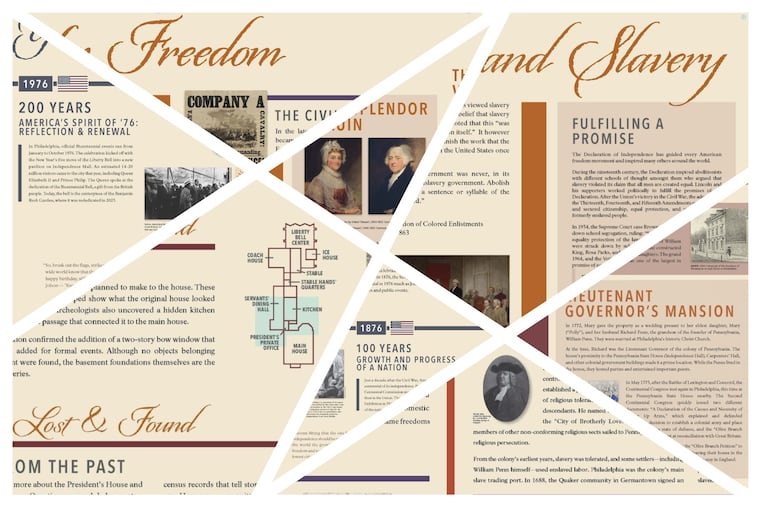
President Donald Trump’s administration quietly unveiled online last week how it planned to sanitize history at the President’s House Site in Philadelphia after having taken wrenches and crowbars to the historical site earlier this year.
Among various changes, the digital renderings uploaded Tuesday to the government-owned President’s House website cast George Washington’s enslavement of nine individuals at his Philadelphia residence in a more favorable light ahead of the nation’s 250th anniversary celebrations this summer.
Of the 11 proposed panels, only two reference the enslaved individuals who lived at the President’s House.
And while the information presented is not inaccurate, historians say the proposed panels fail to focus on the treatment of the people Washington enslaved at the site, which was the exhibit’s original goal. It also dilutes Washington’s role as an enslaver by providing a broad account of U.S. history.
President’s House stakeholders are troubled by the government’s proposed version of history. The Avenging the Ancestors Coalition — the leading advocacy group to protect the site — said it was “deeply offensive and represents yet another troubling attempt to distort and censor American history.”
“No one person — no president, no administration — has the right to dictate what history we tell,“ said Michael Coard, the group’s leader. ”The truth is not optional. We will not stand by quietly while anyone attempts to erase, distort, or whitewash the reality of slavery and its legacy in this country.”
The federal government is enjoined by a court order from replacing the panels. But the renderings show how the administration wants to frame history ahead of the United States’ 250th anniversary.
The Inquirer analyzed each alternative panel proposed by the federal government and how it differs from the historical exhibits that have been at the President’s House Site for 15 years. Here’s what we found:
George Washington’s torment over slavery
The core of the controversy over the President’s House is the spotlight the original exhibit shed on Washington. Trump’s 2025 executive order on “restoring truth and sanity to American history” called for a review of displays at national parks that “inappropriately disparage Americans past or living.”
In the only panel that dives into Washington’s enslavement of people at the President’s House, the proposed rendering portrays the first president in a more sympathetic light. It tells a story of a man who opposed slavery, but was entangled with the institution financially and had a responsibility to keep the union together. The narrative ties neatly in a bow with Washington’s deathbed wish that his slaves be released.
The general of the continental army was “caught between his private doubts about slavery and his public responsibilities as president,” one panel says, adding that privately he “often expressed discomfort with the institution and a desire to see it abolished.”
The truth is more complex, according to historian John Garrison Marks, the author of the book Thy Will Be Done: George Washington’s Legacy of Slavery and the Fight for American Memory.
While Washington wrote privately about his support for abolition, he schemed to ensure the people he enslaved could never take advantage of Pennsylvania’s gradual abolition law.
And when Ona Judge escaped, Washington worked relentlessly to recapture her.
“Those aren’t the actions of someone who feels this deep moral commitment to ending slavery and recognizing slavery’s evil,” Marks said.
Washington’s relationship to slavery represents a paradox, one that cannot be solved by telling his life story as a straight line toward becoming an anti-slavery champion with his final act, the historian said.
“We just need to be honest about the history,” Marks said. “There is no getting past this ambiguity and this complexity, and so instead, we should be leaning into it.”
The brutality of slavery
One of the most sobering parts of the President’s House is its thorough account of the horrors that people enslaved endured.
But when the Trump administration dismantled the site earlier this year — only to later restore most of it by a judge’s order — it took down panels like “Life Under Slavery,” which says “enslaved people were often beaten to break their spirits and whipped to compel them to obedience.”
“Owners were free to beat, torture, or rape the people whom they enslaved,” the panel also said.
The account of this moment in the newly revealed panels glosses over the brutality, and instead offers tidbits that appear to be an attempt to soften reality.
“Slaves living in the President’s House experienced a greater modicum of autonomy than elsewhere in the South such as to explore the city and sometimes even attend the theater, with Washington buying the tickets,” reads a panel called “Presidents Washington and Adams on Slavery.”
Mijuel Johnson, a history tour guide with the Black Journey, noted the inaccuracy of using a word like autonomy, noting, “you have no self-governance as a slave.”
The government’s proposed changes are just as much of an insult as the dismantling of the site in January, Johnson said.
“It’s a desecration of the memorial itself,” he said. “Because the panels that were made for the memorial are just that. They were the ones that were made for the memorial they were made for this specific site. They were all thoroughly researched, all thoroughly critiqued and detailed.”
A broad view on history
The first two panels uploaded provide a general overview of U.S. history and its celebration of milestones, such as the 100th, 150th, and 200th anniversaries of the nation.
Three panels discuss the institution of slavery broadly and the fight for abolition. The renderings mention early Philadelphia abolitionists, and national civil rights icons such as Frederick Douglass, Harriet Tubman, and the Rev. Dr. Martin Luther King Jr.
Critics of the new panels say the broad overview misses the original exhibit’s intent.
“The President’s House site was specifically designed as a memorial to nine enslaved people at George Washington’s Philadelphia residence,” Ed Stierli, senior Mid-Atlantic regional director for the National Parks Conservation Association, said in a statement. “The administration’s efforts to dismantle this exhibit earlier this year were nothing short of an attempt to erase American history and hide the truth from the American people.”
Neglecting to draw from the details known about the people Washington enslaved also wastes a rare opportunity, Marks said.
“There are very few places where we can discuss enslaved people with the kind of detail and specificity of the people enslaved by Washington,” the historian said. “And there are even fewer cases where we can tell those stories at the very site of enslavement where they occurred.”
Lacking the full story
Most of the new panels do not acknowledge the people Washington enslaved. Of the 11 proposed panels, only two reference the enslaved individuals who lived at the President’s House.
On one panel simply titled “The President’s House,” the Trump administration details the ins and outs of William Penn’s grandson residing there or Benedict Arnold living on this property while writing his traitorous correspondence.
And in a trio of displays called “History Lost & Found,” the Trump administration focuses on how the 2007 archaeological dig of the site worked and discovery of primary sources documents it presents as non-controversial: Washington’s letters and a map of the property.
Unlike the original panels about the archaeological dig, the new ones have no mention of slavery, the nine people Washington enslaved, or the National Park Service’s initial apprehension about helping to develop the memorial.