Trump administration gets final legal OK to install own panels at President’s House, city appeals
The Third Circuit Court of appeals took the final procedural step Friday. It was not immediately clear when the Trump administration would move to install its panels.
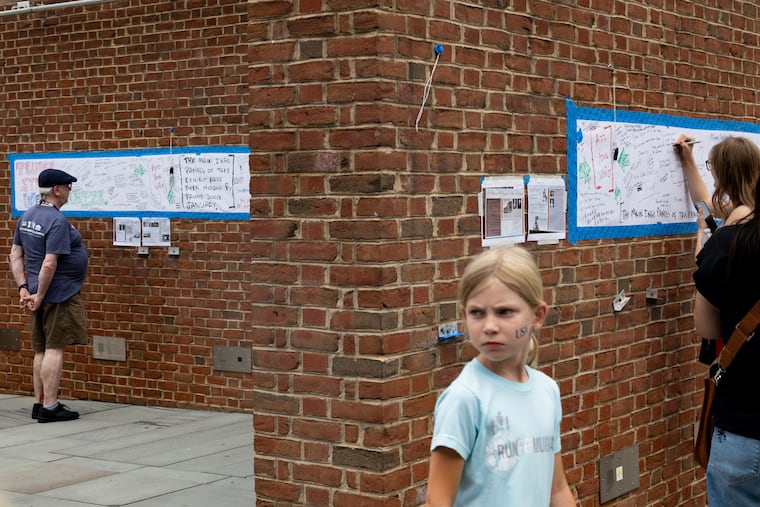
A Philadelphia-based federal appeals court gave President Donald Trump’s administration the final go-ahead to install its own exhibit at the President’s House.
The new panels, which historians have criticized for whitewashing George Washington’s role in enslaving nine people, have been manufactured and stand ready to install, the Justice Department told the court.
The procedural step, which the U.S. Court of Appeals for the Third Circuit took on an observed federal holiday, followed a Thursday request by Justice Department attorneys to allow the National Park Service to “begin work immediately and install its new exhibits.” The Third Circuit ruled last month that the city has no rights over the President’s House.
“The President’s House is an important national historical site, and the Government submits that the President’s House exhibits should be fully installed without further delay,” the government’s filing said.
Only two of 11 new panels mention the people enslaved at the President’s House, which was the exhibit’s original purpose. The exhibits are not factually wrong, historians said, but cast Washington in a more sympathetic light.
“Slaves living in the President’s House experienced a greater modicum of autonomy than elsewhere in the South such as to explore the city and sometimes even attend the theater, with Washington buying the tickets,” one panel reads.
The city quickly appealed and asked the Third Circuit court to recall the Friday-morning order, saying it didn’t have time to respond to the Justice Department’s Thursday request.
And while the federal government asked to install the exhibits “immediately,” the request did not identify a reason for the rush.
“That is not an emergency,” the city’s filing said, “it is a preference for speed.”
The court shouldn’t have issued its final approval for changes without waiting the 90 days Philadelphia had to appeal last month’s order, the filing said.
The city also repeated the argument, which has not found purchase with the appellate judges so far, that allowing the Trump administration to install its own exhibit would cause the city and public irreparable harm.
The city’s motion does not automatically pause the court’s order.
But in addition, the city filed a motion for a stay, while the Third Circuit considers the appeal, with District Judge Cynthia M. Rufe, who issued the now-vacated injunction ordering the Trump administration to restore the exhibits it had removed.
The city and the Department of the Interior did not immediately respond to requests for comment.
The President’s House has been subject to litigation in federal courts since the Trump administration dismantled the slavery exhibit in January.
It has been in legal limbo in recent weeks because of litigation in a Boston federal court, where conservation groups sued to stop the Interior Department’s implementation of Trump’s 2025 executive order requiring no national parks displays that “inappropriately disparage Americans past or living.”
At least 50 exhibits were removed from more than 30 sites nationwide, according to court records. Among them are also mentions of slavery at Independence Hall and the Second National Bank of the United States that the Trump administration quietly removed.
A federal judge in Boston last month ordered the National Park Service to restore all removed exhibits to parks across the nation. But the Court of Appeals for the First Circuit disagreed and stayed that order Thursday.
Hours later, Justice Department attorneys asked the Philadelphia-based federal court to clear the final procedural step — and the court obliged before noon Friday.
The biggest question remaining is whether the Trump administration will attempt to install the panel during this historic July 4 weekend marking the United States’ 250th anniversary.