Trump administration quietly removed mentions of slavery from Independence Hall, Thomas Jefferson portrait
The Inquirer's discovery of these changes come as Philadelphians are grappling with the Trump administration's attacks on the President's House site.
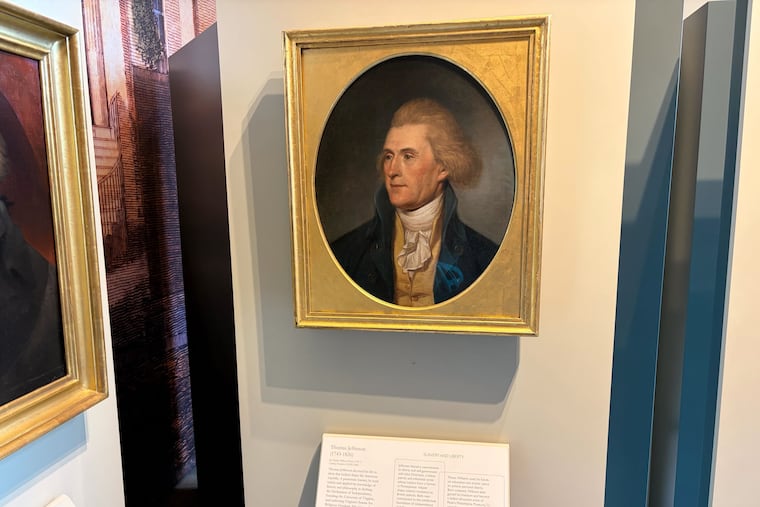
President Donald Trump’s administration has wiped almost all mentions of slavery from a panel accompanying a portrait of Thomas Jefferson at the Second Bank of the United States.
As the Founding Father who wrote the words “all men are created equal” while enslaving more than 600 people throughout his life, Jefferson embodies the paradox at the heart of the revolutionary era.
The description under his iconic portrait attempted to grapple with that tension.
Despite Jefferson’s lifelong pursuit of knowledge, he “never solved the problem of slavery“ and was ”unable to determine how to let go of the notorious system," the original plaque read.
But a new panel simply states that Jefferson’s “vision of an informed, self-governing citizenry was central to his belief that education and liberty were the foundations of an ideal government,” among other changes.
It’s not the only change the administration has made to exhibits around Philadelphia’s Independence National Historical Park ahead of the 250th anniversary.
A touchscreen with a virtual tour of Independence Hall’s second floor now tells visitors that one of the rooms was used to hold “individuals accused of crimes of the period” before their court hearings.
Who were these individuals? A previous version stated clearly: “accused fugitives from slavery.”
The Second Bank and Independence Hall sites — in addition to the President’s House, where slavery exhibits were dismantled by the federal government earlier this year — had been scrutinized by the administration since last summer.
While the changes are more subtle than those that took place at the President’s House in January — and the new exhibits the government proposed a few months later — they further underscore the Trump administration’s goal to sanitize U.S. history, as signified by his executive order to review or remove content at national parks that “inappropriately disparage Americans past or living.”
They also show a lack of transparency. The change to the description under Jefferson’s portrait was only acknowledged following a demand by a federal judge in Boston that the National Park Service share a list of all removals the administration undertook to comply with Trump’s “restoring truth and sanity” edict ahead of the country’s 250th celebration.
In a statement Monday, Avenging the Ancestors Coalition — which has helped lead the efforts to protect the President’s House — said the additional changes were “extremely troubling.”
“The preservation of history requires ongoing vigilance,” the organization said. “Restoring historical interpretation is only one part of the work; protecting it from future revision or erasure is equally important.”
Cheryl LaRoche, a historical and archaeological consultant who helped excavate the President’s House during its development in the early 2000s, said the changes were like “somebody committing murder and wiping the murder weapon clean, so that there is no trace.”
“One of the greatest disappointments of my life, is that we get to the 250th anniversary of this country, and we are still trying to evade the truth of our founding,” LaRoche said.
Among the most blatant examples of the federal government’s desire to retell history has happened at the President’s House, which opened almost two decades ago to memorialize the nine people George Washington enslaved at his Philadelphia home. It also serves as a symbol of exploring the stark juxtaposition of slavery and liberty during the nation’s founding.
But the moves at the Second Bank and Independence Hall signify that the administration is not letting any stone go unturned when it comes to ridding or softening even smaller mentions of slavery at Philadelphia’s most iconic historic sites.
The Department of Interior did not answer repeated questions about the changes.
“No changes have been made,” a spokesperson said via email, citing the President’s House litigation. When an Inquirer reporter pressed again about changes to Independence Hall and the Second Bank, the government spokesperson repeated that there were no changes to the President’s House during the litigation. The Department of Interior did not respond to further inquiries.
At the Second Bank, the panel under Jefferson’s iconic portrait also informed visitors about the population of persons enslaved in 1776, that John Dickinson — a member of the Continental Congress — was an enslaver, and about the life of Moses Williams, an artist who was enslaved at birth and later became a free man.
That’s drastically changed in the new panel.
Jefferson’s grappling with slavery is no longer present and Dickinson is referred to as a “fellow patriot and influential writer. ...” The only mention of slavery remaining is Williams’ story, though it’s reworded.
And at Independence Hall, the touchscreen kiosk describing the second floor Committee of Assembly Chamber previously outlined the irony of the space being used for ratifying the U.S. constitution and later housing the office “where accused fugitives from slavery were held before their hearings, right above the room where the Declaration of Independence had been signed.”
But the reference to slavery has been removed, among other rewordings.
It remains unclear when these changes were made. The Inquirer reported last summer that these items — and an interactive exhibit at the Benjamin Franklin Museum about the Founding Father’s conflicting views on slavery, which is still intact — were flagged for review.
Earlier this month, a federal judge in Boston ordered the Interior Department and National Park Service to restore before July 4 all the removed exhibits nationwide. The order also required the administration to submit to the court a list of all removed items.
An appeal court has since paused the judge’s order, all but guaranteeing that visitors on July 4 won’t see the original exhibits.
» READ MORE: Why a Boston-based appeals court ruling matters for President’s House
In addition to the President’s House exhibits, the list says the administration removed a “portrait description” and cites “disparages Americans past or living” as the reason it is gone.
No entry in the list corresponds to the change made at Independence Hall, which Philadelphia owns.
The city did not immediately respond to a request for comment.
All material changes at Independence Hall should be done after consultation with the city, said Cynthia MacLeod, former superintendent of Independence National Historical Park.
But the Court of Appeals for the Third Circuit ruled that the administration can make changes to the President’s House, which is owned by the National Park Service.
“The National Park service has been known for excellent historians and interpreters and its a shame that they are being muzzled now,” MacLeod said. “It’s a shame and a disservice to all the visitors not to have a more complete history told.”