As the betting industry grows, kids as young as 11 are getting hooked
Experts argue that gambling addiction among youths could be the 'next opioid epidemic.'
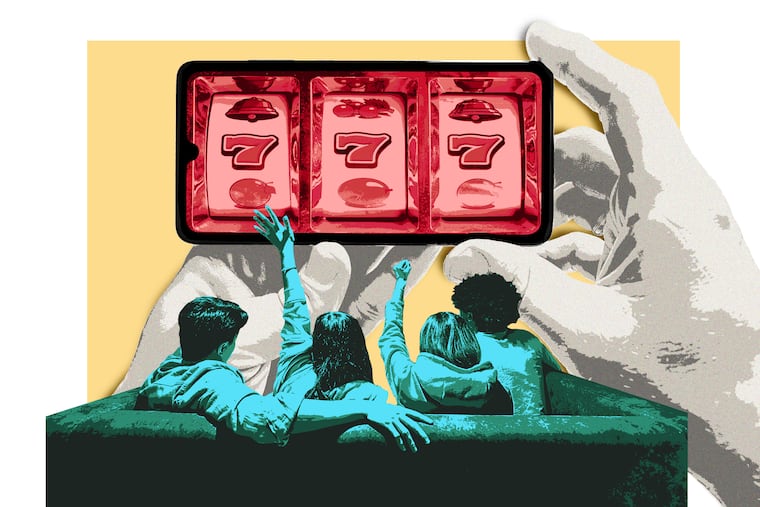
He was just scrolling through TikTok, which overflowed with its usual distractions — recycled memes here, yapping influencers there.
Then John, an eighth grader in Northampton County, spotted something that made him pause. It was an advertisement for an app, Stadium Live, which offered something that for a teenager was ordinarily forbidden: a chance to wager on professional sports.
Apps for popular sportsbook companies like FanDuel and DraftKings cannot be accessed legally by anyone who is under 21. Stadium Live resembles those apps but describes itself as a prediction game. Its users wager virtual coins, instead of real money, to bet on players, teams, and random occurrences, like whether Houston Rockets forward Kevin Durant’s bald spot would be visible on television.
Anyone can download and use the app — even a kid.
John — who agreed to speak freely with The Inquirer about a sensitive matter if he was not identified by his full name — knew other boys who played. It seemed fun. “RISK NOTHING,” reads a preview for Stadium Live in Apple’s App Store. “WIN FOR REAL.”
Who doesn’t like fun?
Stadium Live offers 5,000 digital coins and a free seven-day trial to new users. After that, customers can pay $7.99 a month to continue using the app. They win or lose digital coins on bets, but can purchase additional coins with a credit card.
John gave the app a whirl. His phone began to ping several times a day with notifications from Stadium Live urging him to return, a practice that public health advocates say has helped make legal sports betting apps dangerously addictive.
Nothing about it seemed improper. At school, he said, he knew boys who were using adult sports betting apps, and growing irate as they lost actual money.
Gambling companies and prediction markets have evolved into an inescapable feature of everyday life, rendering Hollywood awards shows, professional sports, and even the deaths of foreign leaders topics that can be wagered upon.
Younger Americans are especially vulnerable to the industry’s allure. In 2025, 36% of boys ages 11 to 17 reported that they had gambled during the previous year, a Common Sense Media study found.
Of the 1,017 boys who participated in the San Francisco-based nonprofit’s research, 49% said they had encountered gambling content on the social media platforms that they used. Nearly 60% said the content appeared even when they had not searched for it.
“Boys are gambling in large numbers, and well before they’re even eligible to vote,” said James Steyer, Common Sense Media’s founder and CEO. “To us, that’s a shocking wake-up call to every parent out there, but also, quite frankly, to gambling platforms, to leagues — like the NFL, the NBA, and MLB — and to television networks and social media platforms that are constantly putting gambling content in front of kids.”
During the three years prior to the legalization of sports gambling in Pennsylvania, the number of juveniles who called the Pennsylvania Council on Compulsive Gambling for help was just seven, records show. Since Pennsylvania began accepting legal sports wagers in 2018, at least 48 juveniles ages 13 to 17 have sought help from the council. And of the 2,959 calls that the council received in 2025, 32% were from people ages 18 to 34.
That tally is likely an undercount: 6,608 people who last year called the council’s helpline — 1-800-GAMBLER — hung up when someone answered, while 749 who spoke to an operator refused to disclose their age.
State officials have a limited picture of underage gambling activity, especially in Philadelphia.
A survey of sixth, eighth, 10th, and 12th graders, conducted every other year by the Pennsylvania Department of Education and other agencies, shows that 15.5% of those students in Philadelphia county had gambled “for money or anything of value” in 2025, below the state average of 18.4%.
But those data are based only on students at 105 local charter and parochial schools, because Philadelphia public schools did not participate in the survey.
In 2023, the same survey found that 25.6% of participating charter school students had gambled, well above the state average. (No explanation is offered for the decrease in gambling behavior. But in previous years, fewer schools participated in the survey.)
Gambling is not the only industry that can influence a young person’s behavior. Online video game platforms and social media companies have also been linked to harmful impacts on adolescents, whose prefrontal cortex — the area of the brain that helps a person assess risk, maintain focus, and manage emotions — is not fully developed until about age 25.
Placing bets and questing for items in video games — like loot boxes in Roblox — each result in similar, immediate dopamine spikes, said Frank James, a psychiatrist with the Department of Child and Adolescent Psychiatry and Behavioral Sciences at Children’s Hospital of Philadelphia.
“When a kid’s reward system is immature, then it actually causes them to experience a craving for that dopamine release,” James explained. “When parents have described to me behaviors that they’re concerned about, they mimic symptoms that I’d see in someone I would treat for opioid addiction or alcohol addiction.”
Last fall, John told a relative, Greg Krausz, that he was using Stadium Live to bet on sports. Krausz was well positioned to help: He works as the director of training and education for the state’s compulsive gambling council.
He asked to see John’s betting history with Stadium Live.
“I lost a lot more [bets] than I won,” John acknowledged during a recent interview.
Krausz explained to him that the odds would always favor companies that were offering betting services. John’s interest in the app later waned.
“I don’t really think that I would want to gamble now,” he said.
Krausz, through his work with the council, said he has found that some teens are able to access adult betting platforms because parents allow them to use their accounts. Among the boys who told Common Sense Media that they were already gambling, 23% reported that their parents had given permission to use their credit cards.
“Some parents, as you talk to them, they don’t see the big deal,” Krausz said. “But it’s illegal, and it creates a good deal of risk for everybody involved.”
The power of saturation
Citizens Bank Park was teeming with children on a cloudless Sunday afternoon in mid-April. They had toddled through turnstiles with their parents to witness a pregame birthday celebration for the Phillie Phanatic.
The Phanatic and a group of googly eyed mascots played and tumbled on the outfield grass, and the little ones let out appreciative cheers.
It was the type of event that is meant to help a new generation of fans fall in love with coming to the ballpark. But even in this setting cultivated for a young audience, the kids were not free from the gambling industry’s reach. Slender digital boards that wrapped around the seating levels displayed ads for theScore Bet, “an official sportsbook of the Phillies.”
A Phillies spokesperson did not respond when asked if the team had a comment.
Major League Baseball, which once shunned players who were involved with gambling, entered into its first partnerships with sports betting companies in 2019. Those arrangements this year grew to include a partnership with the prediction market Polymarket. The deal could be worth as much as $300 million to MLB, Front Office Sports has reported.
Televised games display betting odds for individual players, as if they are just another statistic to consider beyond home runs and strikeouts.
Michael Robb, the head of research for Common Sense Media, led the nonprofit’s study of 11- to 17-year-olds’ betting activity. Robb said gambling content has “saturated” adolescents’ lives.
“They see a ton of advertising on live sports broadcasts and at any major sporting event they attend. These companies are trying to appeal to adults, but the ads are visible to kids,” he said. “All of that saturation helps to make gambling seem like a normal part of everyday life. But it didn’t used to be this way.”
The tobacco industry once occupied a similarly ubiquitous position in professional sports. Its logos appeared in stadiums, and athletes helped pitch products like chewing tobacco, which companies explicitly sought to market to young fans in the 1970s.
In 1998, the four largest tobacco companies — facing nationwide litigation over the harm their products caused to consumers’ health — entered into a master settlement agreement with the National Association of Attorneys General. The companies paid more than $200 billion to 46 states, including Pennsylvania, and were prohibited from marketing their products to adolescents.
Getting the companies to consent to those advertising restrictions was “something that we needed to have,” said D. Michael Fisher, who was Pennsylvania’s attorney general at the time and is now a senior judge on the U.S. Court of Appeals for the Third Circuit.
The agreement meant an end to athletes appearing in magazine ads for cigarette companies, as Baseball Hall of Famers Joe DiMaggio, Mickey Mantle, and Jackie Robinson once had, or in television commercials hawking chewing tobacco, like Red Sox catcher Carlton Fisk did in the late ’70s.
Those promotional relationships have now been replicated between sports betting companies and some of the most recognizable stars of the last 30 years.
BetMGM counts among its ambassadors former NHL great Wayne Gretzky and former Yankees shortstop Derek Jeter. FanDuel offers a slot game called Gronk’s Touchdown Treasures, named after ex-New England Patriots tight end Rob Gronkowski.
In 2023, Sixers legend Allen Iverson appeared in a DraftKings commercial with the comedian — and North Philly native — Kevin Hart. Dressed in a black hoodie and matching headband, Iverson stands on a basketball court, ball in hand.
“This instant offer is kinda like my crossover. Just place your bet,” Iverson says, as the camera cuts abruptly to him sinking a shot over a fallen opponent, “and it’s money!”
Active players, like Los Angeles Lakers star LeBron James, also promote DraftKings, while Milwaukee Bucks forward Giannis Antetokounmpo earlier this year became a minority shareholder in the prediction market Kalshi.
From pool hall bookies to phone apps
States are just beginning to wrestle with how to address the gambling industry’s visibility to young people.
New Jersey earlier this year adopted a law that requires public universities to educate students about the risks of gambling addiction at least once a semester. A bill in the state Senate would expand such education efforts to high schools as well.
In March, the Pennsylvania Gaming Control Board promoted an advertising campaign called “What’s Really at Stake” to raise awareness about underage gambling.
The board cited research that found 75% of college students had gambled — illegally or legally — during the last year, with as many as 6% of students meeting the criteria for a gambling problem.
Last spring, Republicans and Democrats in Pennsylvania’s state House overwhelmingly approved a resolution, introduced by Rep. Tarik Khan, that directed a joint state government commission to study how sports betting platforms use promotions, in-game advertisements, and celebrities to attract customers.
The report, which is expected to be provided soon to lawmakers, is required to also explore kids’ exposure to gambling advertisements.
“We need to understand the scope of the problem,” said Khan, a Democrat who represents Philadelphia’s 194th Legislative District. “And then we have to look at recommendations on how we can improve regulation, and protect people’s health and well-being.”
Another state legislator, Sen. Wayne Fontana, introduced in 2024 a pair of bills that would prohibit the use of credit cards for online casino games and sports betting, and another that would restrict gambling companies from contacting Pennsylvanians who added their names to the state’s betting self-exclusion list.
Neither advanced beyond the Senate’s Community, Economic and Recreational Development Committee.
Fontana, who grew up in Pittsburgh during the 1950s and ’60s, recalls having “a bookie in every bar” and coin-operated machines in pool halls for adults who were looking to get a gambling fix.
Not quite the stuff of Norman Rockwell, but quaint compared with the modern gambling industry’s omnipresence in American culture.
“You see young people with their phones,” the Democrat said, “and they’re betting on every little thing they can.”
Fontana argues that the state should be reacting with more urgency to address the growing number of bettors whose lives are unraveling because of addiction.
A recent Pennsylvania State University report on online gambling found that as many as 6.4% of adults in the state are problem gamblers, a figure that would represent more than 667,000 people.
“I hope it isn’t just about how much money we’re making,” Fontana said of the state, which last year collected $2.9 billion in tax revenue from the gambling industry. “We still have an obligation to do the right thing.”
Down the rabbit hole
Frank James, the CHOP psychiatrist, sees risk in many digital domains that children explore.
Social media platforms, prize-driven video games, and apps that mimic gambling each have the potential to reshape a young person’s psyche.
“All of these things are connected to algorithms that surface whatever rabbit hole it brings you down,” he said. “There are thousands of kids out there who have problems with gaming and social media.”
As with the tobacco industry a generation ago, courtrooms are serving as a battleground to address harm.
In March, a New Mexico jury ordered Meta, the parent company of Facebook and Instagram, to pay $375 million for harming children’s mental health and concealing its knowledge about child sexual exploitation on its apps, the Associated Press reported.
That same month, a Los Angeles jury ordered Meta and Google to pay $6 million to a woman who attributed her struggles with depression and anxiety to having used the companies’ products as a child.
Earlier this month, Meta, Google, and TikTok agreed to settle a lawsuit they faced in Kentucky, where a school district had sued the companies over social media addiction among kids. The companies reportedly face more than 1,200 similar cases across the U.S.
Phil Waibel, a therapist who treats gambling addiction across Pennsylvania, said he has worked with 18- and 19-year-old patients who had already been gambling for years by the time they sought help.
Some of his patients described buying waterproof covers for their phones so that they could continue placing bets in the shower.
“This is the next opioid epidemic,” Waibel said. “It’s coming, and it’s deadly serious.”
Addiction is at the heart of a legal battle between the NCAA and Brendan Sorsby, a Texas Tech quarterback who is facing a permanent ban from college football for having admitted that he placed bets on Indiana University while playing for the school as a freshman.
Sorsby, who recently completed treatment for a gambling addiction, has sued the NCAA. With the support of the university, he sought to be reinstated for the 2026 season, an appeal that the NCAA denied last week.
The quarterback, a senior who stood to be paid more than $4 million by Texas Tech, has accused the NCAA of hypocrisy, noting that the association licenses statistical information to Genius Sports, a data company that in turn supplies the figures to betting platforms.
Sorsby is not the only young adult whose life has been upended by a gambling addiction.
On Sept. 2, 2024, about 18,000 spectators watched a U.S. Open Women’s Division tennis match between Jasmine Paolini and Karolína Muchová at Louis Armstrong Stadium in Queens.
As the match neared an end, Paolini was in danger of losing.
Then, at 12:12 p.m., the U.S. Tennis Association received a direct message through Twitter. “I’m inside Louis Armstrong with a bomb that will go off at 1pm est,” the message read.
Police and emergency personnel scrambled to search the stadium.
The sweep turned up no explosive devices. The tennis association had been the victim of a hoax.
Federal investigators began following a digital trail for the Twitter user who had submitted the threat and used the profile name @GetchiSoto. It led to similar accounts on other social media and gaming platforms — Instagram, Reddit, PlayStation, xBox — and sports betting sites as well.
The person behind the account and the bogus bomb threat proved to be an 18-year-old Lancaster resident named Aidan Getchius.
Getchius had placed a bet on Paolini to win the match, and sought to disrupt the match once it seemed Paolini might lose, according to federal court records.
“The fact that one person, through one impulsive and sinister text, can so easily inflict potential mass scale fear, disruption and damage demonstrates the seriousness of this case,” Josh Davison, the assistant U.S. attorney who prosecuted the case, wrote in a sentencing memo.
Yet Davison also wrote that Getchius, who is now 21, had otherwise been a law-abiding young adult, one whose actions had been “heavily influenced by his sports gambling.”
“This addictive and costly habit led Getchius to lash out, lose control, and commit a reckless and thoughtless act with little to no appreciation of the consequences.”
Getchius’ attorney could not be reached for comment.
In November, Getchius pleaded guilty to one count of conveying false information and hoaxes. He faced as much as five years in federal prison.
On May 21, U.S. District Judge John M. Gallagher sentenced Getchius to three years’ probation, a $1,000 fine, and a $100 assessment.
Getchius’ probation includes a handful of requirements, like submitting to occasional drug tests, undergoing a mental health evaluation, and sharing information about his income with a probation worker.
The judge tacked on an additional condition: For the next three years, Getchius is prohibited from placing a bet.
Staff writer William Bender contributed to this article.
The Inquirer will continue to report on issues related to the growth of gambling addiction — among teens and adults — across Pennsylvania. If you, or someone you know, wants to speak with a reporter, please contact David Gambacorta or William Bender at dgambacorta@inquirer.com and wbender@inquirer.com

The Inquirer’s journalism is supported, in part, by the Lenfest Institute for Journalism and readers like you. News and editorial content are created independently of The Inquirer’s donors. Gifts to support The Inquirer’s high-impact journalism can be made at inquirer.com/donate. A list of Lenfest Institute donors can be found at lenfestinstitute.org/supporters.