An 11-year-old said the Eagles should fire Kevin Patullo. Then they did. Coincidence? | Weekly Report
This week’s Philly report card, grading the good, bad, and weird news coming out of our region.
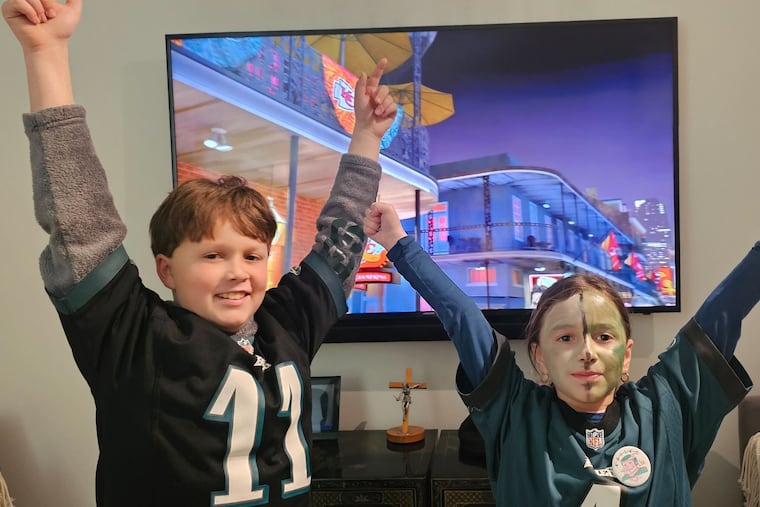
An 11-year-old Eagles fan accidentally runs the coaching search: A+
Philadelphia spent months debating offensive schemes, internal hires, and whether continuity was actually just stubbornness. Then an 11-year-old was handed a microphone and solved it in one sentence.
Sam Salvo didn’t deliver a nuanced breakdown of route trees or personnel groupings. He didn’t cite EPA or All-22 tape. He simply announced — with the confidence of someone who has never had to answer a follow-up question — that Kevin Patullo should be flipping burgers at McDonald’s. Philly nodded in unison.
The funniest part isn’t that it went viral. It’s that a day later, Patullo was gone, and the city collectively decided the kid deserved at least partial credit. In a town where people once egged an offensive coordinator’s house (too far), this somehow felt like the healthier outlet.
Sam’s rant worked because it was pure, unscripted Philly logic: blunt, emotional, metaphor-heavy, and somehow accurate. “One-half cooked, one-half raw” is not just a roast, it’s a season recap. And when he popped back up afterward saying, “I just wanted to say anything that could get him fired. And it worked,” it sounded less like a joke and more like a performance review.
The follow-up reactions only added to the lore. Fans celebrated. Former players debated scapegoating. Someone somewhere probably floated Big Dom calling plays. And the Eagles, intentionally or not, let the internet believe that an 11-year-old helped nudge a major coaching decision.
Philly collectively supports hexing an ex (with rules): A
At some point this winter, Philadelphia decided that asking a witch to curse your ex (politely, creatively, and without touching his health or love life) was not only acceptable, but deeply relatable.
The flier itself did most of the heavy lifting. “Seeking: Experienced Witch to Curse My Ex,” stapled to poles from Phoenixville to Fishtown, with a list of curses so specific and mild they felt less like dark magic and more like emotional Yelp reviews: thinning hair, damp bus seats, buffering Wi-Fi, eternally pebbled shoes. Nothing fatal. Nothing irreversible. Just inconvenience with intention.
Instead of pearl-clutching, the city leaned in. The flier spread through neighborhood Facebook groups and socials, where strangers did what they do best: offered commentary, solidarity, jokes, and unsolicited advice. Some people cheered her on. Some defended the ex. Others asked how it ended. And plenty of women recognized the feeling immediately: that moment after you’ve done the therapy, the journaling, the “being mature,” and still need somewhere for the anger to go. This wasn’t about actually ruining someone’s life. It was about yelling into the city and having the city yell back, “Yeah, that sucks.”
The rules mattered, too. No curses on his health. No messing with his love life. Philly rage has boundaries. Even our hexes come with ethics.
Wawa learns Philly does not want a vibes-only convenience store: C-
Philadelphia has many hard rules, but one of the hardest is this: If you remove the shelves from a Wawa, you are no longer operating a Wawa.
The 34th and Market Street location near Drexel didn’t close because people stopped loving hoagies. It closed because Wawa tried to outthink the entire point of its existence. The fully digital, order-only format asked customers to interact with a screen for everything. No wandering, no impulse grabs, no staring at the Tastykake rack while deciding whether you’re hungry or just bored.
And in Philly, that’s not innovation. That’s friction.
This was once one of the company’s highest food-service locations before the pandemic, which makes the experiment feel even more puzzling in hindsight. People weren’t avoiding this store because they didn’t want Wawa. They were avoiding it because it stopped functioning like one. A convenience store that requires commitment, planning, and patience defeats the entire concept.
The grade isn’t lower because this wasn’t malicious or careless. It was a genuine attempt to test something new. But Philly answered clearly, quickly, and repeatedly: We don’t want a Wawa that feels like an airport kiosk. That’s what will get your store closed.
Saying goodbye to Ranger Suárez hurts, even if it makes sense: B+
This one lands softly and hard at the same time.
Ranger Suárez leaving Philadelphia was never shocking, just quietly devastating. Signed by the Phillies as a teenager, developed patiently, trusted in big moments, and forever tied to the pitch that sent the city to the World Series in 2022, Suárez felt less like a roster spot and more like a constant. You looked up in October and there he was, calm as ever, getting outs without drama.
Now he’s on the Red Sox.
The Phillies weren’t wrong to hesitate on a five-year, $130-million deal for a pitcher with mileage, injury history, and a fastball that succeeds more on craft than velocity. Andrew Painter is coming. The rotation math is real. This is how smart teams stay competitive.
But Philly doesn’t grade purely on spreadsheets.
Suárez embodied a certain Phillies ideal: unflashy, durable when it mattered, unfazed by the moment, and always a little underestimated. He wasn’t the loud ace. He was the steady one. The guy you trusted to calm everything down when the season felt like it might tip.
That’s why this stings. Not because it was reckless to let him go, but because losing someone who felt like a Phillie is different than losing someone who just wore the uniform. Watching him head to Boston is one of those reminders that the version of the team you emotionally commit to is always a few contracts behind the one that actually exists.
OpenTable adds a 2% fee, and Philly sighs deeply: C
Philadelphia understands restaurant math. We’ve lived through inflation menus, pandemic pivots, staffing shortages, reservation deposits, and the great “please cancel if you’re not coming” era. What we don’t love is when the bill quietly grows another line item after we thought we were done reading it.
That’s why OpenTable adding a 2% service fee to certain transactions (no-show penalties, deposits, prepaid dining experiences) landed with more fatigue than outrage. Not rage. Just tired acceptance.
The logic isn’t wrong. No-shows are brutal for small dining rooms, especially in places like South Philly where a missed table can knock a whole service sideways. Restaurants can absorb the fee or pass it on, and in many cases, the platform is genuinely helping places protect their bottom line.
But from a diner’s perspective, this is yet another reminder that convenience now comes with micro-costs layered so thin you barely notice them, until you do. The reservation is free … unless you’re late. Or cancel. Or book a special dinner. Or blink wrong. It’s another reminder that each new surcharge chips away at the simple joy of making dinner plans without feeling like you’re navigating airline baggage rules.
Philly draws the line at selling dinner reservations: A-
Philadelphia has tolerated a lot in recent years: prix-fixe creep, credit card holds, cancellation windows measured in hours, and now, yes, platform fees (see above). But selling a free dinner reservation for profit? That’s where the city finally says no.
The attempted resale of coveted tables at Mawn didn’t just irritate the restaurant’s owners, it offended a basic Philly value system. You can love a place. You can hustle for a table. You can brag that you got one. What you can’t do is turn access into a side hustle and expect people to shrug.
The reaction was swift and very local: public call-out, canceled reservations, and a clear message that this isn’t New York, Miami, or a StubHub-for-dinner experiment. Yes, reservation scalping exists elsewhere, powered by bots and platforms like Appointment Trader. And yes, Philly has passed laws trying to shut that down. But what made this moment resonate wasn’t legislation. It was cultural enforcement. A collective agreement that making money off a free reservation crosses from clever into gross.
Put simply: Waiting your turn is still the rule here. And if you try to flip your way around it, don’t be surprised when the city flips right back.
Amanda Seyfried gives Colbert a very real Allentown community calendar: A
Stephen Colbert has a recurring bit where he asks celebrity guests to promote actual events from their hometowns. When Amanda Seyfried, who grew up in Allentown, took her turn this week, she didn’t try to punch up the material.
She didn’t have to.
Seyfried read through a lineup of events that sounded exactly like a Lehigh Valley bulletin board: all-you-can-eat pasta night, speed dating for seniors, board games at a funeral home, a pirate-themed murder mystery, and Fastnacht Day donuts heavy on lard and tradition. No setup. No apology. Just listings.
That restraint is what made it land. Seyfried treated the segment like she was helping out a neighbor, not auditioning for a tourism campaign.
For viewers around Philly and the surrounding counties, it was immediately recognizable. This is the kind of stuff you scroll past in a local Facebook group or see taped to a coffee shop door without a second thought. Put it on national TV, though, and suddenly it becomes comedy.

- After the Gillian’s closure, boardwalk merchants agree it will never be the same. They want a say in what comes next.
- The Eagles are done. Which team, if anyone, am I allowed to root for now?
- How to have a Perfect Philly Day, according to ‘RuPaul’s Drag Race’ star Mandy Mango
- An 11-year-old said the Eagles should fire Kevin Patullo. Then they did. Coincidence? | Weekly Report
- The best things we ate this week
- She saved $100,000 for a house in Port Richmond| How I Bought This House
- Citywide Quest: Do you know where these Martin Luther King Jr. landmarks are?
- Waterfalls, cabins, art, and eats in Milford, Pa. | Field Trip
- ‘Sex to me is like having anchovies — yeah, I suppose I could, but I’d really rather not.’
- Capturing the sun
