Philadelphia judges order Sheriff Rochelle Bilal to fix deed problem — or they’ll appoint someone who will
The sheriff's office will have to explain at a public hearing why a 'special master' should not be brought in to oversee property auctions and help clear out the backlog of unprocessed sales.
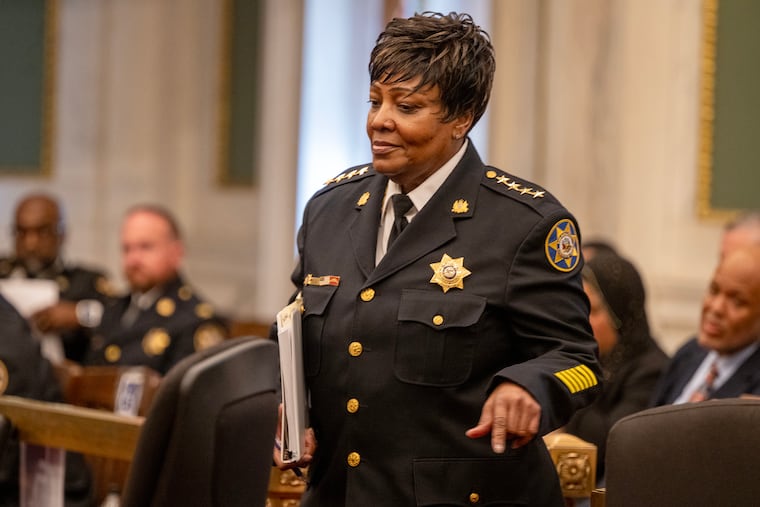
Philadelphia judges are threatening to appoint a “special master” to oversee sheriff sales in the city if Sheriff Rochelle Bilal does not resolve ongoing delays in processing deeds of properties won at auction.
A court order filed Wednesday requires Bilal to submit a detailed accounting of every sheriff sale since she took office in January 2020, as well as a plan for “promptly” handling post-sale payments and delivering deeds to the winning bidders.
Bilal or a representative from her office must also appear at a public hearing before a judge in July to demonstrate why a special master, title agent, or someone with similar expertise in real estate should not be brought in to oversee the auctions and help clear out an extensive backlog of unprocessed sales.
The court order, which was signed by Common Pleas Court Judge Paula Patrick, supervisor of the court’s commerce division, says Bilal’s office appears not to be “timely performing its essential, non-discretionary, ministerial duties, which are mandated by law.”
As a result, the order states, buyers are repeatedly having to petition the courts to obtain deeds to properties they have already purchased. The delays also affect taxpayers by “delaying the productive return of distressed properties to lawful and economically beneficial use,” according to the order.
Bilal did not immediately respond to a request for comment, nor did a spokesperson for the courts.
The court order is a stunning rebuke of the sheriff, who just two weeks ago told City Council that the deed-processing problems had been fixed and sheriff sales were going “full blast.”
Councilmember Cindy Bass, who was running the budget hearing, praised Bilal and suggested that any criticisms of her had been exaggerated.
Philadelphia’s sheriff auctions off thousands of tax-delinquent or foreclosed properties each year, a duty that Bilal has mostly outsourced to an online auction platform, Bid4Assets.
But the sheriff’s office must still process millions in cash owed to banks, the city, and utility providers, then issue signed deeds of sale to winning bidders.
The Inquirer has been reporting since mid-2024 on lengthy post-sale delays under Bilal.
The sheriff has never fully explained the causes of the delays, other than to cast them as a “staffing error” or a temporary hiccup as a new software system was put in place.
“What happened to the deeds is we changed the whole technology system,” she said in a 2025 NBC10 interview. “Because we put this whole new platform in, things had to go manually.”
History of dysfunction
Judge Patrick’s order was issued in response to one of several lawsuits filed against Bilal by property buyers who assert they never got their deeds.
One company, JSB Property Group, demanded in March that the court enforce the terms of a 2003 consent order against then-Sheriff John Green, which requires deeds to be processed within 40 days of settlement.
That older consent order stemmed from a 2002 lawsuit filed by the Pennsylvania Land Title Association, which claimed that under Green, it took the office months or years to complete sheriff sales and distribute auction proceeds.
Much like Bilal, Green disputed the scope of the delays, blaming them on a computer glitch, but he agreed to begin transferring deeds within 40 days, as required by state law. Green was later convicted of accepting bribes and sentenced to five years in prison.
This week’s court order reaffirms that the 2003 decree is still in effect, and cites evidence Bilal may have violated its terms: In one recent lawsuit cited by the order, a plaintiff had to file five court motions to compel the sheriff to complete five sales.
The JSB Property Group lawsuit argued that Bilal had not taken steps to finalize the sale of eight properties the company had purchased for nearly $1 million at auction. It cited Inquirer reporting on other buyers who had similarly waited a year or more for deeds.
“Here we are 23 years later and it’s the same issue,” said Dan Bernheim, an attorney for JSB. “One would think with today’s technology this wouldn’t be such a heavy lift. The problems this causes for everybody are pretty real.”
State Rep. Jared Solomon (D., Philadelphia), who has previously accused Bilal of “administrative malpractice” and called for an overhaul of the sheriff’s office, said in response to Wednesday’s order that he is “preparing articles of impeachment in the event the sheriff continues to defy our courts.”
“The sheriff is not performing the essential duties of the office as mandated by law,” Solomon said.
Buyers contradict Bilal
At last month’s budget hearing, Bilal said any ongoing delays reported in the media were the fault of bidders failing to submit payment or paperwork in a timely manner.
“A lot of the stuff that is being put in the papers is basically twisting the narrative,” Bilal told Councilmember Bass.
Neither Bass nor any other Council member probed further on the issue. Most commended Bilal for how well she runs her office.
Inquirer interviews with a dozen real estate agents, investors, and attorneys following Bilal’s testimony, as well as court documents and city records, showed that the delays have not been resolved and, in some cases, have gotten worse.
“Nothing has really improved,” said Mary Jo Potts, a foreclosure specialist at Elfant Wissahickon Realtors who resells properties after mortgage-foreclosure auctions. She and other real estate agents say they are still waiting up to a year or more for deeds to be recorded, followed by additional delays in settling old tax and utility liens.
The deed-recording process used to take six to eight weeks in Philadelphia.
New data obtained from a major institutional buyer of distressed properties show that, since 2022, Philadelphia had by far the longest processing time of any county in Pennsylvania: Out of 1,700 foreclosure sales across the state, Bilal’s office took an average of 223 days from the date of a foreclosure sale to record a deed, compared with an average of just 38 days in Delaware County.
Moreover, the same data show that a large chunk of that time — 148 days — was spent waiting for Bilal’s office to transmit a cost sheet breaking down various fees and liens that must be paid in advance of a deed transfer. This fairly routine step took an average of 14 days in every county other than Philadelphia.
The lengthy delays have also coincided with a $76 million increase in delinquent property taxes owed to the city since 2019 and have led to foreclosed properties sitting vacant for months or years in limbo.
Both the 2003 order and the Wednesday filing note that the delays also harmed indigent homeowners who had lost property at auction, as they are entitled to any excess proceeds after debts had been paid.
This is the third time Philadelphia’s judges have publicly rebuked Bilal, who was elected in 2019 as a self-styled reformer.
In December 2024, the Administrative Governing Board of the First Judicial District, a panel of judges that oversees Philadelphia court operations, demanded that Bilal address major courthouse security lapses that had delayed criminal proceedings and left judges feeling unsafe.
The Inquirer had reported that September that security incidents in court buildings, such as assaults and threats, had nearly tripled since 2019, the year before Bilal took office.
In March 2025, the judges filed a second court order, saying Bilal had not done enough to address the deputy shortage, resulting in “direct harm to the proper functioning and safe operation and administration of the courts.”
Bilal’s campaign, Friends of Rochelle Bilal, initially sent a fundraising email to supporters that blamed the judges themselves. She later redeployed deputies to better secure court buildings, although that caused temporary problems in the Adult Probation and Parole Department, where deputies had been providing security.
Inquirer staff writer Abraham Gutman contributed to this article.

The Inquirer’s journalism is supported, in part, by the Lenfest Institute for Journalism and readers like you. News and editorial content are created independently of The Inquirer’s donors. Gifts to support The Inquirer’s high-impact journalism can be made at inquirer.com/donate. A list of Lenfest Institute donors can be found at lenfestinstitute.org/supporters.