Jay Maisel, photographer of Miles Davis and much more, dies at 95
He said in a documentary: “I think that my entire motivation and execution and philosophy can be two words: ‘Hey, look.’”
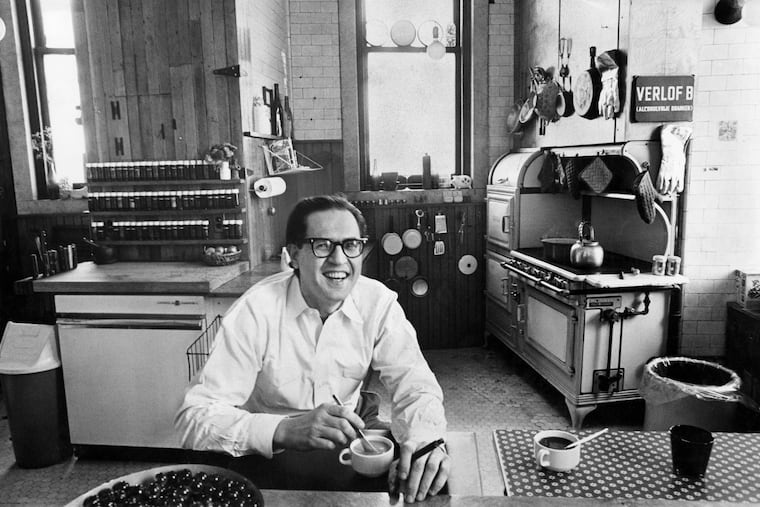
Jay Maisel, a masterly photographer whose dark and moody portrait of jazz great Miles Davis performing at the Apollo Theater appeared on the cover of his landmark 1959 album, Kind of Blue — Mr. Maisel’s best-known work in a long and varied career — died on Aug. 20 at his home in Brooklyn, N.Y. He was 95.
His daughter, Amanda Maisel, said the cause was cancer.
While not necessarily his best photograph — he wished it had been sharper — the Davis picture became part of a portfolio of remarkable depth that included coal miners silhouetted in an eerie glow a mile beneath the earth, the Statue of Liberty surrounded in a mist, and Sports Illustrated swimsuit models.
Mr. Maisel was impossible to ignore: He was 6-foot-1, barrel-chested, charismatic, and profane, with a Brooklyn accent. He smoked cigars and collected stuff to the point of hoarding.
And he spoke passionately — and practically — about his art. “The drama in light exists not only in what is in the light, but also in what is left dark,” he wrote in Light Gesture & Color, his 2015 book. “If the light is everywhere, the drama is gone. When I see light that moves me, that I cannot explain, I won’t leave until I figure it out.”
More simply, he said, in a documentary: “I think that my entire motivation and execution and philosophy can be two words: ‘Hey, look.’”
Mr. Maisel’s picture of Davis reveals him in a splash of light and shows his fingers moving in a blur on his trumpet. Mr. Maisel had taken it for himself; months later, Columbia Records asked if he had any photos of Davis that could be used for Kind of Blue, which music historian Ashley Kahn, writing in the New York Times in 1999, said “floats above jazz history in an ether all its own.”
The Davis photo came early in Mr. Maisel’s color photography career, but he would go on to produce many memorable shots, like a man in a blue uniform, his face unseen, dragging a heavy white and purple rope, against a red wall in Singapore; and a shirtless New York City cabdriver, sunbathing from the open driver’s side door, as if he’d just let out a fare and stripped down.
His many other shots included two men silhouetted against a red wall near the World Trade Center while a street sign says, “Don’t Walk,” and two doves, one white, one black, perched in different sections of a window frame, surrounded by a bright blue wall in Portugal.
“I think of him as being extraordinarily versatile and visually restless,” said John Paul Caponigro, a visual artist and writer who taught in the same workshop programs with Mr. Maisel. “His work was a constellation of ideas,” he said, adding, “His books aren’t exactly how-to manuals. They’re about seeing.”
Mr. Maisel was a freelancer who worked for magazines, advertising agencies, and corporations. He photographed the covers of New York magazine’s first two issues in 1968, including its inaugural skyline image, and five covers of Sports Illustrated’s swimsuit issue.
He collected his photos in several books, including Bearing Witness (2011), pictures taken at ground zero two weeks after the World Trade Center was destroyed on Sept. 11, 2001. At the time, he lived and worked in a 19th-century, six-story, former bank building on the Bowery, not far from the towers.
For American Barrick Resources (now Barrick Mining), a corporate client, Mr. Maisel descended a mile into a coal mine. Believing that the strobe lights he had in the mine would not produce quality photos, he found an alternative in the natural lighting of the miners’ headlamps. But first, he asked his client to fire up machines that raised as much dust as possible.
The final image is of two silhouetted miners — backlit by two others behind them — surrounded by an aura of golden dust. The headlamps of the two miners in front emit crisscrossing beams of light. It appeared on the cover of the company’s 1987 annual report.
“It took all of two minutes, we coughed our way out and that was the shot they used,” Mr. Maisel wrote in his 2014 book, It’s Not About the F-Stop.
Mr. Maisel’s honors include the 1987 Infinity Award from the International Center of Photography and induction into the Art Directors Club Hall of Fame (now the Creative Hall of Fame) in 1995.
Jay Nathan Maisel was born on Jan. 18, 1931, in Brooklyn. His father, Lester, was a clothing salesperson, and his mother, Eva (Levine) Maisel, managed the home.
In high school he focused on graphic design and painting; during three years at Cooper Union in Manhattan, he also studied drawing and architectural design while pursuing photography on the side.
At Yale, he studied color theory under painter Josef Albers and continued to pursue photography, which provided him with the immediate gratification that painting did not. He also worked with other students on geodesic structures with engineer and philosopher R. Buckminster Fuller.
Although he graduated in 1953 with a bachelor of fine arts degree in painting, he decided that he wanted to be a photographer. He started shooting in black and white, mostly street scenes in New York City. He also captured a distant-looking Marilyn Monroe in close-up at the after-party for the film East of Eden, and evangelist Billy Graham preaching at night in Times Square in 1957 lit by a cluster of neon signs for Budweiser, Canadian Club whisky, and the Capitol Theater.
In addition to the cover of Kind of Blue, Mr. Maisel shot the covers of albums by Harry Belafonte, Louis Armstrong, Ella Fitzgerald, Duke Ellington, Dave Brubeck, and Count Basie. But he was most enthralled by an assignment to photograph Indian sitar virtuoso Ravi Shankar.
“He asked what I wanted him to do,” Mr. Maisel told the interviewer Dave Dye in 2018 for the advertising blog Stuff From the Loft. “I said, ‘Play.’ He played for two or three hours. I shot to my tapping feet’s delight.”
For a dozen years, Mr. Maisel worked out of a studio at 122 Second Ave. Then his rent went up, prompting him to buy the abandoned Germania Bank building at 190 Bowery for $102,000 in 1966. Forty-nine years later, he sold it to a developer for $55 million.
The 35,000-square foot building with 72 rooms was more than Mr. Maisel’s studio and home: It contained his gallery, his basketball court, his archives (he took about 4 million photos over the course of his career), his workshop, and a hoarder’s bounty that included gadgets, antique tools, rocks, mannequin body parts, bells, gears, screws, rocks, table legs, and pieces of wood.
“He did a lot of dumpster diving,” Amanda Maisel said in an interview. “I didn’t want to walk home with him while he was pulling out pieces of wood and metal.”
The ephemera — not much of which found its way into his photos — were part of her father’s “obsession with how things worked/the beauty of functional things and arranging them,” she added, in a text.
In addition to his daughter, Mr. Maisel is survived by his wife, Linda (Adam) Maisel, whom he married in 1989. His marriages to Sarah Linder and Suzanne Housman ended in divorce.
Mr. Maisel stopped commercial work in 1995 — when “the whole thing turned to crap,” he told Stuff From the Loft — and focused on teaching, personal photography, and his books.
After he sold his building, he moved to a town house in Brooklyn he bought for $15.5 million. At the time, it was the highest price ever paid for a residence in the borough. Nearly all his stuff is now in a storage facility near his home.
The move formed the narrative spine of Jay Myself, a 2018 documentary directed by photographer Stephen Wilkes, one of Mr. Maisel’s former associates.
Near the end of the film, Mr. Maisel said: “There’s a quiz I give people. Do you like photographing or do you like photographs? Choose one. And you learn a lot about yourself by choosing one or the other. Some people like photographs. I like photographing.”
He added: “The act of photographing is what it’s all about.”
This article originally appeared in the New York Times.