The annoying buzz of our AI future is keeping Vineland awake
A massive data center on the outskirts of Vineland is triggering noise complaints as the future of data centers arrives.
VINELAND, N.J. — The semirural solitude of a cul-de-sac at the edge of placid South Jersey woodlands is what Scott Montgomery craved when he bought a sturdy new colonial 18 years ago, as a peaceful place for him and his wife to raise their three kids.
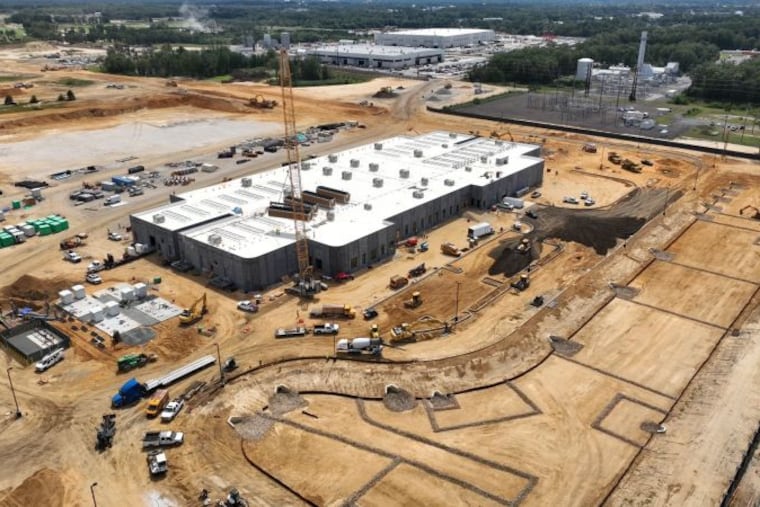
But the world of Montgomery, a 59-year-old government consumer protection official, was turned upside down last summer. That’s when his son started complaining of a steady noise like helicopters out back. He learned that the land just past his backyard was not becoming a 9-hole public golf course, as neighbors had been told, but a massive data center. It will eventually be powered by a bank of 35 gas turbines to host routers aimed at making Microsoft’s artificial intelligence, or AI, run faster, in a $17 billion deal.
Today, with French-based DataOne’s planned 300-megawatt facility partially open but mostly still under construction, Montgomery has become an unlikely viral Instagram star by posting videos of the steady humming sound that — intermittently, but for hours at a stretch — comes from the site, often in the dead of night.
“You hear that continuing noise for hours on end, and it disrupts your sleep,” Montgomery told me Wednesday afternoon, as the occasional earth mover was visible just behind his three-acre tract. The neighborhood was relatively quiet then, but Montgomery had shared a new video from just that morning of the incessant hum. Not knowing when the noise will come and go has heightened the angst.
“There’s a poor lady that lives even closer — I saw her on the news,” Montgomery said. “She said it was giving her anxiety.”
Residents on the southern fringe of this South Jersey crossroads city are hardly alone in feeling high anxiety from the sudden and unanticipated surge in data centers — the sprawling, unsightly utility closets of the AI boom that is already rapidly changing the way we work (or don’t work), learn (or don’t learn), and live.
Dozens of power-thirsty data centers across New Jersey have been blamed for rising electric bills, and now the new generation of massive facilities like the one in Vineland is sparking wider environmental worries that go beyond the noise complaints. The buzz here in South Jersey carries echoes for Pennsylvania, where the supply of fracked natural gas and pro-business politicians has made the Keystone State an epicenter, with 50 projects in the works.
I traveled to Vineland on a day when a lot of other cataclysmic stuff was happening in the world, when an increasingly unpopular president struggled in a slurred speech to justify his lethal war in Iran, and the U.S. Supreme Court was hearing his regime’s plea to strip citizenship from millions of children of immigrants. Still, I think future generations will look back — if their brains aren’t too addled by a robotic society — at the ways the AI revolution is upending the fabric of our daily lives as what mattered most about the 2020s.
That’s already happening in Vineland, where a growing number of residents feel they are canaries in a 21st-century coal mine, on the knife’s edge between a predictable life on what was mostly farmland a couple of generations ago and now the bad vibrations of a computer age.
Cumberland County isn’t traditionally a hotbed of environmentalism. Donald Trump narrowly won it in 2024. But the data center is forging a coalition of unlikely activists like Mike Gentile, a 62-year-old retired highway construction laborer who lives on an eight-acre tract on Pennsylvania Avenue, less than a mile from the DataOne site.
“If you’ve ever been to an airport, you hear that noise all the time,” Gentile told me as we sat on his front porch, and I asked him to describe the intermittent noises, which he compared to running generators — although, like his other neighbors, he has little insight as to what’s actually happening over there.
Officials with DataOne have stated that any sounds coming from the site are only the result of the current construction — the data center is supposed to be fully completed by the end of the year — and are not violating any noise ordinances. They insist noise pollution will not be an issue when it’s fully built.
» READ MORE: In 2026, America needs an anti-AI party | Will Bunch Newsletter
The company’s CEO, Charles-Antoine Beyney, has come to Vineland to reassure residents that, as a child who was raised in a vineyard in rural France, he understands their concerns. He’s said that his firm’s data center is designed to avoid the kind of complaints lodged against its first-wave predecessors, with on-site generators providing 85% of the needed power and a closed-loop cooling system that recycles water. He says the company has purchased the closest homes to house some of an estimated 200 full-time employees, and that Vineland will benefit from a flow of tax dollars — after a five-year abatement, that is.
A growing number of locals aren’t buying it.
More than 100 people showed up at a protest against the data center in late March, and DataOne recently asked to postpone a Vineland planning commission meeting about the second phase of the giant project. Activists like Montgomery are hoping to at least minimize any future pollution, even though it’s too late to block the project. One completed, 130,000-square-foot building already has three data rooms up and running for Nebius Group, the Netherlands-based firm that operates the site and sells the data capacity to Microsoft.
Vineland’s environmental commission recently sent a letter to the planning board voicing its concerns about the data center, noting that its conservation plans are “experimental” and asking for stronger guarantees that it will not strain the city’s water supply. Residents are also worried that the natural gas pipeline — and a large on-site storage tank — could be prone to an accident, or even a terrorist attack.
“It’s a bomb,” Gentile said of a proposed 60-foot-tall gas storage tank that’s awaiting action from the planning commission.
The Vineland activists aren’t alone in raising concerns about constant, strange noises from data centers. Numerous residents of northern Virginia, which is currently home to the nation’s largest cluster of data centers, have also complained about constant humming noises and a low, steady vibration.
The noise pollution complaints should also be an alarm siren for Pennsylvania, where tech companies and developers are seeking exponential growth in places like the small town of Archbald, just outside of Scranton. There, locals feel bombarded by five separate planned data centers, including a couple that would be among the world’s largest.
Public opposition may be slightly turning the tide. Gov. Josh Shapiro, who is seeking reelection amid rumored White House ambitions, went from unbridled boosterism to a more cautionary tone in his latest budget address, saying the state won’t approve new data centers that are a drain on electric supplies. Shapiro knows how to read the polls; the most recent survey found that a whopping 68% of Pennsylvanians don’t want a data center in their community.
There’s arguably a bigger noise here than just the low rumble from a massive server farm. In talking to folks like Gentile and Montgomery — middle-aged men of a fairly conservative ilk — one can’t help but sense that the data centers are a bigger symbol of a brave new world that’s being forced upon middle-class communities, ready or not.
Both men grumbled, in asides, about the parallel chaos caused by Trump’s ongoing war of choice in Iran, just one more crazy thing in a world where nothing makes sense anymore. It was one thing to see the idyllic farmland just past Vineland swallowed by new subdivisions and constant truck traffic, but the new data center feels like something else — something more sinister foisted upon them.
The dystopian present reminds Gen Xer Montgomery of 1984 — not the George Orwell book, but the actual year when, as a teen, he saw Arnold Schwarzenegger in the first Terminator film. “If you remember that movie,” he said, “the machines took over the world.”

Sign up for the Will Bunch Newsletter