City Council’s threats over the school closure plan won’t help Philadelphia’s students | Editorial
While politicians are happy to grandstand in favor of keeping specific schools open, they are less forthcoming about which schools should be closed instead.
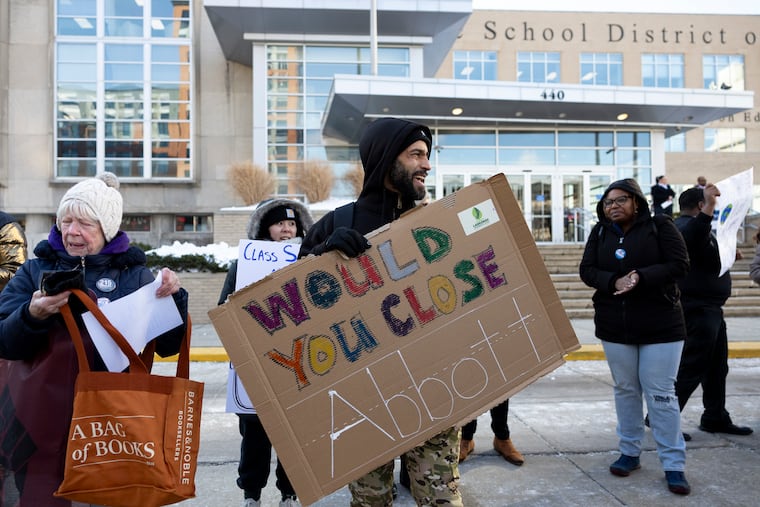
There is no such thing as a good school closure plan, and the Philadelphia School District proposal — scheduled to be voted on Thursday — is no exception. Local schools are important to communities across the city, and many residents still feel the pain of the last round of closures in 2013.
But City Council members and state legislators who are now menacing the district and making ominous pronouncements about withholding funding are a day late and a dollar short.
The facilities master plan is not a rushed endeavor, and hardly a surprise. School officials have been talking about closing and rebuilding schools for years. The proposal is a much-needed effort to modernize and rightsize the district.
While politicians are happy to grandstand in favor of keeping specific schools open, they are less forthcoming about which schools should be closed instead. It is easy to say, “Save Lankenau.” It is harder to follow that up with “and close Roxborough High School instead.”
Council is also a large reason why the district is in such a financial pickle to begin with.
» READ MORE: Philadelphia school closure proposal is not perfect, but it is necessary | Editorial
Members have routinely increased the city’s homestead exemption. While this helps protect homeowners, many of whom have low or moderate incomes, from big tax bills, it is a choice that has undermined the fiscal stability of Philadelphia’s schools. The tax break now adds up to more than $300 million per year, roughly identical to the district’s projected deficit.
The median property tax bill in Philadelphia is under $2,500, compared with nearly $4,000 in Upper Darby, a suburban township with similar income levels as the city.
Most Pennsylvania school districts can raise property taxes on their own, a power that has not been granted to Philadelphia’s school board. It is unlikely the city would have such a long list of supplemental school taxes — from the liquor-by-the-drink fee to the sugar tax to the recently proposed ride-share levy — if the school board were able to increase the rate without Council approval.
Council also has had ample opportunity to raise concerns about the district’s spending. After all, Superintendent Tony B. Watlington Sr. and Board of Education Chair Reginald Streater report for budget hearings every year. It has long been apparent that an influx of federal COVID-19 relief funds had papered over a serious shortfall. If Council members wanted the district to cut back earlier to avoid asking for more, they could have spoken up.
That’s not to say the district’s plan is flawless, or that its leadership is without fault.
» READ MORE: Americans continue to bear the cost of Trump’s chaos | Editorial
For example, the proposed closure of Lankenau Environmental Science Magnet High School, which is one of the best-performing public high schools in terms of academics, remains puzzling. The urge to ensure each school has adequate resources to provide a wide spectrum of courses is admirable, but things are clearly working for students at the environmentally focused campus.
A ride-share tax is also a confusing fit for funding schools. If the money were spent on increasing the frequency and coverage of public transit, the city could plausibly claim the tax would save some residents money overall. But sending the money to the district forecloses on that opportunity.
Still, school board officials have gracefully listened to members of the public, whose responses to the facilities plan have ranged from disappointment to fury — all to improve a proposal board members would avoid implementing if they could.
The Philadelphia School District is not perfect, but until City Council can supply a realistic alternative to the facilities plan and ride-share tax proposal, issuing threats is irresponsible.