For La.’s ‘Cancer Alley,’ Black voting struggle is a fight to breathe
For disadvantaged Black residents of the most heavily polluted region in America, racial redistricting is a life-and-death matter.
If you view the world through cable TV news and its talking heads, it can be too easy to see America’s rapidly escalating wars over gerrymandering and racial politics as a numbers game: which party gained how many seats, and which party lost out.
But in a place like Louisiana’s Ascension Parish — “the Jambalaya Capital of the World,” midway on the Mississippi River between Baton Rouge and New Orleans, where about a third of residents are Black or brown — the state’s looming new congressional map is a life-and-death matter, the tyranny of toxicity without representation.
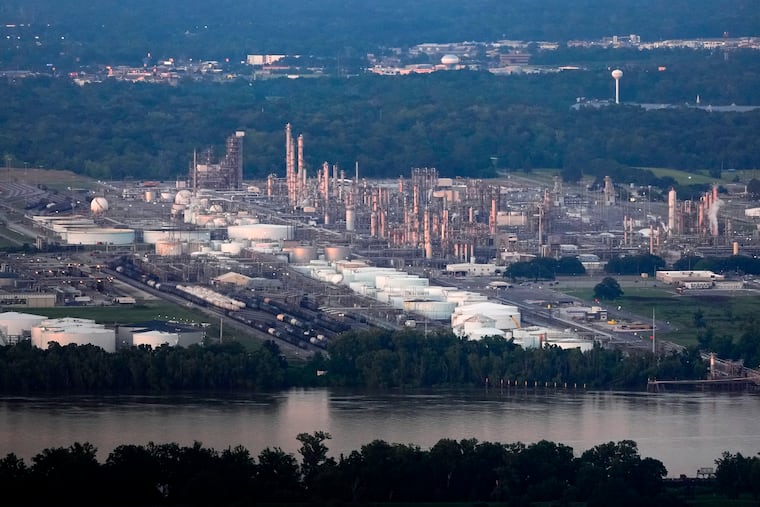
Ascension Parish is also the congestive heart of “Cancer Alley,” the seemingly endless stretch of oil refineries and chemical plants that lines the mighty river, and is linked to the worst pollution and health outcomes of anywhere in the United States. It was hard to imagine how things could get worse for this poverty-stricken region, until a team of industrialists and developers announced their scheme for the ominous-sounding RiverPlex MegaPark, a 17,000-acre pollution palooza that includes an ammonia plant and a steelmaking facility for Hyundai.
To local Black community activists like Ashley Gaignard, president of Rural Roots Louisiana, the toxic “megapark,” which may dislocate as many as 800 residents of African American neighborhoods, and has already led to the bulldozing of historic cabins where enslaved plantation workers once lived, is the epitome of the environmental racism embedded in Cancer Alley’s tainted soil.
“Down here, corporate executives don’t wear hoods or burn crosses,” Gaignard wrote recently for the progressive site Common Dreams, “but their greed can kill us just the same.”
Residents of the predominantly Black neighborhood of Modeste could sure use some representation on Capitol Hill, but instead, state lawmakers up in Baton Rouge — jacked by a U.S. Supreme Court that gutted the 1965 Voting Rights Act, which for decades uplifted African Americans across the South — just diluted that power.
The GOP-dominated legislature and right-wing extremist Gov. Jeff Landry are working to draw a new map that will replace at least one of the two Black Democrats — Reps. Troy Carter and Cleo Fields — who currently represent parts of Ascension Parish, and replace them with a Republican in lockstep with Donald Trump’s pro-fossil fuel agenda.
Veteran environmental activist Anne Rolfes of the Louisiana Bucket Brigade told me Wednesday that the megapark developers already have the ear of the White House, with Trump inviting Hyundai executives and Landry into the Oval Office in March 2025 to assure them that federal permits would be no problem. “That is abuse and corruption of the highest order,” Rolfes said.
Reducing Black Louisianans’ clout in Congress ensures residents of a neglected community like Modeste won’t have a voice in the room where those decisions are made. This is exactly the point of the abomination that is the rapid race to undo the victories of the 1960s-era Civil Rights Movement across the former Confederacy.
The legislative white privilege of unhindered gerrymandering that aims to erase many of the 23 Black Southern House members who are the living legacy of the Voting Rights Act and the environmental racism that spews cancer-causing chemicals like ethylene oxide, chloroprene, and formaldehyde into Louisiana’s poorest and most powerless communities are not separate issues. They are part of the same unbreakable narrative, a song of the American South where Black lives don’t matter.
This is the human angle of the 6-3 Trump-fried Supreme Court’s callous Louisiana v. Callais ruling, and the racial realpolitik of redistricting, that too many people are missing in this pivotal plot moment in the American storyline. To be sure, the race for at least 218 seats and the House majority in the 2027 Congress — with Republicans hoping to shield the Trump regime and its high crimes and misdemeanors from accountability — is at the core of the gerrymandering wildfire jumping from state to state.
But what matters even more is how this gerrymandering aims to once again take away basic rights and a political voice from the people who’ve had to fight for it every day of their lives. That starts with the dozen or so Black Congress members whom Republicans are so eager to fire hose out of the corridors of power.
These are people like Mississippi Rep. Bennie Thompson, who started as a civil rights protester with the 1960s Student Nonviolent Coordinating Committee (SNCC) and who, with powerful dignity, led the effort on Capitol Hill to bring accountability for Trump’s attempted coup on Jan. 6, 2021 — and who was told this week by GOP Gov. Tate Reeves that his “reign of terror” is ending soon.
They are people like Texas Rep. Al Green, a former NAACP leader in Houston who has been relentless in seeking Trump’s impeachment, who was dragged off the House floor for protesting the president’s State of the Union address — and whose congressional seat was the first one Texas GOP lawmakers sought to decimate last year.
» READ MORE: GOP canceling elections? It’s already happening. | Will Bunch Newsletter
And people like veteran South Carolina Rep. James Clyburn, who was arrested in 1960 as he and other students ultimately succeeded in desegregating lunch counters in Orangeburg, S.C., and who some 66 years later finds himself facing a modern white-power play as he fights to save his House seat from gerrymandering.
Forcing out the heroes of Black political empowerment like these three would bend the arc of the moral universe away from justice. But the people who’ll arguably be hurt the most by the SCOTUS-fueled racial gerrymandering are the everyday folks who will be locked out of the process. Who will fight for people in places like Ascension Parish to keep struggling rural hospitals open, or subsidize health insurance for blue-collar workers — or make sure the Clean Air Act is actually enforced?
And it’s not just Louisiana’s Cancer Alley. Environmental racism has covered the South like kudzu for decades in places like rural Emelle, Ala., where in the mid-1980s I interviewed the Black low-wage workers who toiled without protective gear in the world’s largest toxic waste dump. But recent events — from the U.S. oil-and-gas boom to the push for energy-guzzling “hyperscale” data centers — have pushed environmental racism to new depths.
One of the biggest fights right now is taking place in Memphis and the bordering suburb of Southaven, Miss., where the world’s richest person, Elon Musk, has selected this working-class region with a large Black population as the site for the massive data centers to power Grok, the artificial intelligence component of his social media site, X. The project includes more than two dozen gas turbines at the Mississippi location, which, according to a lawsuit by the local NAACP, lack proper air permits.
Did I mention Memphis is also the place where Tennessee’s GOP-majority legislature just carved up and eliminated that state’s only Black-majority, Democrat-electing congressional district? Again, is this a coincidence? I think not.
It’s important to note that environmental racism often transcends partisan politics across the South, as the endless cash of Big Oil and Gas executives often flows not only to Republicans. In Louisiana, many on-the-ground activists like Rolfes have been deeply disappointed that Democratic House members like Carter and his predecessor, the powerful ex-Joe Biden aide Cedric Richmond, have been too friendly to fossil fuels interests.
Still, Carter has at least called for stricter government regulation of air pollution in Cancer Alley, and for health monitoring so that his constituents won’t have “to die for their jobs.” A pro-Trump Republican who replaces Carter under the new map is a guaranteed vote to decimate what’s left of environmental protection, and to deny the existence of the climate change triggered by greenhouse gas pollution on the Gulf Coast.
“A second majority‑Black district is the difference between one congressional voice for the petrochemical corridor and two; between a Cancer Alley constituent who has someone to call and one who does not; between a Caddo Parish family whose FEMA appeal gets a hearing and one whose appeal disappears into a representative’s voicemail,” Andrea Hagan, a criminology instructor at Loyola University New Orleans, wrote in an essay for the Louisiana Illuminator.
“Take the district away and you do not just take a seat,” she added. “You take a habit. You take the muscle memory of believing the ballot does something.”
This is the tragedy of a land where the past is never dead, where giddy white lawmakers are literally taking the Confederate statues out of storage, where the goal is not just to undo the Civil Rights Movement but punish its surviving leaders for what they can now openly call “a reign of terror,” where losing the right for your vote to mean something and losing the right to inhale clean air are the same ungodly thing.

Sign up for the Will Bunch Newsletter