Chase Utley’s path to the Phillies Wall of Fame was forged with hours in the video room
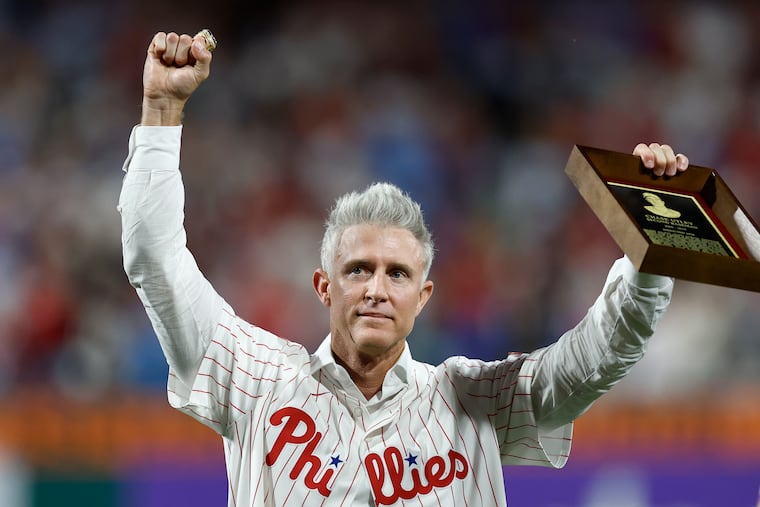
Utley, who was inducted to the Phillies' Wall of Fame on Friday night, spent hours before — and after — games in the video room to find any advantage.
The game was finished and the Phillies had a flight to catch as Kevin Camiscioli hurried to unhook the computer monitors and video equipment in the visiting clubhouse.
But Chase Utley — “Nobody spent more time in that video room than Chase,” Pat Burrell said — wasn’t finished yet.
Forget that the game was over. Utley had more tape to dissect. He replayed each at-bat like it was the Zapruder film. So Camiscioli, then the team’s director of video, gave his workstation to Utley and packed up everything else.
“But then I pulled the wrong power cord, and it was the main power cord,” Camiscioli said. “As soon as I pulled it out, I could hear the power supplies click. They lost power.”
» READ MORE: Phillies Wall of Fame and then Hall of Fame? Chase Utley putting ‘pieces together’ on his Cooperstown chances.
Camiscioli stood up and locked eyes with Utley.
Utley spent hours before — and even after — games in the video room trying to find any advantage he could. He was obsessed, Utley said. And it’s that work ethic that he credits for the iconic career that landed him Friday night on the Wall of Fame at Citizens Bank Park and soon could take him to Cooperstown, N.Y.
But when Utley’s computer unplugged, Camiscioli held his breath.
“I said, ‘Man, I’m sorry,’” Camiscioli said. “He starts walking to me. I’m like, ‘Here we go.’ He looks at me and goes, ‘That’s OK.’ Phew. Bullet dodged.”
Earning Philly’s respect
Utley debuted in April 2003 as a pinch-hitter for the final home opener at Veterans Stadium. But he didn’t really arrive until later that month when the Phillies recalled him from triple A.
The Scranton Wilkes-Barre bus pulled over and Utley waited at a Subway until a ride arrived to bring him to Philadelphia. A day later, he hit a grand slam for his first big-league hit and sprinted around the bases as if he was being chased. From then on, his connection with Philadelphia was unrivaled.
“I get asked all the time, ‘What was it like to play in Philly?” Utley said. “The truth is you don’t just play in Philly. You survive it. You earn it. And, if you’re lucky, you grow from it. To me, this city is about passion. It’s about emotion. It’s about toughness. But most of all, it’s about winning. For 13 years, I tried to play the game that this city expects us to play: hard, honest, no shortcuts, no excuses. You let me know every night whether I was doing my job. That’s what I love most about this city. In Philadelphia, you don’t get respect. You have to earn respect.”
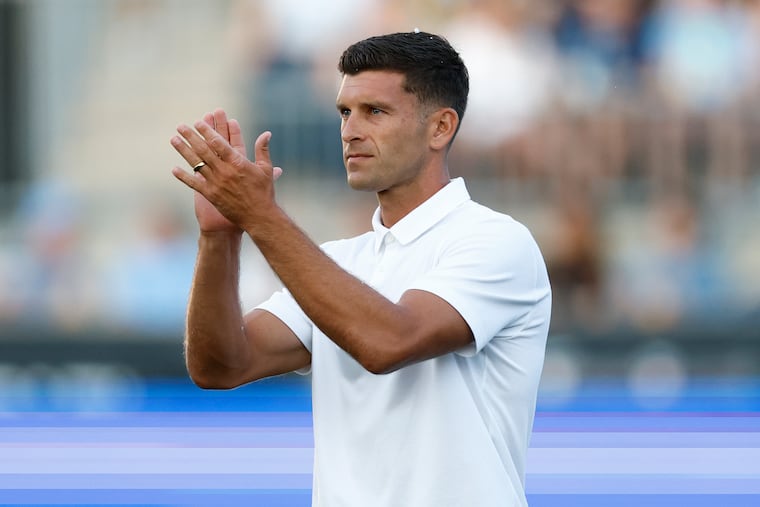
Fans roared on Friday when Utley walked onto the field and interrupted his Wall of Fame speech with ovations and catcalls.
“I love you, too,” Utley responded to a screaming fan.
Philadelphia has fallen for athletes: Wilt, Bednarik, Dr. J, Iverson, Schmidt, Clarkie, and so on. But there’s an argument to be made that no one won over Philly like Utley.
» READ MORE: The making of an icon: How Chase Utley became ‘The Man’ for the Phillies
“I adore this town,” Utley said. “We had such amazing moments over the years and created so many memories together. Winning the World Series was No. 1, but there were so many other great times together. They supported me essentially from Day 1. I had to earn their respect, and I felt like I did a good job of that. I’m as much obsessed with the fans as they seem to be with me.”
He grew up in Southern California but was made for South Philly. He played with a scowl and let his game do the talking. He was The Man and always arrived first at the ballpark and was last to leave.
Utley would go to the trainer’s room before checking in with Camiscioli to watch video. Then he ate a peanut butter and jelly sandwich, hit the weight room, and took batting practice. He grabbed a sweet potato and watched more video before the game began. It was the same thing every day. Even the food didn’t change.
“He just had that look in his eye,” Camiscioli said. “You got the heck out of the way. You knew when to talk and when not to talk. Just because you knew he was in the zone. You knew. Roy Halladay had that look, too. When it got to a certain time before the game, he would walk from Point A to Point B with determination. There was more speed than regular. A 7 o’clock game, he’s basically suited up to the cleats by 6 ready to go.”
‘What could he be looking at?’
Utley sat for more than an hour in the afternoon before a game studying every opposing pitcher. The video guys eventually knew what Utley wanted to see so they queued up clips of the other teams’ pitchers in every situation possible and watched Utley go to work.
“He’d call you over sometimes after he was sitting there for three hours and he’d be like, ‘I don’t know if my eyes are going cross, but is this what I’m seeing?” Camiscioli said. “Some guys go to the clubhouse and they play cards. Some guys do nothing. Some guys play ping-pong. Chase watched video. That’s what he did. I’m surprised he doesn’t need glasses from staring at the monitors so much.”
Other players soon filtered in, sitting with Utley as if he was a professor teaching a class. He shared the tidbits he gleaned from video — like the opposing pitcher always throws a fastball if he starts with his glove by his belt — and hoped he gave his teammates an advantage before the game started.
» READ MORE: Chase Utley serves tomato pie at Sarcone’s, talks playing for Don Mattingly, and what it’s like to be an All-Star
“I wanted to be as prepared as I possibly could,” Utley said. “I felt like the more video I watched, the more information I could gather, the better suited I was to compete on a nightly basis. There were some days when it didn’t tell much, but there were plenty of days where I felt like I benefited greatly from the preparation I put in, my teammates also. Nowadays, the game has changed, and there’s plenty of people watching video. Back then, it wasn’t quite the same. I wanted to be as prepared as possible.”
The video room is just a few feet from the dugout at Citizens Bank Park, and Utley would stop back after each at-bat, when players were still allowed to watch video during games. He used two monitors to compare what he saw before the game to what actually happened during the game and then leave the monitors up for teammates to check out. Class was always in session.
“He was very generous with his knowledge,” Camiscioli said. “I never really saw him force himself onto anybody, but eventually people knew and figured it out. Ut had a routine. He was in the video room all the time. There were so many times where it would be like, ‘Oh my God. What could he be looking at?’ But then you started to notice guys filtering in and hovering around him. His preparation was just off the chart.”
It was one thing to pick apart pitchers during a regular-season game, but Utley requested the same footage when he was selected to the All-Star Game. Camiscioli, who worked for the Phillies from 1996 to 2021, loaded an iPad before the All-Star break with clips of the American League pitchers. For Utley, nothing was an exhibition.
“All-Star Game? He wanted to hit,” Camiscioli said. “You know how the All-Star Game is. It’s a fun time. He wanted to rake. It was business as usual.”
A sense of pride
It didn’t take long for Utley to tell Camiscioli and his staff to just give him some basic instructions on the computer so he could move through his film without help. That’s who he was, Camiscioli said. Utley didn’t want to bother anyone else.
“He was great to us,” Camiscioli said. “He respected us and appreciated us. It wasn’t, ‘Oh, you’re just staff.’ In return, everyone wanted to run through a freakin’ wall for him. To this day, I still would.”
So it meant something that Utley invited Camiscioli and other staff members from his playing days to be at his induction on Friday night. Jimmy Rollins, Ryan Howard, and Cole Hamels were there. But so was Camiscioli and other behind-the-scenes folk who helped Utley become The Man. They loved him, Camiscioli said. Even if he made packing up the equipment a little bit complicated.
“For me and the guys who worked with me, it was a sense of pride,” Camiscioli said. “We were proud that we could be a part of it. He treated us with respect. You know, that doesn’t always happen. He was really good to us.”

Let's talk about the Phillies' bullpen. Larry Andersen happens to be an expert on the subject. The popular Phillies radio analyst had a 17-year major-league career in which he appeared in 699 games – all but one in relief. He joins Phillies Extra to break down the biggest question standing between the Phillies and a long run through October: How will they bridge the gap to closer Jhoan Duran? Watch here.
You can also subscribe to the podcast version of Phillies Extra on Spotify or Apple Podcasts.
Previous episodes: Matt Klentak | Jeff Francoeur | Luke Murton | Mike Hazen | Tony Gwynn Jr. | Kevin Stocker | Bobby Dickerson | Jim Bowden | John Middleton | Ryan Howard