I compared the ‘I Play Rocky’ film to my book. Here’s where they’re different.
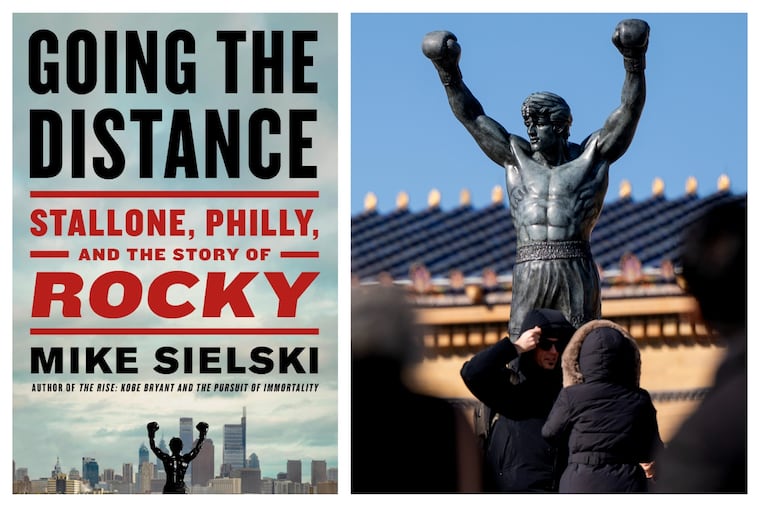
Mike Sielski's 'Going the Distance: Stallone, Philly, and the Story of ROCKY' is available Nov. 10 wherever books are sold.
I’ve never had an experience at a movie theater like the one I had last Monday, when I attended a screening of I Play Rocky, and I don’t know that I’ll ever have such an experience again.
There were the expected wrinkles. I’d never been to a “special” or “advance” screening of any kind, and this one — at the Philadelphia Film Society in Center City, for a movie about the making of the quintessential Philadelphia movie — promised to feature the same cheering, euphoria, and civic pride that Rocky inspired 50 years ago.

Mike Sielski alerts
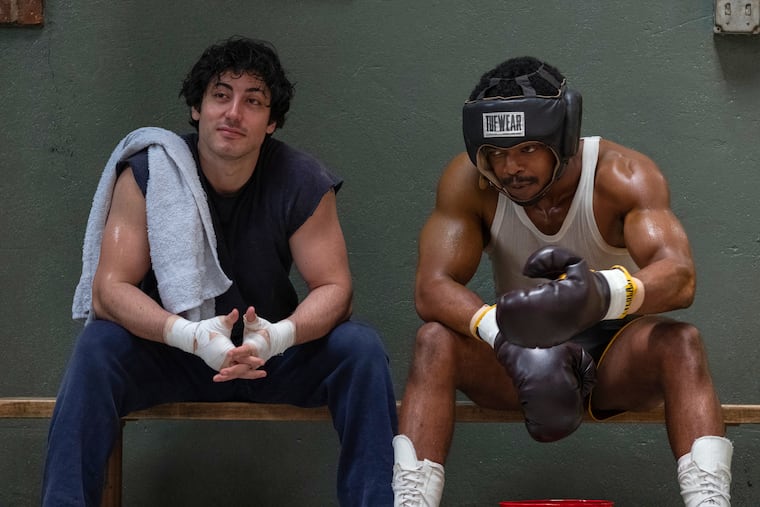
Anyone familiar with Philadelphia’s culture and community knows what that movie means to the city’s collective identity, and I Play Rocky, by telling the story of how Sylvester Stallone and those involved in the film brought Rocky Balboa to life, presented an opportunity to savor it all again. Sure enough, the theater was full, and the movie, as I suspect it will throughout its run in theaters, pleased the crowd. Anthony Ippolito didn’t portray Stallone as much as embody him, and while the movie slows down a bit in the second half, it was fun from the first frame to the last. It’ll do gangbuster business around here.
My perspective on I Play Rocky, though, was unlike that of everyone else in the theater. The screening was held eight days before the publication of my book Going the Distance: Stallone, Philly, and the Story of ROCKY. (It hits stores Tuesday and will make a great holiday gift. Trust me.)
To answer the obvious question: No, there was no direct connection between the movie and the book. Peter Farrelly, who produced and directed I Play Rocky, did not purchase the book’s option rights, and screenwriter Peter Gamble didn’t base his screenplay on GTD. (But hey, Petes, call me! There’s still time. Let’s do lunch!) It just so happened that the soil they tilled for their movie was the same ground that I mined for my book.
Mostly.
A Hollywood movie and a nonfiction book have different aims. The movie’s creators aren’t necessarily bound by fact (which is why five of the most important words in Hollywood are “based on a true story”). Their mission is to make an entertaining, dramatic film, just as mine is to write an entertaining, dramatic book. But everything in the book, if it is to be considered nonfiction and trusted as such, has to be the truth … or at least the truth as best as the author can determine or discern it. Sitting in the darkness, I couldn’t help but compare and contrast the story that I Play Rocky’s cast and crew had decided to tell with the one I had.
It is a strange thing, to be fact-checking a film while watching it, but that’s pretty much what I did. So without giving away too much of the movie’s plot or the book’s narrative threads and big revelations, here are three key differences between I Play Rocky and Going the Distance:
Sly was no pushover
If there’s any flaw in Ippolito’s performance — it’ll be a shock if he doesn’t earn an Academy Award nomination for best actor — it’s that he softens Stallone a bit too much. In this way, he falls into the same trap that so many fans of the original film do: They presume Stallone and Balboa were the same person, and they weren’t.
Stallone did not merely star in the film and make cautious recommendations to director John Avildsen and carry himself with humility and gratitude. He was so assertive and resolute in his opinions that he came into frequent conflict with Avildsen, producers Irwin Winkler and Bob Chartoff, and others — disagreements, shouting matches, the works.
One night, for instance, as Avildsen and editors Richard Halsey and Scott Conrad lounged in the editing room — “Lit up a doobie,” Conrad told me — a security guard at the lot’s front gate called to tell them Stallone was on his way to check on their progress. Avildsen wanted the editors’ work to be free from Stallone’s interference. So when Stallone got to the room’s door, Avildsen tried to gather up his papers and slip out, only to have Stallone pick him up off the floor, tell him with tension in his voice, I wanna see some of the film, and plop him back down in the room.
Multiple studio execs in one
The veteran actor and Pulitzer Prize-winning playwright Tracy Letts delivers one of the strongest performances in I Play Rocky as studio executive Sandy Maddox. He also was at the center of my moment of greatest anxiety about the film.
When I first saw that Letts was playing “Sandy Maddox,” I panicked. I knew who the studio execs involved in Rocky had been. None of them was named “Sandy Maddox.” Oh, no, I thought, did I write a whole book and miss this pivotal figure?
I didn’t. “Sandy Maddox” is a composite character based on those United Artists executives. Whew.
Rocky’s good boy
Butkus — Stallone’s and Rocky Balboa’s lovable bull mastiff — gets plenty of screen time and cute scenes in I Play Rocky. But the film includes a tale that Stallone has told for decades now: Broke and down on his luck, he had to sell Butkus to make ends meet. Then, upon getting the deal for Rocky, he found the owner, who demanded a huge cash payment before giving Stallone the dog back.
That story is, to put it gently, inaccurate, and it has cast a key figure in the making of Rocky in a terrible and unfair light for a long time. If you want to find out what really happened, I’ll give you two words: Page 166.