Bryce Harper responds to controversy over his personal video message to a FanDuel customer with a gambling addiction
The All-Star first baseman claims he didn't know FanDuel would use the video for commercial purposes. But he mentions the company in the 21-second video he made for a VIP gambler.
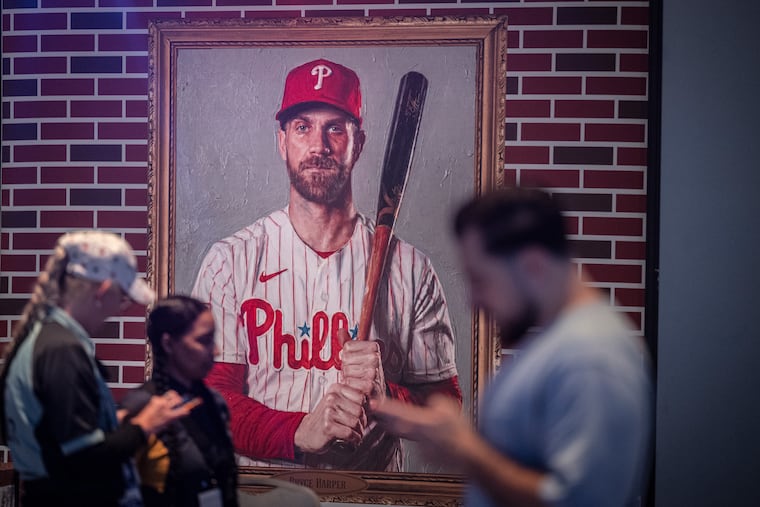
Bryce Harper, the Phillies’ All-Star first baseman, said on Monday that he was unknowingly working on behalf of FanDuel when he recorded a personalized video for a man with a gambling addiction who had placed millions of dollars in bets on the site.
Harper, in a story on his verified Instagram account, wrote that he thought he was just doing a message on the site Cameo — in which celebrities are paid to record videos for fans — but “what happened here went beyond anything I knew about or approved.”
“I did not know this video would be used for commercial purposes,” Harper wrote. “The request included a short script. I read it in good faith. FanDuel then put its own logo on the video and used it as a gambling promotion. I did not know FanDuel would do this, I did not consent to it, and FanDuel had no right to do it.”
The Inquirer obtained a copy of the 21-second video from November 2024, which is marked with a blue FanDuel logo and shows Harper offering a greeting to the bettor, Terry Thompson, and Thompson’s son, by name.
Harper’s statement also said he has no affiliation with FanDuel and that “Contrary to the Inquirer’s suggestion, I did not know that the Cameo video would be used for a FanDuel VIP promotion.”
However, in the video Harper states that he’s reaching out at the request of Thompson’s VIP manager — “your host Bryttanni at FanDuel.” Harper also posted the Cameo script, which included the same language about FanDuel.
The Inquirer reported on the video on Thursday. Harper had declined to comment until Monday. His statement came ahead of his planned appearance at Monday night’s 2026 MLB Home Run Derby at Citizens Bank Park.
Beginning in 2020, Thompson wagered $18.5 million with FanDuel and lost $1.5 million, according to a lawsuit that the Public Health Advocacy Institute filed in March in Common Pleas Court in Philadelphia on behalf of Thompson and against FanDuel and DraftKings, to which Thompson also lost money.
Harper says he did not know anything about Thompson.
“Had I known FanDuel’s true intent, I would not have made the video,” Harper wrote on Instagram. “The same is true had I known anything about Terry or his situation, or about any alleged ‘partnership’ between Cameo and FanDuel.”
On the advice of counsel, Harper wrote, he would not comment further. Harper did not discuss the matter further during a media availability Monday.
Cameo notes in its terms of service that celebrities are not required to follow a purchaser’s instructions exactly. Harper, however, mostly stuck to a short script that made clear to Thompson that the Thanksgiving message was arranged by the FanDuel host.
Cameo has not responded to requests for comment.
FanDuel did not respond Monday to Harper’s Instagram post. Last week the company released a statement:
“FanDuel is committed to fostering a culture of responsible gaming and protecting our customers. Unlike illegal offshore sportsbooks, FanDuel employees are trained to recognize and flag signs of problem gambling and offer resources and tools, and we continue to review and strengthen our policies to ensure we have the industry’s strongest consumer protection initiatives.”
The Phillies and Major League Baseball have so far declined to comment on the video.
The Pennsylvania Gaming Control Board, which regulates casinos, online gambling and sports wagering, said on Friday that it is examining the video, but a spokesman for the board declined to provide details.
The Inquirer will continue to report on issues related to the growth of gambling addiction — among teens and adults — across Pennsylvania. If you, or someone you know, wants to speak with a reporter, please contact David Gambacorta or William Bender at dgambacorta@inquirer.com and wbender@inquirer.com

The Inquirer’s journalism is supported, in part, by the Lenfest Institute for Journalism and readers like you. News and editorial content are created independently of The Inquirer’s donors. Gifts to support The Inquirer’s high-impact journalism can be made at inquirer.com/donate. A list of Lenfest Institute donors can be found at lenfestinstitute.org/supporters.