MLBPA’s Andrew Miller on why a salary cap won’t work, the cost of a lockout, and more | ‘Phillies Extra’ Q&A
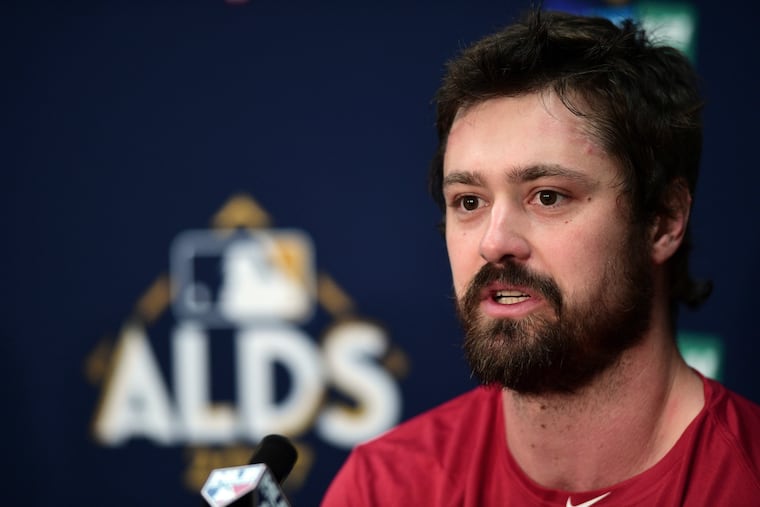
The former All-Star reliever has a seat at the table as the MLBPA’s director of collective bargaining and strategic initiatives. He joined The Inquirer's baseball show to discuss the looming lockout.
In a week — after 11:59 p.m. on Dec. 1, to be precise — the collective bargaining agreement between MLB and the MLB Players Association will expire.
Then, Baseball Armageddon will begin.
The owners are expected to lock out the players, halting all 40-man-roster transactions and effectively freezing the sport until a new agreement is negotiated. And with neither the owners nor the players budging from their positions on a salary cap, it’s going to be a cold winter.
Andrew Miller, a two-time All-Star reliever and one of 27 former players on the 2027 Hall of Fame ballot, has a seat at the table as the MLBPA’s director of collective bargaining and strategic initiatives. Miller joined Phillies Extra to discuss why the union opposes a cap-and-floor system, whether a compromise will be reached before games are canceled in 2027, and more.
Watch the full interview below and subscribe to the Phillies Extra podcast on Spotify or Apple Podcasts. (Answers have been edited for clarity and brevity.)
Q: Where do negotiations go from here on the core economic issues? Because it does seem like the sides aren’t talking to each other as much as they’re talking past each other — and in different languages, no less.
A: I think we’ve done a good job of making sure our side of the story is out there. That’s important to players. But yeah, it’s tough. Clearly, [a salary cap] is something that’s always kind of been a third rail for players, and the league is very openly trying to go after and get a salary cap. And our job, my job in particular, is to make sure the players are educated on what that means, why it hasn’t worked in other leagues, what it means financially, why the numbers that the league may be using in public are very misleading or just flat out false, and making sure that they’re educated and understand so that a guy like [Phillies player representative] Garrett Stubbs can then go to his teammates and explain to guys what’s going on. Because not everybody’s going to be as involved as Garrett. Garrett’s a great rep. He’s on every phone call. He calls us and asks questions, making sure he can then explain it to his teammates so that when we do kind of get to really needing to make a decision that everybody’s educated and knows what’s going on.
» READ MORE: Garrett Stubbs on why a lockout will cost games, the salary cap debate, and more | ‘Phillies Extra’ Q&A
Q: How do you explain why a cap system isn’t good for baseball when it has become the way of the world in the NFL, NBA, and NHL?
A: I think, first of all, the players in those other sports didn’t want a salary cap. They found themselves at a crossroads and weren’t able to fight it off. Their unions, I’m sure, look up to us. Everybody looks at the Major League Baseball Players Association as one of the strongest unions anywhere in any industry. So, we have fought that off. And there’s so many traps that come with it, and that’s something I generally leave to [MLBPA interim executive director] Bruce Meyer. But when it comes to defining revenue, it’s an endless battle to track down dollars into what counts, [and] what shouldn’t count.
Guaranteed contracts are something that are so important to our players that were fought for. To have those go away in a salary cap system is something that is going to be pretty hard for them to ever consider. So, there’s a lot of reasons it doesn’t work. That’s our job to educate those guys and make sure they understand. And when the league sends across a proposal, we look at it and we, in good faith, try to understand everything that’s going on and make sure that our players know everything that’s going on and they can take that to the table and they can make the decisions and tell us where to go.
Q: We keep hearing from the commissioner’s office that baseball needs a salary cap to solve competitive imbalance. But we just saw a World Series in which the team from the smallest market [Milwaukee] defeated a team with the third-lowest payroll [Tampa Bay]. We just saw the Mets give Tarik Skubal a record contract for a pitcher [nine years, $450 million] in free agency, and they outbid at least three other teams that we know of that were interested. Those things don’t seem to align with the claim that salaries have to be reined in for the good of the sport. As someone who sits across from them at the bargaining table, how do they attempt to make sense of those competing things?
A: Honestly, it’s a little perverse because the game is in such a good place. We have stars everywhere. We have small markets competing. The Dodgers certainly went on a run — and I don’t think they’re going away — but to basically say that the only reason the Dodgers won is because of money well spent, that’s kind of demoralizing to what they’ve actually accomplished. They’re an incredibly well-run organization with talented players, and a lot went right. It’s not like they steamrolled everybody. There were some pretty close series they played to get it done.
» READ MORE: A (likely long) lockout looms again for MLB. Why a salary cap is at the center of it all. Again.
So, the idea that this is about competitive balance or parity or whatnot is pretty clearly not true. We understand the owners are businessmen and this is what that’s about. They want to see their franchise values go up. They would like to make more money, and by controlling labor costs that’s the easiest way to do that. So, our guys understand that there are things that we can tweak and we can improve in the system, and we want the game to be as good as it possibly can be. And you don’t need a salary cap to do that. There are [other] things, and our proposals are littered with ways to help small markets, ways to help player movement, ways to help teams find ways to compete if they do a good job. And I think that we don’t need a salary cap to make that happen.
Q: Should fans be optimistic that there’s going to be a full season next year — or any season next year, for that matter? And if so, why?
A: I’m optimistic because the game’s in a great place, and players want to play. There is a lot of posturing, whether that’s in public or behind the scenes. It seems crazy to me that right now would be the time to essentially take the industry and tell all the fans that hey, we’re gonna break this up when we have all this momentum. That seems wild. But the players are gonna fight for a fair deal, and that’s never gonna go away. And it’s our union leadership’s job to make sure they understand everything and that we get them a fair deal and we help them accomplish that.

Phillies Extra is your deep dive into all things Phillies on Gameday Central! Hosted by Scott Lauber, each episode brings you insider analysis, exclusive interviews with players and experts, reader emails, and more to cover the hottest topics with the Phillies and across Major League Baseball. Don’t miss it — the conversation starts here!
You can also subscribe to the podcast version of Phillies Extra on Spotify or Apple Podcasts.