Trump administration sued over ‘selective removal’ of Black history at the President’s House
Avenging the Ancestors Coalition and The Black Journey opened a new front in the legal battle over the President’s House after a previous push met a dead end in a federal appeal court.
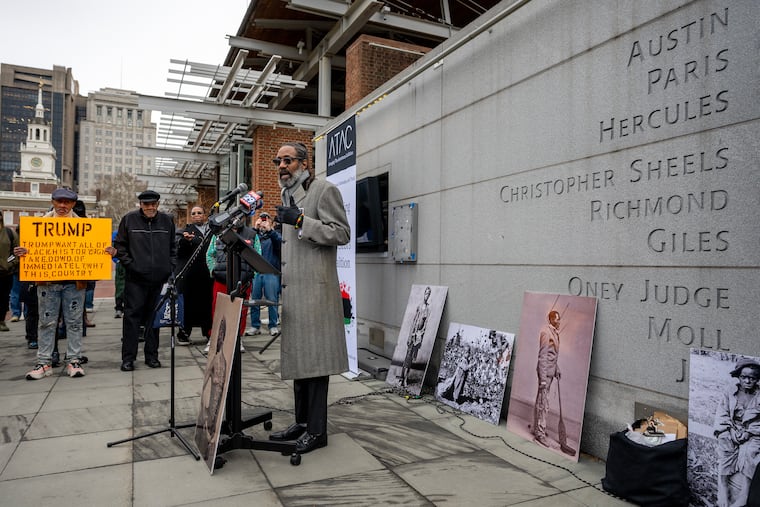
Activist groups revived the legal battle over how the story of slavery is told at the site of the nation’s first executive mansion on Independence Mall with a federal lawsuit.
Avenging the Ancestors Coalition and The Black Journey said in a 77-page complaint that President Donald Trump’s administration violated the U.S. Constitution’s guarantee for equal protection under the law in January when the National Park Service abruptly dismantled the exhibit memorializing the nine people Washington enslaved at the his home on Sixth and Market Streets
The original President’s House exhibit was the “first commemoration of enslaved people within the National Park System and is the first slavery memorial of its kind on federal property in American history,” according to the complaint. And it’s removal, the suit says, sends a “message that the history of slavery and the lives of the Black people connected to that history are unimportant and should be excised from discussions on American history within the National Park System.”
Avenging the Ancestors Coalition is asking a federal judge to find the removal and replacement of the exhibit unlawful, and order the full restoration of the original exhibit.
The National Park Service and the Department of Interior did not immediately respond to a request for comment.
The lawsuit was filed Monday afternoon by Avenging the Ancestors Coalition, an advocacy group that pushed for the development of the site as a slavery memorial in the early-2000s and its restoration since January, and The Black Journey, a walking historical tour company. The complaint names Interior Secretary Doug Burgum and his department, and acting National Park Service director Jessica Bowron and her agency.
The suit says that the removal has harmed both groups directly. The Black Journey, for example, spent roughly $14,000 on research and labor to update a tour to “maintain the examination of the paradox between slavery and freedom” once the panels were removed.
And, the suit says, the harm extends beyond the economic impact.
“Black people are uniquely impacted by the selective removal of their history, while history involving white historical figures at the President’s House site remains undisturbed,” the complaint says.
Behind the two groups’ lawsuit is significant legal muscle. They are represented by University of Pennsylvania Law Professor Cara McClellan, as well as attorneys from the NAACP Legal Defense Fund and WilmerHale, one of the Big Law firms targeted by a 2025 Trump executive order for providing services for the president’s political opponents.
The Trump administration’s version of the exhibit has adorned the walls of the site of President George Washington’s residence on Sixth and Market Streets since July.
The panels currently on the President’s House walls mention slavery, note Washington owned slaves, and names the nine people he enslave. But the Trump administration’s exhibit tells an incomplete and whitewashed version of that history that fails to recognize the brutality of slavery, the suit says.
Even the name of the new exhibit — Visiting the President’s House Site: From Enslavement to Emancipation — is misleading, the suit says, given than none of the nine people enslaved by Washington in Philadelphia were emancipated. Two of them, Ona Judge and Hercules, gained freedom by escaping.
» READ MORE: What’s changed at the President’s House with the Trump administration’s new exhibit
The lawsuit also repeats the claim that the administration violated the Administrative Procedures Act because the abrupt removal of the exhibit was an arbitrary and capricious act.
The U.S. Court of Appeals for the Third Circuit rejected that argument in June, finding that the removal wasn’t a final agency action and thus isn’t reviewable under the act, when it vacated a district court injunction obtained by the administration of Mayor Cherelle L. Parker ordering the National Park Service to restore the exhibit.
The Third Circuit denied in August the city’s request to rehear the case, bringing efforts to revive the injunction to a dead end.
The new front in the legal battle battle over the President’s House comes more than a year since the Trump administration began scrutinizing the site as part of the president’s executive order to review or remove displays at national parks that “inappropriately disparage Americans past or living.”
The abrupt removal of the exhibit in January sparked nonstop advocacy from stakeholders who helped develop the site in the early 2000s, in addition to a legal battle waged by the city. The city sued in January when the slavery exhibit was abruptly dismantled, asking a federal judge to issue an injunction ordering the panels be restored. Judge Cynthia M. Rufe issued a blistering opinion on Presidents Day ordering the restoration, comparing the Trump administration’s action to the Ministry of Truth from George Orwell’s 1984 novel.
The administration installed roughly half of the removed panels before Rufe’s deadline, but left the site’s walls half bare after appealing to the Third Circuit and securing an administrative stay.
» READ MORE: Centuries of controversy at the President's House
A unanimous Third Circuit three-judge panel — which included Trump, George W. Bush, and Barack Obama appointees — held in June that the city had no rights over the exhibit after having donated the President’s House Site to the National Park Service.
On July 3, the eve of the nation’s 250th celebration, the Third Circuit gave the Trump administration the final go-ahead to replace the panels. And less then two weeks after, the National Park Service swapped the exhibit in the early morning hours after the city hosted MLB All-Star Game events near the site.
The administration also bolstered security around the site, which has since been flanked by three mobile surveillance trailers.