Derek Hill and Andrew Painter suffer injuries in Phillies’ 10-4 loss to Nationals in 11 innings
Painter exited after the fourth inning with left hamstring tightness, while Hill suffered a bruised shoulder crashing into the fence on a fly ball in the 11th. Both will be reevaluated on Thursday.
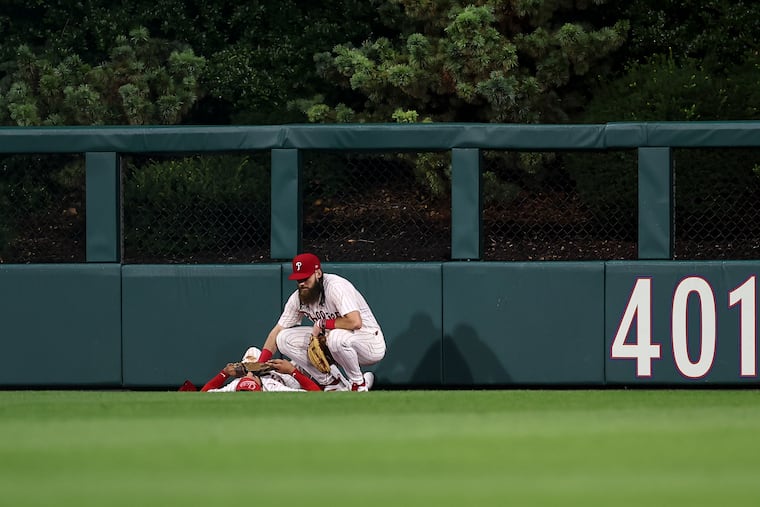
Derek Hill has made several spectacular catches in the two months he’s roamed the outfield for the Phillies.
He robbed Juan Soto of a homer in June, made a highlight-reel dive in Detroit in July, and earlier this series snagged a ball while tumbling to the ground. When Nationals shortstop CJ Abrams hit a laser to center field in the 11th inning on Wednesday, Hill made another all-out effort. But this time, he couldn’t come up with it and crashed into the fence.
Hill remained on the ground at first, but was eventually helped to his feet and walked off under his own power.
» READ MORE: Andrew Painter exits his start vs. Nationals with left hamstring tightness
Interim manager Don Mattingly called it a bruised shoulder, but added the Phillies were evaluating “everything” for the center fielder, including a potential head injury. Hill was not made available to media postgame.
“You hit a wall like that, it’s not too forgiving,” Mattingly said. “I think, give it a chance to evaluate overnight, see what happens, how it comes in tomorrow.”
What unraveled into a six-run 11th inning sealed the Phillies’ 10-4 loss to Washington, but most pressing for the club is the status of Hill and starter Andrew Painter, who exited the game after four innings with tightness in his left hamstring. Both will be reevaluated Thursday.
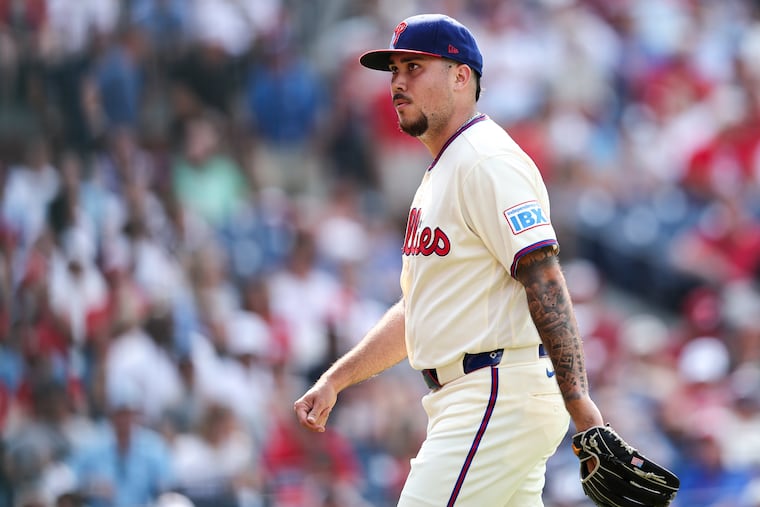
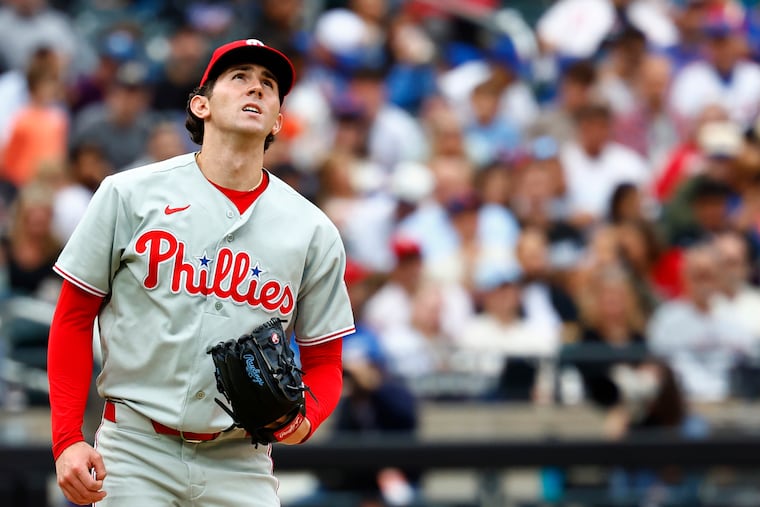
Painter grimaced after falling off the mound during his delivery of a 3-2 pitch to Daylen Lile in the first. He initially remained in the game, with the Phillies checking on him after each inning. When he reported that his hamstring began to tighten up after the fourth inning, the staff decided to pull him.
Painter said he has never had a hamstring injury before, but he was not concerned that it will turn into something serious.
“I’m not too worried about it,” Painter said. “I felt like I could have gone out there and still competed. They felt like they didn’t want to risk that, so that’s why we made that decision.”
With their lack of starting pitching depth, the Phillies cannot afford an injury to Painter. They did not add rotation help at Monday’s trade deadline, with president of baseball operations Dave Dombrowski citing Painter’s encouraging outing against the Orioles as one reason why.
“Really, the choice came: Do you end up getting a guy that’s a fifth starter that you don’t think is as good as your guy that you have now, and option the guy that you think is a better chance to win to help your depth, or do what we’re doing?” Dombrowski said Monday. “And we figured we do what we are doing.”
» READ MORE: New Phillies relievers Brooks Raley and Caleb Kilian happy to contribute to a team that’s ‘gunning for it’
While Painter worked on his fastball in Lehigh Valley, the Phillies relied on Alan Rangel and a patchwork of bullpen games to cover the No. 5 spot in the order. It did not work. They have lost 13 consecutive games started by that rotation spot, a streak that includes Painter’s struggles before he was optioned on June 17.
Painter threw just 63 pitches and appeared to improve as the game went on. After giving up a run in the first on a hit batter and two singles, Painter held the Nationals off the scoreboard for the next three innings. He sidestepped a walk and another single, while striking out four. He tossed a 1-2-3 fourth inning, using just nine pitches.
“The changeup was really good. Something we’ve been building on,” Painter said. “Got some good swing and miss there. I feel like the command of it is getting better and better each time I go out there.”
With Painter’s outing cut short, the bullpen had to cover the next 21 outs as the back-and-forth game marched into extras. Tim Mayza, Orion Kerkering, and Jonathan Bowlan each delivered a scoreless inning.
Newly acquired reliever Brooks Raley coughed up a 2-1 lead in the seventh inning. He surrendered a 404-foot homer to Brady House, followed by a double and a single to left field that scored another.
The Phillies punched back. Cleanup hitter Luis Arraez had launched his fifth homer of the year in the second inning, but outside of that the Phillies generated most of their offense from the bottom half of the order. In the seventh, Alec Bohm worked a leadoff walk, advanced on a single from Brandon Marsh, and tied the game at 3 on Bryson Stott’s RBI single.
They had the chance to add more, loading the bases against Nationals reliever Tom Cosgrove, but Trea Turner flew out to right field to end the rally.
Closer Jhoan Duran pitched a scoreless ninth inning to give his team the chance to walk it off. When they came up short, José Alvarado entered for the 10th. After getting the first two outs, he completely lost the strike zone. He threw seven consecutive balls as he walked Andrés Chaparro and then Nasim Nuñez, forcing in a run as the Nationals took a 4-3 lead.
In the bottom of the inning, Turner hit a sacrifice fly to right field that Dylan Crews made a diving catch on, scoring Hill from third to tie the game once more. The Phillies put the winning run aboard when Bryce Harper drew a four-pitch walk.
» READ MORE: Luis Arraez drives in two runs, brings ‘new blood’ energy in his Phillies debut
With Arraez at the plate, the Phillies called for Harper to steal second, and he was thrown out to end the inning.
Mattingly said the reasoning behind the decision was to get Harper into scoring position for Arraez. Even with the possibility of the Nationals countering by intentionally walking Arraez, Mattingly said he felt comfortable with Bohm coming up to the plate in that situation.
“It’s still going to be a situation where we’re at Bohm and he’s going to need to get a hit,” Mattingly said. “We take a shot there, knowing that Luis is going to be there the next inning and he’ll lead off.”
By the time Arraez was back in the batter’s box, though, the game was already out of hand. Caleb Kilian had entered for the 11th and walked nine-hole hitter Jacob Young. That brought up Abrams, who drove in two runs with his triple to center.
Nationals manager Blake Butera had emptied his bench, and without further options, he called on pitcher Miles Mikolas to pinch-hit next. He laid down a bunt that scored Abrams.
“I think the biggest the thing that hurt us the most there is really the guy walking, and then it puts Abrams in a spot where he gets to hit, we knew the pitcher was behind him,” Mattingly said. “They were out of players, so if we can get him out there, Abrams basically doesn’t swing the bat. But once you walk him, that’s the biggest problem there.”
By the time the Phillies secured the third out, Chase Shugart had replaced Kilian and the Nationals had scored six total runs in the frame. The Phillies’ offense went down in order to end it.

Matt Klentak's fingerprints are still on the Phillies' roster six years after he was the team's general manager. These days, Klentak is part of the front office for the Brewers, who recently clinched their fourth consecutive NL Central title. With the Brewers coming to town Tuesday, Klentak joined Phillies Extra to discuss his current and former teams. Watch here.
You can also subscribe to the podcast version of Phillies Extra on Spotify or Apple Podcasts.
Previous episodes: Jeff Francoeur | Luke Murton | Mike Hazen | Tony Gwynn Jr. | Kevin Stocker | Bobby Dickerson | Jim Bowden | John Middleton | Ryan Howard | Dan Baker