A.R.T. helps disabled artists create their visions
Lori Gibbs paints by dictation, following step-by-step instructions from artists who cannot use their hands and some who cannot speak.
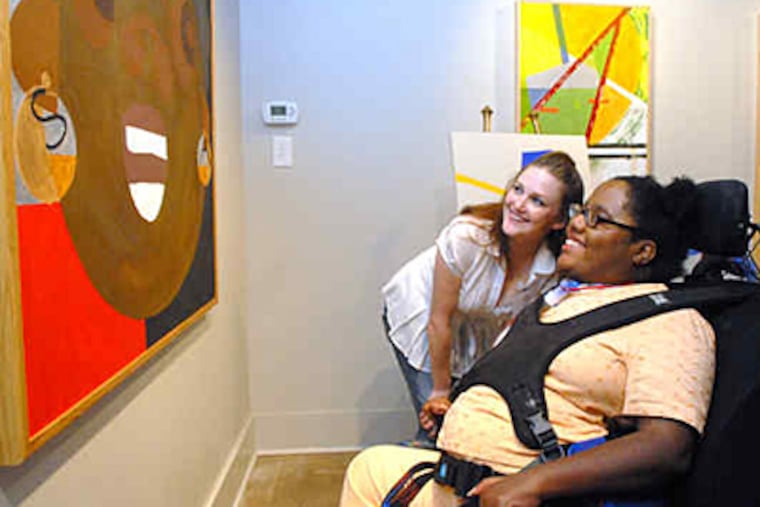
Lori Gibbs paints by dictation, following step-by-step instructions from artists who cannot use their hands and some who cannot speak.
Asking "yes and no" questions and using a yardstick, pencil, color chart, and a bucket of brushes, she translates the visions of severely disabled students at the Bancroft School at Voorhees Pediatric Facility.
She's a "tracker" trained in artistic realization technologies (A.R.T.), developed in the 1990s by painter Tim Lefens of Belle Mead, N.J., who is based at Princeton University.
"We don't see ourselves as art therapy; we see ourselves as ambitious artists," Lefens said.
Bancroft students' works - many abstract, some funny, all colorful - wowed art lovers at an exhibit last month at the Markeim Center for the Arts in Haddonfield.
"They have people helping them with everything," said Kathy Ross, Bancroft NeuroHealth vice president for communications and community relations. "This is theirs."
Lefens developed A.R.T. in 1994 after showing his own work at a school for disabled students.
"My whole thing was freedom, freedom, freedom. I saw the barriers they faced. It broke my heart to see how alive they looked in their eyes," he said. "It squeezed out of me how you could paint without using your hands."
Initially, he developed a painting technique using the wheels of wheelchairs. Then, with the help of engineers, he brought in laser pointers and response buzzers to enable artists to communicate with the trained assistants, who are called trackers.
"It's still the last frontier," said Lefens, 55. "We're working with artists people on the street would rather avoid and abstract paintings they don't understand."
Now a nonprofit, A.R.T. has expanded into sculpture, photography, and music. Lefens has trained more than 300 trackers to work in schools, institutions, and group and private homes. Satellite operations have opened in Miami, San Diego, Cincinnati, and New York City. Support comes from corporations and organizations such as the Christopher and Dana Reeve Foundation.
The Bancroft School at Voorhees Pediatric has offered A.R.T. off and on for about eight students at a time, depending on funding. Wawa Inc. underwrites the program.
Voorhees Pediatric has 119 beds for children who need 24-hour nursing and respiratory care because of congenital anomalies, prematurity, post-trauma and respiratory disorders. Bancroft NeuroHealth operates five classrooms in the hospital for about 65 students, preschool through age 21.
Teachers identify students who have an aptitude for art to participate in A.R.T. as long as they are interested. Some pieces take months to complete.
One 16-year-old wished he could paint every day, he said, even though he enjoys math and doesn't mind his occupational, group and speech therapies.
"I like to mix colors," he said. "I like working on the canvas. I use all different shapes."
His abstract paintings generally include yellow - his favorite color - and often silver and gold. His latest work features broad brushstrokes, which he prefers to Jackson Pollock-style splatters.
"He's pretty good about knowing what he wants," Gibbs said.
She tried to coax direction Monday from a less-decisive 9-year-old. In previous sessions, he had ordered up silver and red semicircles, a yellow slash, and black splatters.
After several failed attempts to decide a starting point, Gibbs asked, "Are we going to pay attention today?"
"No-no-no-no," he indicated by pushing a buzzer, and then smiled widely and gazed about the room.
Gibbs laughed, sighed, and straightened him in his wheelchair.
"I definitely get frustrated. Sometimes it takes a lot to get them motivated," said Gibbs, 30, of Pennsauken. She has worked for nine years at Bancroft as a teachers' aide. "Even when I've exhausted all my ideas, I still know there's something they can do."
The best trackers don't talk too much and love physical work, Lefens said. They're the "opposite of a social gadfly."
"They're not there to help; they're there to do what they're told," he said. "A.R.T. is extremely clean and pure. No one says anything to the artists. It's 100 percent them."
Bancroft students' pieces also have been exhibited at the Kimmel Center in Philadelphia, Princeton University, and on Bancroft NeuroHealth properties. Sales benefit the students directly.
"Each one represents what the child was feeling. They picked the size, shape, colors and design," said Colleen Rowan Valentino, principal of the Bancroft School at Voorhees Pediatric. "It's a wonderful opportunity for them."