Ubiñas: Let's give kids a chance
It will take a village to help neighborhoods and kids survive and thrive.
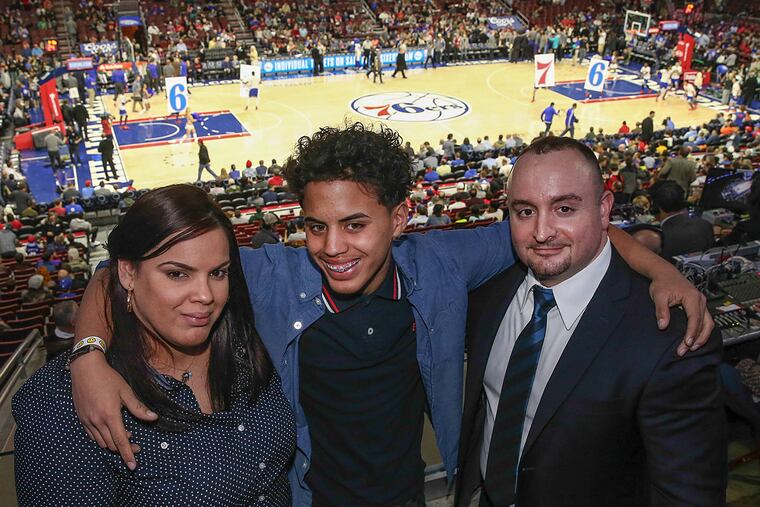
AROUND 9:30 p.m. Tuesday, March 29, 14-year-old Donavin Caminero was walking out of his first Sixers game with his mother and his mentor.
The Sixers lost, but Caminero was in good spirits. He ate his weight in hotdogs and pizza. He got to spend time with his mom, Jennifer Martinez, who spent three years in federal prison on drug charges, and his mentor, Daniel La Luz, a lawyer who has quickly become his confidante.
At the same time on the same Tuesday, another 14-year-old was shot in the back, left bleeding on a West Philadelphia street.
If that doesn't illustrate what's at stake for Philadelphia's children, I don't know what does:
One night.
Two 14-year-olds.
And the sometimes razor-thin line between a young boy being able to act like a boy and another being gunned down on a city street.
I don't know much about the 14-year-old who was shot and is reportedly in stable condition. Police aren't sure if he was the intended target, and they don't yet have a motive or suspects. He had apparently cut off his ankle monitor for a previous incident before the shooting. But as I sat down to write about Caminero I couldn't stop thinking about both boys and the precarious path to life or death in this city.
After being released from federal prison, Caminero's mother participated in the U.S. District Court's inspired Supervision to Aid Reentry Program (STAR). When Martinez, a single mom, appeared before Judge Timothy Rice, she told him she was concerned about her son.
Caminero, who lived with his grandmother while his mother was away, was acting out and hanging with the wrong people. Martinez was worried about her son's education and his future.
It was clear that her progress hinged as much on her son's success as her own. Judge Rice, known for his networking skills, got to work.
He called attorney Tracey McDevitt Hagan, a board member of the Friends of Saint Malachy in North Philly. They had space for Caminero but no financial aid. So McDevitt Hagan asked them to put her yearly donation to the school toward his tuition.
Meanwhile the reentry team started to look for a mentor for Caminero - something we're apparently short of in Philadelphia. One organization, I was told, had a two-year waiting list for mentors. If that's true (and I'm checking), that's crazy.
In stepped Jacqueline Romero, an assistant U.S. attorney and a facilitator for reentry court, who reached out to the Hispanic Bar Association of Pennsylvania. They hooked up Caminero with La Luz. The association also gave Caminero a scholarship for his second year at Saint Malachy.
Caminero wouldn't share specifics about what he and La Luz talk about - you know, bro code - but he said this about the man he's grown to trust. "Let me put it this way, I've cried on the phone with him."
Next year, Caminero is headed to Cristo Rey High School, an independent school for low-income students that recently announced that 100 percent of their first graduating class was accepted into a four-year college. "I've got goals that I can only achieve through school," Caminero said. "I want to be a lawyer like Dan."
You see what happened here - a network mobilized to come to one family's aid. And it's making all the difference.
After my last column about youth violence, I got the typical responses from people screaming about personal responsibility. Look, you'll get no argument from me. Children shouldn't be having children. Parents, whatever their age, need to step up. Broken families absolutely contribute to poverty and violence.
But let's get real. We can continue to scream about what should be or we can deal with what is: 60,000 children in Philadelphia are growing up in deep poverty in the poorest big city in America, often with one parent. And while we love to demonize them, some of those parents are actually like Martinez, busting their humps to put food on the table, having to choose between being present or going hungry. Martinez commutes almost an hour each way to her job as a hairdresser.
These kids, in turn, are on their own in crappy neighborhoods, underfed, undereducated, and undervalued - how else to explain the "not my problem" response from so many?
So we have two choices: We can smugly scream personal responsibility while deliberately choosing to ignore the reality in front of us, not to mention the racial and economic history behind it. (But that's a whole other column.) Or, we can own the fact that writing off these kids costs us all in one way or another. At a recent hearing on youth violence, Kathleen Reeves, from the Lewis Katz School of Medicine at Temple University, said that in 2012, gun violence in the U.S. cost $229 billion, almost $90 billion more than the budget of the U.S. Department of Education.
We can't help every family or every kid. But we can each help one. It could be through an organization, or more informally in your own neighborhood. Talk to that kid on the edge, talk to the knucklehead on the corner; show them that we care what happens to them, that we want them to be kids, going to school or enjoying a game, not fighting for their lives on our streets.
215-854-5943 @NotesFromHel
Helen.Ubinas