Pakistani civilians flee Swat battles
MINGORA, Pakistan - Tens of thousands of civilians, many on foot or donkey-led carts, took advantage of a lifted curfew to flee Pakistan's besieged Swat Valley yesterday, while the army said it had killed 400 to 500 militants in its battle against the Taliban.
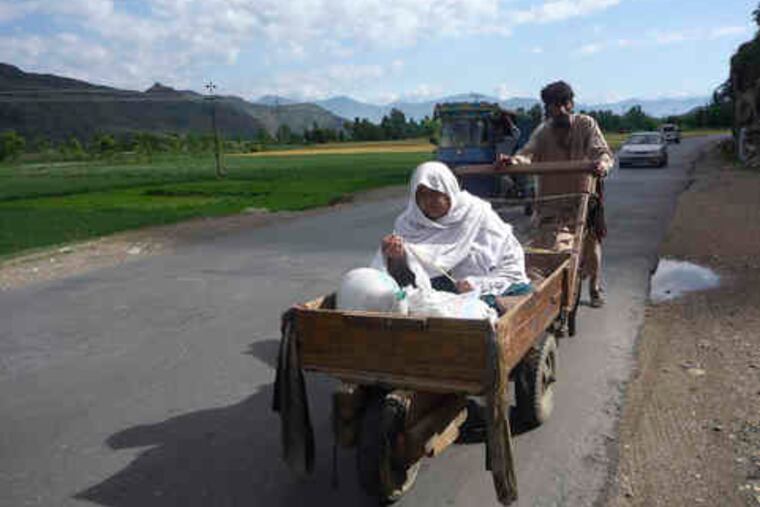
MINGORA, Pakistan - Tens of thousands of civilians, many on foot or donkey-led carts, took advantage of a lifted curfew to flee Pakistan's besieged Swat Valley yesterday, while the army said it had killed 400 to 500 militants in its battle against the Taliban.
The hemorrhaging of residents from a scenic valley that once attracted hordes of tourists threatened to greatly exacerbate an internal refugee crisis for a nuclear-armed nation already facing economic, political, and other woes.
The army offensive has been praised by the United States, which wants Pakistan to root out havens on its soil where Taliban militants can plan attacks on American and NATO forces across the border in Afghanistan. In an interview aired yesterday on NBC's Meet the Press, Pakistani President Asif Ali Zardari urged international support for the fight and insisted the army had enough troops in the northwest to handle the threat.
Some residents leaving Swat's main town of Mingora cursed the situation and condemned the Taliban, while others blamed Pakistani leaders for bowing to the West. "Show our picture to your master America and get money from him," some taunted.
The desperate Swat residents were trying to leave any way they could - on motorbikes, animal-pulled carts, rickshaws, or foot. A ban on civilian vehicles entering the valley complicated the exodus for those without cars. Some chided an Associated Press reporter for slowing them down by asking questions.
"We are going out only with our clothes and a few things to eat on the long journey," said Rehmat Alam, a 40-year-old medical technician walking out of Mingora with 18 other relatives. "We just got out relying on God because there is no one else to help us."
The army's nine-hour suspension of the curfew yesterday could signal a more intense operation now that more civilians have left.
Fighter jets and helicopter gunships have pounded Swat and surrounding districts for several days after Taliban fighters in the valley moved out and tried to impose their reign in other areas, including a stretch just 60 miles from the capital, Islamabad.
Much of the latest fighting occurred along the periphery of Swat and Shangla, a neighboring district, and at least 140 bodies of alleged militants were discovered at a militant training camp in that area, Army Maj. Gen. Athar Abbas said.
In Swat, Mingora was relatively calm, though an army statement said 50 to 60 militants died yesterday in various parts of the valley. Taliban fighters remained visible in Mingora.
In the northwest district of Mardan, government official Khalid Umerzai said more than 100,000 displaced Pakistanis were expected, on top of 252,000 already there. Before the latest operation, about 550,000 people were registered as displaced from past offensives in other parts of Pakistan's northwest, including the semiautonomous tribal belt, according to the United Nations.
The international aid agency World Vision said its relief workers were finding "intolerable" conditions at some camps due to soaring temperatures, overcrowding, inadequate toilets, and a lack of electricity.
"Despite the coordinated efforts of the Pakistani authorities, World Vision, and other aid agencies on the ground, we may not be able to meet the most basic needs of the refugees as quickly as they are arriving in the camps if it continues at this pace," said Jeff Hall, an official with the aid group.