What to know about the ceasefire for a besieged Ukrainian city announced by Melania Trump
Melania Trump announced the local truce Friday after negotiation with both the Russian and Ukrainian governments.

KYIV, Ukraine — A rare local ceasefire in Ukraine is expected to take effect early Tuesday morning, to allow aid delivery and evacuation in a Russian-occupied frontline city where about 2,000 civilians are trapped, threatened by starvation and constant bombardment.
The plight of the city, Oleshky, has drawn international attention. Melania Trump announced the local truce Friday after negotiation with both the Russian and Ukrainian governments. A week earlier, Pope Leo XIV, just three days after surgery for lung cancer, spoke with Russian President Vladimir Putin and called for a ceasefire to enable an evacuation there.
Ukrainian officials, volunteers and relatives of people in Oleshky joined a frenzy of messages, calls and announcements to organize residents to register for transport out of the city.
“Every three minutes, people message and call me about evacuation,” said Ksenia Arkhipova, a Ukrainian volunteer worker from Oleshky who has been helping with coordination plans from elsewhere in Ukraine.
People were asking her if many others had signed up for the evacuation, and when she said they had, they asked to join, too, she said. By midday Monday, she said she had gathered 200 names on a list and had some 300 more people she wanted to contact.
“They gave us so little time,” she said of the Friday announcement.
Why Oleshky is caught in this vise
Oleshky sits on the southeastern bank of the Dnieper river in southern Ukraine, where the river forms the front between the warring armies. It has been under Russian occupation since the full-scale invasion of 2022.
On the opposite bank of the river is the much larger city of Kherson, which fell to Russia but was later retaken by Ukrainian forces.
About 24,000 people lived in Oleshky at the time of the invasion, but most of them fled early on.
Yuri Sobolevsky, deputy chair of the Kherson regional council, the local Ukrainian governing body, said many of those who remained were older people.
“In most cases, people don’t leave because it’s their home, and they will stay despite any circumstances and wait for better times,” he said.
But the civilian population has dwindled as things worsened in Oleshky.
“It’s hell there,” Sobolevsky said. “People need to be evacuated from there, one thousand percent. They’re living 24/7 under risk of death.”
How conditions there got so bad
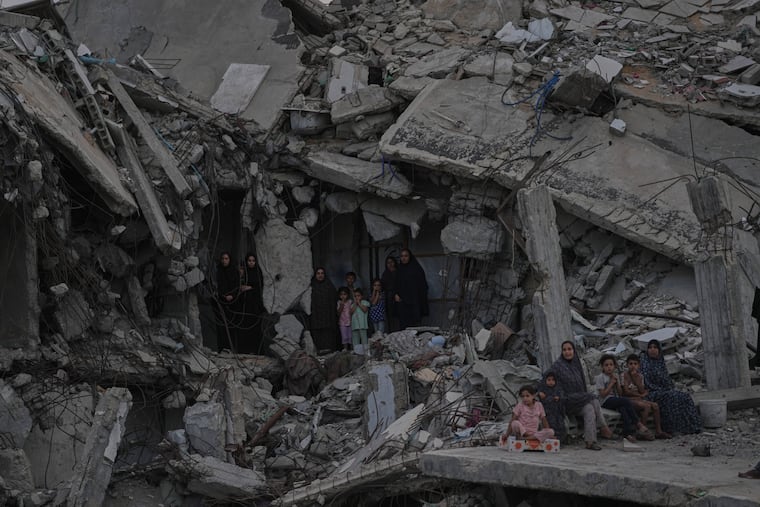
With the rising dominance of drones in this war, Oleshky falls squarely in the widening “kill zone” between the two sides, largely abandoned by civilians, where anything that moves on the ground can be seen from above as a target.
This year, that drone warfare has grown markedly more intense. Russian soldiers and drone pilots operate out of ruined buildings in Oleshky, using it as a base to strike Kherson, on the northwest bank. Kherson, where more than 40,000 people live, is hit daily by drones and bombs.
Ukrainian drone pilots, in turn, try to defend Kherson by hitting the Russian military in Oleshky.
“It’s the constant accumulation of drones on both sides,” said Roman Kostenko, a member of Ukraine’s parliament and secretary of the defense and intelligence committee. “The intensity of combat operations has grown due to the fact that there are more drones, more crews, and the enemy has set a goal to destroy Kherson.”
“So many apartment buildings in Oleshky are used for positions to strike Kherson,” he said.
“Of course, then it’s a two-way battle,” he added. “Kherson is also under increased attack since the spring. Therefore, in response, our defense forces are also trying to destroy the enemy.”
In addition, most roads in and out of the city have been mined and traffic is targeted by drones. Trucks stopped delivering food and medicine to Oleshky months ago because the drive was too dangerous. Many people have lost electricity, heat and gas service.
A Ukrainian drone operator working in the area said pilots took pains to distinguish between civilians and soldiers.
“If surveillance sees a person in a uniform, we strike,” said the pilot, who asked to be identified only by a call sign, Dragon, for security and in accordance with military protocol. “If we find a house with people in uniform, we knock it down.”
How the evacuation is supposed to work
The ceasefire was set to begin at 3 a.m. Tuesday in Ukraine (9 p.m. Monday in the eastern United States), but the evacuation cannot begin right away.
The first task will be mine clearance of access roads by Russian engineers, followed by the trucking in of humanitarian aid, including medicines and food, to the city. People will then be registered for evacuation and are expected to leave on a convoy of buses starting Thursday.
Russia and Ukraine have blamed each other for turning Oleshky into a death trap, and both are trying to dominate the public relations around the evacuation.
Yana Lantratova, Russia’s human rights commissioner, said in a statement Monday that a Russian mission to Oleshky would learn the needs of the people there and deliver aid.
“Another task is to ensure the departure of people who, I emphasize, will voluntarily make such a decision,” she said.
She added, “there are not many people in Oleshky who have expressed a desire to leave.”
The agreed route for the evacuation is through Russian-held territory, so only Russian forces will be involved. Ukrainian officials are concerned that Russia will present the event as a grand humanitarian gesture by Moscow.
They have also warned that the civilians feared that they would be arrested or harassed by the Russians, or that Russia would make it difficult for them to return to Ukrainian-held territory.
Why conditions in Oleshky are unlikely to improve
As long as Russia keeps bombarding Kherson, Oleshky will remain strategically important to it.
The Ukrainian drone pilot said, “If we want Kherson to live, not one building should remain standing in Oleshky.”
“People should leave,” the pilot said. “They should leave, and not return.”
Kostenko, the Ukrainian parliament member, said there were concerns that a ceasefire would allow the Russian military to resupply and rotate its troops there, including some who have positions on islands in the Dnieper delta.
(STORY CAN END HERE. OPTIONAL MATERIAL FOLLOWS.)
Some Russian soldiers had even attempted a river crossing to Kherson several weeks ago, he said.
“We understand the enemy will use this to his advantage,” he said. “I think they will try to do a rotation, bring in more forces, regroup, take better positions. So we will need to watch them.”
This article originally appeared in The New York Times.