Fipp, Eagles' kickers experimenting with kickoffs
THE FIRST TWO kickoffs in the Eagles' 17-9 win over the Buccaneers on Thursday landed a few blades of grass shy of the goal line.
THE FIRST TWO kickoffs in the Eagles' 17-9 win over the Buccaneers on Thursday landed a few blades of grass shy of the goal line. On the first, Kenny Bell fumbled Caleb Sturgis' kick at the 16-yard line. On the second, Donteea Dye returned Cody Parkey's kick to the 25-yard line.
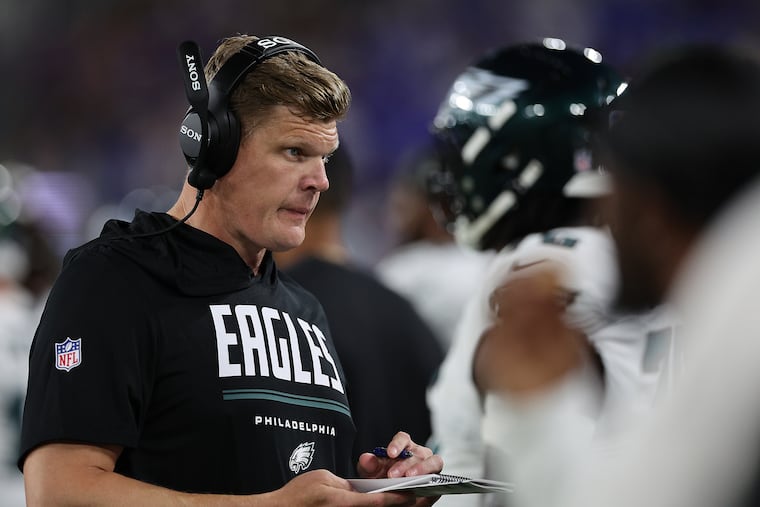
All that mattered to special teams coach Dave Fipp was getting Tampa Bay's returners out of the end zone.
In the offseason, the NFL changed the way it handles touchbacks on kickoffs. Instead of a touchback bringing the ball to the 20-yard line, the offense starts at its own 25-yard line, a 25 percent increase in field position.
Just five years after the league moved the kickoff to the 35-yard line to cut down on returns and injuries during those manic maelstroms, the shift to the 25-yard touchback would seem to make it once again more enticing for teams to draw kick returners out of the end zone.
Yet, as with all new rule changes, teams are treating it as a work in progress.
"It's kind of a mystery," Trey Burton said, "because you don't really know what other teams are going to do. We know what we want to do, and we know that Fipp's going to try a bunch of stuff out."
Fipp himself said after the game that he plans on experimenting plenty in the preseason.
Sturgis, whose second kickoff landed 4 yards into the end zone after his first just grazed the goal line, said he feels as if he can aim the ball with reasonable accuracy, not just left-to-right but also for depth.
"We can get it to a pretty good 4- or 5-yard range, plus or minus," Sturgis said. "It's just like golf. There's mis-hits. But if I hit a good ball, I can know probably within 3 or 4 yards of where it's going to be."
Both Parkey and special teamer Trey Burton pointed out another key part of the team's short-kickoff strategy: angle toward a corner.
"You're really just trying to get under the ball a little bit and aim it," Parkey said. "You want to go either left or right with it, try to push them in a corner and make it hard for them to get out. On some kicks you're still going to kick it deep, and on some kicks you're going to be asked to kick it shorter. The goal is to make them not know what you're going to do. I try to line up the same time and make it different for them."
Burton said the team was definitely trying to force the Buccaneers' receivers into returning the kickoffs Thursday night.
"Yeah, for sure," Burton said. "If you can get good hang time, and you can put it between the 5 and the goal line, it's really hard to get past the 20-yard line just because everyone's flying down there."
Of course, this was just the first game of a four-game trial period. Fipp reiterated that he's eager to see how the rest of the league plays it. He also said the approach will depend on specific situations.
"I think at the end of the day that's what's going to factor into it: who's your team, who's their team," Fipp said. "What's the situation in the game, and what's the risk-reward?"
On Parkey's second kickoff, the ball meandered down the field, resembling the kind of squib kick often attempted at the ends of halves. It looked intentional at the time - maybe Fipp experimenting with more unorthodox approaches. Parkey acknowledged sheepishly after the game that it was an accident.
"I just tried to kick it too hard and sometimes you miss the ball, so that happened," Parkey said. "I still think we got them at the 24, so it's like a touchback I guess."
But who knows? Maybe the squib will become the kickoff approach du jour across the league. It's all question marks right now.
The kickoff, it seems, is up in the air.
@AdamWHermann