Can Cooper stay with Eagles after slur?
In trying to forecast Riley Cooper's future with the Eagles, two dynamics are in play. On the field and in the locker room.
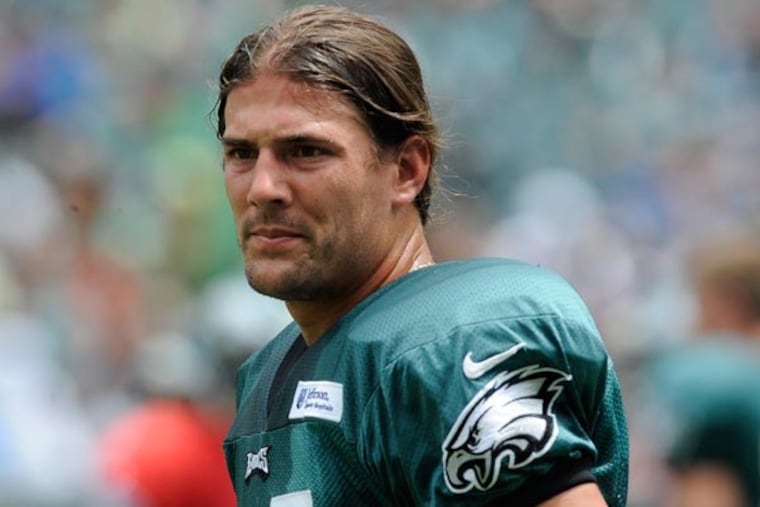
In trying to forecast Riley Cooper's future with the Eagles, two dynamics are in play.
On the field and in the locker room.
Having worked in the National Football League, in the Green Bay Packers' front office, and also as a consultant helping with contract negotiations for the Eagles, Andrew Brandt tends to take a clear-eyed look at NFL issues, including how Cooper's fate will play out.
"You have to realize all players aren't created equal," Brandt said Thursday, talking about how personnel decisions are based on past performance, talent, and need. "My sense is that if it wasn't Riley Cooper making these comments but some bottom-of-the-roster player, he'd be gone."
Before Cooper was heard using a racial slur at a Kenny Chesney concert in an online post Wednesday, the wide receiver presumably had moved up on the depth chart after starter Jeremy Maclin suffered a season-ending torn knee ligament last week.
Brandt, who also worked as a player agent, knew the Eagles would be monitoring their own locker room carefully for player reaction. Already, one unnamed Eagles veteran told The Inquirer on Thursday that he didn't think he would ever speak to Cooper again. LeSean McCoy said he didn't see too many teammates talking to the wide receiver Thursday.
"What teams crave is no drama," said Brandt, now director of the Moorad Center for Sports Law at Villanova and an ESPN analyst. "This is not good to have."
John Giannini, the La Salle University men's basketball coach, said dynamics within a team, any team at any level, can be fragile and potentially explosive.
Giannini said that during two different seasons over his career individual players had problems with each other, and it clearly affected the team, including its performance.
"Both situations started with joking around and escalated pretty quickly," said Giannini, who also had been head coach at Maine and Rowan. "It pretty much ruined our season. We never recovered from it. . . . If teammates are at odds with each other at that level, it's almost irreparable. . . . You can't help but have teammates lean toward one side or the other thing. It's an intangible thing, but, as a coach, there's not a lot you can do besides the obvious of trying to mend fences."
Making it clear that no racial aspect was involved in his examples, Giannini said regrettable comments made within a team dynamic are different because of "how delicate chemistry and intangibles are when people have to live with each other for eight months and depend on each other for their livelihood."
And in the experiences he was citing, Giannini said, "nothing criminal happened. It was all personal."
It's not a perfect parallel, but incendiary comments by Atlanta Braves pitcher John Rocker in 1999 greatly affected that team's clubhouse atmosphere.
"It's never forgotten once you do it," said Jeff Pearlman, the author of the Sports Illustrated story in which Rocker made his most insensitive comments. "In some odd, really strange way, it's easier to overcome the killing of the dogs than this."
The difference from Cooper's situation, or from Michael Vick's situation, was that Rocker seemed more consistent. Rocker already had referred to an African American teammate, Randall Simon, as "a fat monkey." In the SI article, Rocker talked of taking the No. 7 train in New York, how he never could do that all the time.
"Imagine having to take the 7 train to the ballpark, looking like you're [in] Beirut next to some kid with purple hair next to some queer with AIDS right next to some dude who just got out of jail for the fourth time right next to some 20-year-old mom with four kids. It's depressing."
Teammate Brian Jordan described the fallout this way to ESPN the following season: "It's hard enough to play this game, when in every game you've got to face, you've got to hear one guy on your team being a cancer. I mean, time and time again, it is going to eventually take an effect."
"It definitely had an effect," said Pete Van Wieren, a Braves announcer at the time. "The one big difference is, John Rocker never showed any remorse for anything he said or did. . . . Everybody in the clubhouse distanced themselves from him."
The Braves still made the playoffs in 1999 and 2000, but Rocker was traded during the 2001 season.
"I do think when he was eventually traded, there was almost a collective sigh of relief," Van Wieren said Thursday. "I think more than anything, there's a tenseness in the clubhouse when the player is there."
Brandt said there is no perfect locker room. Players sometimes have issues with each other. Tensions exist for many reasons.
"For anybody to say any locker room is 'Kumbaya' is probably false and just spin," Brandt said.
Asked whether he thought Cooper would stay with the Eagles, Brandt said: "I would sense, as long as he plays well - as long as he's doing well on the field - they'll move past this."
Click here for complete coverage of Philadelphia Eagles training camp.