Eagles concerned about players' lives on and off field
Alleged murder by former Patriot Aaron Hernandez has Eagles reassessing the way they evaluate the character of players.

WHEN NEW England Patriots tight end Aaron Hernandez was charged with first degree murder this summer, shock waves echoed through NFL personnel offices.
Teams across the league knew that they easily could have been the Patriots, dealing with questions about whether they'd harbored or even enabled a killer in their locker room. As New England comes to Philadelphia tomorrow for 3 days of practice with the Eagles heading into Friday's preseason opener, it seems likely the Hernandez horror will haunt one of the NFL's showcase franchises for a long time.
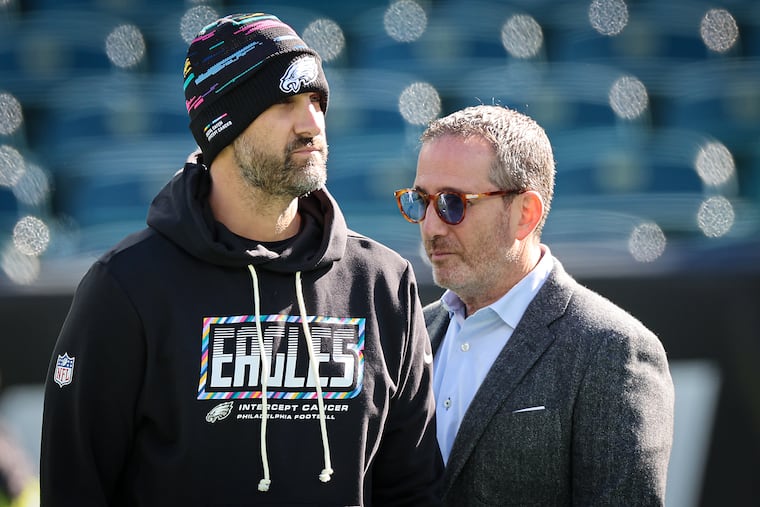
The Eagles certainly noticed. General manager Howie Roseman said recently that the team will ramp up its efforts to learn everything it can about college prospects' lives off the field. Roseman also said the Eagles have a set of criteria, which he wouldn't disclose, intended to keep them from being overly swayed by a potential criminal's talent. Basically, if this, this and this have happened, the Eagles aren't drafting the guy, in any round, under any circumstance.
"We spend as much time on that as we do how they're going to fit into our defense or offense," Eagles player personnel exec Rick Mueller said last week.
Hernandez slid from the second round to the fourth in the 2010 draft, allegedly because of character concerns. Still, there are concerns and there are concerns. Eagles director of college scouting Anthony Patch said recently: "Aaron had some red flags, but a situation like that, nobody thought it would be that extreme."
Roseman said the Eagles depend heavily on their area scouts. Maybe what the scouts do in this respect is more important than actual talent evaluation, because Roseman or Patch or Mueller or player personnel vice president Tom Gamble or head coach Chip Kelly can watch a wide receiver's tape and tell if he's talented. What they can't assess is his ability to stay out of jail.
"We've always told our area guys that's the most important aspect of their jobs. At the end of the day, they need to know these guys backwards and forwards," Roseman said. "We've come up with a way that we have kept players off our board - we have criteria to do that. But we're not going to be perfect. There are some guys we've met with and thought would be great character guys, and they've gotten into trouble. And then there's guys that have been in here and we've said there's no way they'd be able to stay out of trouble in the city, and they go on to other places and do really well. That's the hardest part of it. It's easier to evaluate the players on film. Knowing what a 21-, 22-, 23-year-old is going to end up becoming, in this environment, is hard."
Teams traditionally have placed a lot of emphasis on interviews at the Senior Bowl and the NFL Scouting Combine as character assessment tools, but as Eagles chairman Jeffrey Lurie noted last week, albeit in a different context, agents polish players' interviewing skills to a dazzling brilliance. Everyone is chipper, upbeat, respectful, personable. Interviews aren't as big a deal as they once were.
"The guys that are really, for lack of a better term, good con men, it's hard to see through them," Roseman said. "It's hard to really know them. You can spend time with someone and go on campus and interview a lot of people, and one day maybe they just snap and go in a different direction."
Roseman decided that the aftermath of the Hernandez arrest would be "a good time to reevaluate [the process] as a scouting staff."
He said that means more time on campus, trying to get background.
"When our scouts go in there - we send them in there a bunch of times - we've told them we're going to send them in there an additional time this year just to make sure they get that," Roseman said. "You're talking about talking to the coaches, talking to the trainers, talking to the strength and conditioning staff, talking to the academic adviser, going around campus and trying to figure out if there are [unsavory] people they've been associated with, talking to the players on the team. If we have guys that we're really unsure of, we'll go to their high school and spend the day. We've had our scouts or one of us go down and spend the day with the person's family. See how they interact with their family. See the kind of situation they're brought up in.
"But again, we're talking about young guys sometimes coming into a different atmosphere. You're talking about maybe small-town guys coming into the city of Philadelphia. How are they going to adjust to that?"
Is it hard to get people at schools to level with you? College teams recruit off their success in sending players to the pros. How often is anyone around a college program going to tell you, "Nah, don't draft this guy"?
More often than you might think, Roseman said. Though you might not hear anything quite so blatant, coach X might have reason to be frank with a potential future NFL employer.
"You find that a lot of people want to have a good reputation in the National Football League. Most of the people you deal with are straight shooters. They don't want to throw their players under the bus, but they'll say, 'Maybe that's something you should look at'- give you a little hint," Roseman said. "And that's why we tell our area scouts to go in and make sure you have good relationships with people, because at the end of the day, those people you see year-in and year-out, that you see three times a year, should have some sense of loyalty toward you."
Gamble said a team has to take special care with sensitive information, has to make sure it doesn't get out that someone at the school told you something unfavorable.
"You hope that we all kind of work together," he said. "You start talking about negatives and families, it's really tough. All we're trying to do is get the best information to make the best decision."
Gamble cautioned that you just can't afford to red-flag every prospect who seems a little iffy off the field. The Eagles struggled at times during the Andy Reid era with maybe wanting every player to be an Eagle Scout, team captain-type. But a lot of football players come from rough backgrounds, have some growing up to do when they arrive in the NFL. Brian Dawkins, the most admired Eagle of the last decade or so, has acknowledged he fell into that camp, when Dawk came here from Clemson in the second round in 1996.
"It's not a choirboy league," Gamble said. "It's not a choirboy game, when it's all said and done. Ya gotta balance that a little bit - what are you willing to tolerate?"
Click here for complete coverage of Philadelphia Eagles training camp.
Eagles: DN Members-only: Download our exclusive ebook on what we can learn from a coach's first training camp.
[link: http://www.phillydailynews.com/sports/Eagles_training_camp_ebook.html