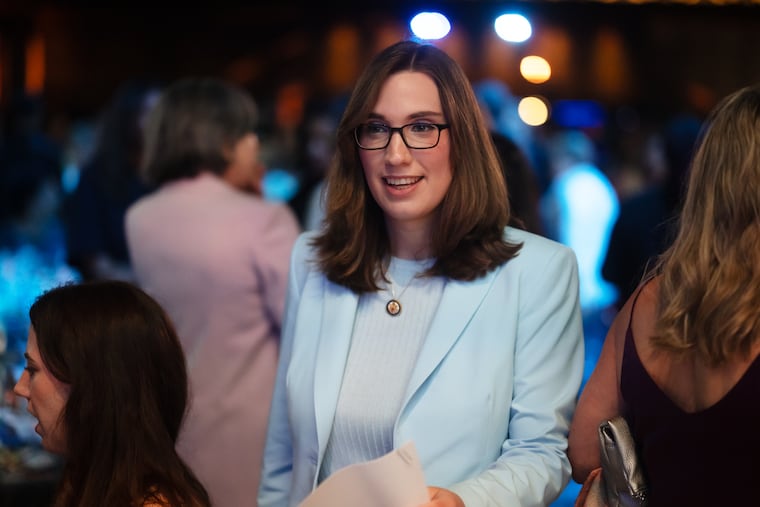
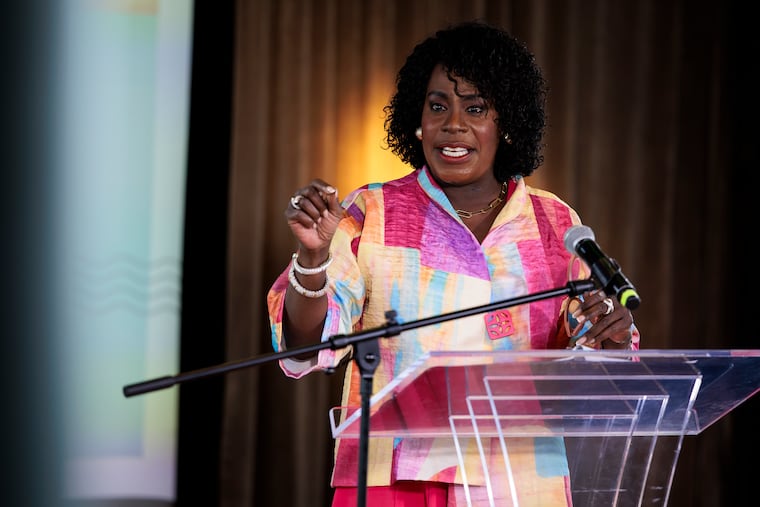
Mikie Sherrill was underestimated. So was the extent of anti-Trump sentiment in New Jersey.
Sherrill won the governor’s race by driving up Democratic margins in every county in the state, particularly in counties home to large Latino and Black populations.

As pundits and some pollsters forecast a nail-biter in the New Jersey governor’s race, Dawn Rowe felt calm and confident. The 66-year-old Democratic organizer in Sussex County has known U.S. Rep. Mikie Sherrill since her first Assembly run.
“I have been saying since we went out canvassing for her: When you meet her, and you speak with her, and she looks right at you, you understand integrity,” Rowe said Tuesday night at Sherrill’s election night party. “We knew if enough people connected with Mikie, they’d see that, too.”
With a commanding 13-point victory over Republican Jack Ciattarelli on Tuesday, Sherrill silenced the critics — some of them within her own party — and fueled a Democratic wave that could portend good things for the party in the 2026 midterms. In the aftermath, some political observers conceded they had failed to grasp the strength of both Sherrill’s careful campaign and the anti-Trump sentiment in New Jersey.
Sherrill called out President Donald Trump in her victory speech, blaming him for escalating healthcare costs and terminating important infrastructure projects.
“We here in New Jersey are bound to fight for a different future for our children,” Sherrill told supporters Tuesday night. “We see clearly how important liberty is. We know that no one in our great state is safe when our neighbors are targeted, ignoring the law and the Constitution.”
Democrats have a voter registration advantage in New Jersey and Trump’s popularity has reached new lows in some polls, signaling an opportunity here.
Every county in the state voted more Democratic than in the 2024 presidential election as turnout surged compared with recent gubernatorial elections. Sherrill flipped back all five of the counties Trump won in New Jersey last year, reversed losses in urban counties like Hudson and Passaic, overperformed in South Jersey, and ushered in along with her a wave of Democratic state legislators running down-ballot.
Reflecting on her win Wednesday, Sherrill pointed to a focus on pocketbook issues as the way she crafted a diverse statewide coalition.
“What I saw was that our message was resonating,” Sherrill said in Trenton. “Because I think these working-class communities, whether it’s, you know, suburbs in Gloucester or Black communities or Latino communities, depends so much on good governance.”
And for many Democrats scarred by Vice President Kamala Harris’ loss, the victory by Sherrill — the first Democratic woman to be elected governor in New Jersey — sent a strong signal that, yes, women can win competitive races.
“She was absolutely underestimated, as women often are,” said Jennifer Holdsworth, a national Democratic consultant and chair of a super PAC that backed Sherrill, at the election night party in East Brunswick.
Most polling had Sherrill up between five and eight percentage points, though several reputable surveys showed a tied race in the final weeks. Polling also under-measured her 13-percentage-point win in the June primary.
“A lot of pollsters were being cautious because they were burned before by voters who were not recognized by their methods,” Holdsworth said. “Now, I think it’s time to come out from under the covers.”
Her margin of victory was even larger than Democrat Zohran Mamdani’s in the New York City mayoral race. Sherrill’s moderate approach was often contrasted against Mamdani’s progressive promises in the lead-up to Election Day, but her commanding win will give a boost to the party’s centrist wing heading into the 2026 midterms as Democrats continue to grapple with the best approach to countering Trump.
Women contributed significantly to the victories for Sherrill and Gov.-elect Abigail Spanberger in Virginia, according to early exit polls. Both women come from national security backgrounds and were first elected to Congress in 2018, a year when women won a historic number of races amid an anti-Trump backlash.
“She went from the Navy to being a prosecutor, to Congress, to raising four children … she’s remarkable,” said Megan Parmelee, celebrating at Sherrill’s election night party with her son, who worked on the campaign.
“It means I have someone in my corner, fighting for me and my kids.”
Focus on affordability – and Trump
Sherrill rode a wave of anti-Trump sentiment to her victory, but she also successfully connected Trump to an affordability crisis in New Jersey and offered some ideas, albeit often lacking specifics, for how to fix it.
“I saw her talking about the things that people cared about, and all the exit polls told you people’s lives are too f— expensive,” Democratic National Committee vice chair Malcolm Kenyatta said. “And she is not just sort of, you know, saying it’s too expensive … she’s saying here’s an executive order on freezing the cost of utility bills.”
To Antoinette Miles, the director of the New Jersey Working Families Party, Tuesday showed that Democrats across the ideological spectrum can win so long as they have something in common: a clear message that motivates voters to get out, and not just vote against something.
“Messages, ones that prioritize working people and point out the problems, and point out who is getting in the way of progress … resonated,” she said. “And I do think Sherrill ultimately found her way to speaking to those things."
At Roosevelt Elementary School in New Brunswick, Luke Peebler, a 21-year-old urban planning major at Rutgers, voted for Sherrill. He had some reservations, he said — she’s further left than he is — but ultimately her message on bringing down energy costs won him over.
Peebler said his energy bill for his one-bedroom apartment skyrocketed this summer, from $125 one month to $300 the next. It was the first time he connected personal finances with an election.
“I feel like I understood where my parents are coming from. One person wants to lower my electric bill and not increase the sales tax, and the other person wants to double the sales tax, essentially,” Peebler said. “Those financial motivations have really driven me, particularly in this election, more than I expected.”
Sherrill repeatedly attacked Ciattarelli for remarks he made during his campaign in which he said that “every option is on the table” after noting other states’ sales tax rates.
Thaiz Cedres, 27, a drug and alcohol counselor in New Brunswick, also said she voted for Sherrill in the hope she would improve affordability in the state.
“I have siblings and I have family on food stamps and SNAP, and I think it’s important to raise awareness, care for people that look like us,” she said.
But for Cedres and several other voters, it was also a way to push back against Trump.
“For me, it is voting blue as far as just wanting to just be a change. I mean, you got to stand for something.”
Reengaging Black and Latino voters
Sherrill improved on Harris’ margins in every county in the state, but her success was particularly telling in counties with large cities, such as Hudson and Passaic. Sherrill won Hudson by 50 percentage points, a 22-point improvement on Harris’ performance there. She won Passaic by 15 points, an 18-point swing. They were the two counties with the largest shifts back to Democrats in this election.
“You know, the last election, we made so much about Donald Trump’s strength, but really what I thought it was about was the couch’s strength,” Kenyatta said. “A lot of people sat out the election.”
She made frequent appearances in Newark, including in the final week of the election with former President Barack Obama. She also had buy-in from local Black leaders like progressive Newark Mayor Ras Baraka, who had attacked Sherrill in their primary competition.
Miles said these appearances, as well as help from progressive groups, served as “a very clear demonstration of the type of coalition that is needed in this moment.”
The Rev. Charles Boyer, a pastor at Greater Mount Zion A.M.E. Church in Trenton, organized Black churches to get out the vote for Sherrill. Boyer supported Baraka in the primary but endorsed Sherrill and worked to get her elected.
“She came out very affirmatively around things very important to us, around housing, partnerships with faith-rooted institutions, to do economic and community development, focus on Black maternal health, education, so we feel very good about that,” Boyer said.
“And honestly, I think, after today, after this election, when, when the campaign sees the enthusiasm of the Black vote and what that’s meant, I’m expecting her to lean in to that much more.”
Sherrill noted Wednesday that Newark had its best gubernatorial turnout since 2005 and said those voters had given her a mandate to drive opportunity and strengthen “education systems.”
Sherrill also focused on her background as a Navy pilot, a prosecutor, and a member of Congress. Her pick for lieutenant governor, Dale Caldwell, will be the first Black man to serve in that position in New Jersey.
“While they try to tear women down, we are sending the first Democratic woman to the governor’s office,” Caldwell said Tuesday night. “While they try to silence communities of color, we’re sending the first Black man to the lieutenant governor’s office.”
At the polls in New Brunswick, several Latino voters said Trump’s immigration enforcement actions and a feeling that the economy had not improved prompted them to vote Democratic.
Kevin Canseco, 27, a New Brunswick Sherrill voter whose parents emigrated from Mexico, said that as Trump focuses his immigration enforcement on noncriminals, Canseco feels more driven to vote blue.
“It’s not always about who has the best, I guess, plan for everyone, it’s who’s genuine? Who cares about me and my community? And who has a heart at the end of the day?”
Sherrill achieved lopsided wins in several Hispanic-majority municipalities.
In Paterson, Union City, and West New York — three municipalities where Hispanic residents make up 64% or more of the population — Sherrill’s margins over Ciattarelli ranged from 57 to 71 percentage points as of Wednesday.
Patricia Campos-Medina, vice chair of Sherrill’s campaign, noted the focus on Latino voters as part of a larger coalition in a big-tent party that got her the win.
“We are progressive, we’re moderate, but at the core we are New Jerseyans,” she said. “We are teachers, nurses, carpenters. … And, most of all, we are all immigrants. Whether you came here 100 years ago or 10 years ago, we are in this country and we belong in New Jersey and in the United States of America.”
A strong South Jersey showing
Sherrill was expected to do well along the New Jersey Turnpike and in populous counties in the central and northern parts of the state. But she also got a big boost from South Jersey, which had been seen as key to a Ciattarelli victory.
The five counties south of Camden — Atlantic, Cape May, Cumberland, Gloucester, and Salem — all went for Ciattarelli in 2021, giving him a combined 56.8% of the vote. Trump also won those counties in last year’s presidential election. Those results led the GOP candidate to focus on South Jersey.
Sherrill won three of the five counties, and had a slim lead over Ciattarelli in the region’s combined vote total. With 93% of the statewide vote counted, Ciattarelli had 49.1% of the region’s vote, a decline of nearly 8 percentage points from his 2021 vote share.
Every county in the state saw increased turnout in 2025 compared with the 2021 and 2017 gubernatorial elections. Overall, about 49% of voters had turned out as of Election Day, up from about 40% in 2021 and about 39% in 2017.
On average, each county swung about 10.6 percentage points more Democratic in 2025 than in 2021. Early voting may have been the driving factor.
As of Election Day, nearly 1.4 million New Jerseyans had voted early, 742,000 in person at early-voting sites and another 641,000 via mail ballots.
Just over half those voters were Democrats, 29% were Republicans, and about 21% were registered with neither party. There was a partisan split between the voting methods, with Democratic voters swamping their GOP counterparts by a whopping 62%-to-21% ratio among the mail vote and a more modest 42%-to-35% ratio among the early in-person vote.
Tim Alexander, a Democrat taking on incumbent Republican U.S. Rep. Jeff Van Drew in 2026, was part of Sherrill’s South Jersey “army.”
He said the campaign coordinated with established grassroots organizations and networks, with a lot of work put into creating more ambassadors in those communities. And he thought her affordability pitch resonated in a place where anti-Trumpism might not have been as effective across the board.
“She talked about real issues. Keep in mind that South Jersey has a strong MAGA presence,” Alexander said. “We had to reach not just Democrats and independents but some Republicans who recognized that your interests are being trampled upon.”
Alexander, who is on his third congressional run, said the Democratic results in South Jersey make him more hopeful as he again attempts to win the district, which stretches from Gloucester County to the Jersey Shore.
Meanwhile, across the state on Tuesday, voters at the polls brought up Trump and many described their decision as a vote against him, rather than specifically for Sherrill or her platform. That prospect had worried some observers in the lead-up. Was Sherrill giving people enough to vote for?
Heather Bryceland, a 52-year-old middle school teacher in Salem County, thought so. Bryceland’s great-grandmother was a suffragette. She voted with her daughter’s rights in mind, feeling lucky, she said, that Sherrill was the Democratic candidate.
“She’s a military vet, making her a strong female,” Bryceland said. “A figure to admire by my daughter and the girls I teach.”
Graphics editor John Duchneskie and staff writer Alfred Lubrano contributed to this article.