Keeping Black history alive at the President's House
Philly’s Black History Month began with an important piece of history missing at the President’s House. Its restoration comes after the community rallied to save it.
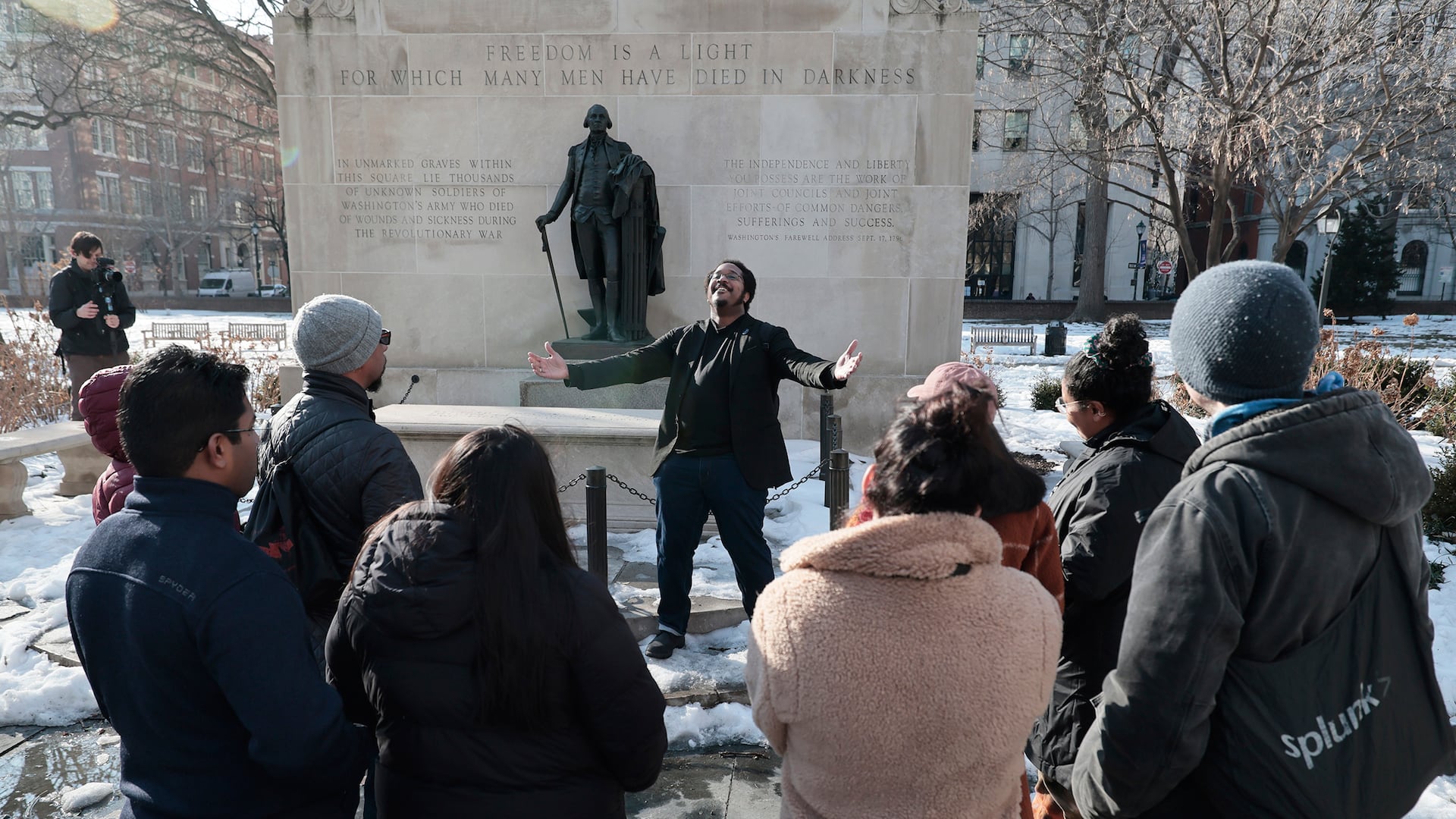
Mijuel K. Johnson stood on the ground where the dining room of the first president’s residence once stood as he told the story of Ona Judge’s path to freedom.
Speaking to a group assembled just steps from the Liberty Bell, Johnson recounted how Judge escaped George Washington’s household in Philadelphia into the city’s free Black community before eventually making her way to New Hampshire, and evading the Washingtons’ several attempts to recapture her.
It’s a story Johnson has told many times as a guide for the Black Journey, which offers walking tours focused on African American history in Philadelphia. One of the first stops on “The Original Black History Tour” is the President’s House Site, an open-air exhibit at Sixth and Market Streets that memorializes Judge and the eight other people enslaved by the first president here.
But last weekend, instead of the educational panels and informative videos displayed for the last 15 years, the guide and his group were faced with faded brick walls and blank TV screens. Adhesive residue marked the spots where colorful panels had been.
It was Johnson’s first group tour since National Park Service employees wielding wrenches and crowbars — acting at the direction of President Donald Trump’s administration — last month stripped out every panel at the President’s House, censoring roughly 400 years of history. Judge’s name was still inscribed on the Memorial Wall and her footprints still imprinted into the concrete as the group walked through the site, but her story was missing. Television screens recounting her life had been abruptly disconnected.
Black History Month began this year with visitors unable to read displays juxtaposing the cruelty of slavery with the country’s founding principles for the first time since the site opened in late 2010. For many tourists and the guides who know the site best, the removal was a call to action.
“In telling their stories, I’m telling my own,” Johnson, 34, of South Philadelphia, said of the nine people the site memorializes, “and that’s where it becomes personal, so that in trying to erase their story, they’re effectively trying to erase me, too, and I just refuse to be erased.”
A federal judge — whom Johnson guided through the site earlier this month — ordered the federal government to restore the exhibits, siding with Mayor Cherelle L. Parker’s administration.
The National Park Service began restoring the panels Thursday, a major development after weeks of activism and litigation.
Parker celebrated the reinstallation in a post on social media Thursday but cautioned: “We know that this is not the end of the legal road.”
The Trump administration is appealing the ruling, so the future of the site remains uncertain even after this week’s victory. On Friday, a federal appeals judge said that the Trump administration does not have to restore more panels while the appeal is pending.
Seeing the site bare without the panels last weekend felt like a “slap in the face” for Maria Felton, 31, a stay-at-home mom from Roxborough. Felton, who is Afro-Latina, joined the Black Journey’s tour with best friend Jahmitza Perez, 37, as part of her quest to reconnect with her heritage.
“The administration can take away physical things. They can’t take away our ability to connect and learn and share our culture,” Felton said.
‘A sign of the revolution’
Johnson has been giving tours since 2019, delivering rousing accounts of U.S. history interwoven with humor and theatrical gestures. He tells his patrons, who come from around the country, that long before cheesesteaks became Philly’s iconic food, the city was known for its pepper pot stew, an African dish.
“We can tell the full story of America,” he said.
Last weekend, Johnson’s tour group was more “somber” than usual, he said, as they saw the bare walls of the “desecrated” site.
“People seeing it for themselves that this actually did happen,” Johnson said.
For Toi Rachal, 47, a pharmacist from Dallas, and her husband, the tour was eye-opening. The couple had been unaware of the Trump administration’s changes to the site until they joined the tour during their visit to Philadelphia. The work of Johnson and other community members to continue telling the story was even more crucial with the exhibits gone, Rachal said.
“If we just walked in these areas on our own, eventually we would have probably figured it out,” she said, “but you may not have known exactly what happened.”
The exhibits were removed under an order issued by Trump instructing the Department of the Interior to remove materials at national parks that “inappropriately disparage Americans past or living,” widely criticized as an effort to whitewash history ahead of this year’s celebrations of the country’s 250th anniversary.
In telling their stories, I’m telling my own, and that’s where it becomes personal, so that in trying to erase their story, they’re effectively trying to erase me too, and I just refuse to be erased.”
But the move brought unprecedented attention to the President’s House, drawing curious onlookers. When the panels were beginning to be restored Thursday, a group observed as park employees put history back in its rightful place.
Shortly before Johnson’s tour group stopped at the site, a volunteer read from a binder containing the informational text that had been removed. The volunteer was one of dozens of people who had signed up for a shift with Old City Remembers, a grassroots effort to speak the history of the President’s House even if the panels were no longer there.
“Because those have been removed, somebody needs to tell the story, somebody needs to make sure that we’re not going to let that history be erased,” Matt Hall, a professor and the organizer of the group, said in an interview earlier this month.
It’s “active history,” said Ashley Jordan, president and CEO of the African American Museum in Philadelphia, located blocks away from the site. “The fact that they are using their words, their demonstrations, through art-making, through signage, through print materials — that has always been a sign of the revolution in America.”
Ahead of Johnson’s tour last Saturday, visitors taking advantage of the warmest winter day in weeks congregated around the bare exhibit wall. In its place were educational fliers about Washington, Ona Judge, and other historical figures. Posters displayed messages: “Truth Matters,” “Erasing Slavery is Pro-slavery,” and “Dump Trump Not History.”
Philadelphians celebrate, but prepare for more fights ahead
Avenging the Ancestors Coalition members gathered Thursday afternoon at the President’s House, celebrating the reinstallation earlier in the day.
“This is actually a moment in time,” said Michael Coard, attorney and leader of the coalition, which had fought tirelessly to develop and, now, protect the site. “Your children, your grandchildren, your great-grandchildren are going to be talking about this for years.”
Coard emphasized the fight was not yet over while highlighting the significance of the community’s contributions in the fight to safeguard the President’s House.
“I just want you for a few seconds just to think about what you all have done,” Coard told the crowd. “Because what you’ve done is to actually create history. … Think about it. You fought the most powerful man on the planet, and you won.”
Even as Philadelphians celebrated the reinstallation, more efforts were being planned to continue sharing the story of the President’s House.
Mona Washington, a playwright and Avenging the Ancestors Coalition board member, is crafting a series of plays related to the President’s House, which she hopes to showcase this summer, during the height of the 250th anniversary celebrations. Some of the plays, she said, are written in the first person for the people who were enslaved by the first president at his Philadelphia residence.
“We’re here, and you can try and erase whatever you want, as much as you want, but guess what? There are lots of us, and we’re just going to keep moving and moving and moving toward truth,” Washington said.
At the President’s House last Saturday, there were few pieces that Johnson could share with the group that had not been tainted by the Trump administration. One of them was the Memorial Wall, which is engraved with the names of Ona Judge and the eight other people George Washington enslaved — Austin, Paris, Hercules, Christopher Sheels, Richmond, Giles, Moll, and Joe. A few paces away, their quarters once stood, where at least four of the nine individuals would stay at any given time, Johnson said.
Outside the quarters appears a plaque signed by the city and the National Park Service that reads: “It is difficult to understand how men who spoke so passionately of liberty and freedom were unable to see the contradiction, the injustice, and the immorality of their actions.”
These words are preceded by an italicized quote from former President Barack Obama, the country’s first Black president: “It was whispered by slaves and abolitionists as they blazed a trail toward freedom … yes we can, yes we can.”
A lack of proper tools and the snow were the only things standing in the way of the Trump administration making further alterations to the President’s House last month. U.S. District Judge Cynthia M. Rufe has now ordered that the President’s House cannot be further altered.
Last Saturday, Johnson assured his tour group as they were filing through the quarters that this piece of history would remain.
“They can’t touch this,” he said.
Staff writer Maggie Prosser contributed to this article.