The Trump administration wants to sanitize George Washington’s role in slavery at President’s House
The federal government uploaded digital renderings of 11 new panels that it was preparing to display at the President's House. They reframe George Washington's role in upholding slavery.
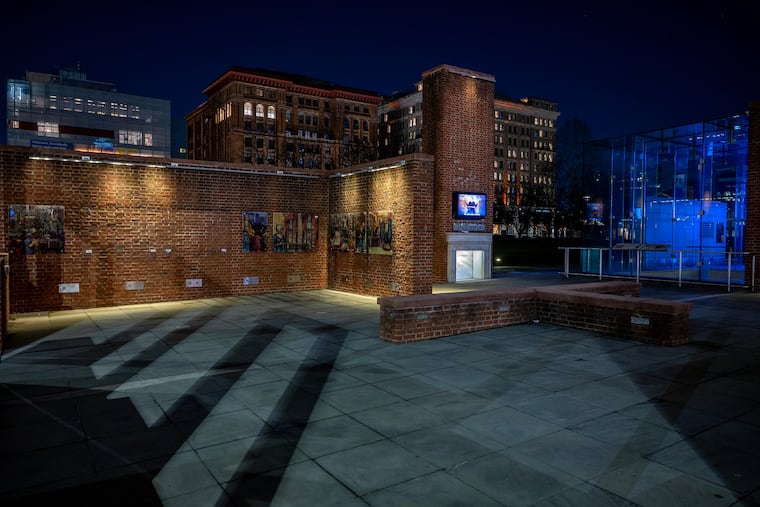
After President Donald Trump’s administration dismantled exhibits about the horrors of slavery at the President’s House Site earlier this year, the federal government planned to replace them with its own account of history.
Details of those replacement panels remained unclear until now.
Digital renderings of 11 new panels uploaded to the government-owned President’s House web page Tuesday provide a broad timeline of U.S. history that includes slavery, the Underground Railroad, and the Civil War. But the panels are less focused on George Washington’s role in upholding slavery and frame the founding father’s enslavement of nine African individuals at his Philadelphia home during the first presidency in a more sympathetic light.
The replacement of the panels came to a halt after a federal judge in Philadelphia ordered the original panels to be restored to the site on Independence Mall. The government was within days of installing the panels when Judge Cynthia Rufe issued her injunction in February, the Department of the Interior said at the time.
But the newly revealed digital renderings show the Trump administration’s willingness to reframe history ahead of the United States’ 250th anniversary this summer and portray Washington in a more favorable light.
For instance, on one panel titled “Presidents Washington and Adams on Slavery,” the Trump administration writes that “Caught between his private doubts about slavery and his public responsibilities as president, George Washington navigated a nation deeply divided over slavery.”
“Privately, George Washington often expressed discomfort with the institution and a desire to see it abolished,” the panel continued. “Yet as a Virginia plantation owner, his wealth and livelihood were deeply tied to it.”
And later in the same panel: “Slaves living in the President’s House experienced a greater modicum of autonomy than elsewhere in the South such as to explore the city and sometimes even attend the theater, with Washington buying the tickets.”
The President’s House, which opened in 2010, is a product of local Black-led advocacy and serves as a memorial to the nine people Washington enslaved at his residence and a reminder of the contradiction of liberty and slavery during the nation’s founding.
Since last year, the Trump administration has scrutinized the site under an executive order that called for a review of displays at national parks that “inappropriately disparage Americans past or living.”
The panels taken down by the Park Service in January included displays titled “The Dirty Business of Slavery” and “Life Under Slavery,” as well as illustrations about the Fugitive Slave Act and Ona Judge, who was enslaved by Washington and later escaped.
But the government is “celebrating and acknowledging the full breadth of our nation’s history,” a spokesperson for the Department of the Interior said in a statement Wednesday.
The spokesperson said the Trump administration encourages visits to the President’s House and wants to acknowledge “the full breadth of our nation’s history” and that “No piece of history should be washed away.“
“The hard work and sacrifices of the men and women who built this nation deserve to be remembered and honored,” the spokesperson said.
Stark differences and new additions
Some similarities and acknowledgment of Black history can be found throughout the Trump administration’s version of the panels, such as mentions of Harriet Tubman and the Underground Railroad, Philadelphia’s Black abolitionists, and Washington signing the Fugitive Slave Act.
The Trump administration also refers to slavery as an “odious and pernicious affront to the glorious rule of liberty.”
But many stark differences remain in content and framing, including in the federal government’s account of the archaeological dig that took place at the site of the President’s House at Sixth and Market Streets during the exhibit’s development in the early 2000s.
The original panel, titled “History Lost & Found,” details the brutality of slavery, Washington’s role in it, and how slavery at the President’s House “undermined the meaning of freedom and mocked the nation’s pretense to be a beacon of liberty.”
It also characterizes the National Park Service’s original hesitancy to help develop the President’s House and the difficulties in locating historical information about Africans who were enslaved.
The Trump administration’s version shares the title, but the content is quite different.
Among three different displays, slavery and the Park Service’s apprehension go unmentioned. Rather, they focus on how archaeology works and the discovery of Washington’s letters and other primary source documents.
They exclude the significance of the remnants found during the archaeological dig that relate to slavery, such as the basement where people enslaved by Washington carried out tasks.
Tuesday’s upload also includes entirely new additions, including two panels titled “Celebrating Independence Throughout the Years,” which detail milestone celebrations of the United States. Also included is additional information about antislavery sentiments, the Union Army in the Civil War, and the role that Christianity played in the abolition movement.
Where things stand
The future of the President’s House continues to be entangled in a legal battle that is playing out in federal court.
Mayor Cherelle L. Parker’s administration sued the Department of the Interior and the National Park Service in January, asking the court to issue an injunction forcing the full restoration of the slavery exhibits.
Rufe issued an injunction on Presidents’ Day that was accompanied by a blistering opinion chastising the Trump administration’s attempt to rewrite history through executive fiat.
Park Service employees restored most of the exhibits in the days following the injunction, while the Department of Justice appealed the ruling to the U.S. Court of Appeals for the Third Circuit. The higher court issued an administrative stay on the requirement to restore the site, but let the prohibition on future changes stand. That portion of the injunction enjoins the administration from “making any and all changes to the President’s House Site, including the installation of replacement materials, without mutual agreement of the City of Philadelphia.”
The Third Circuit has not ruled yet on the merits of the injunction.
The federal government did not approach the city about the new panels, according to a statement by City Solicitor Renee Garcia.
Meanwhile, in the Eastern District of Pennsylvania, the Justice Department filed a motion to dismiss the city’s underlying lawsuit on procedural grounds. City attorneys have until May 1 to respond to the motion.