How Camden tells the story of Mikie Sherrill’s big win and New Jersey’s blue wave
The governor-elect’s dominance in the city reflected her success in winning back the voter groups she needed.

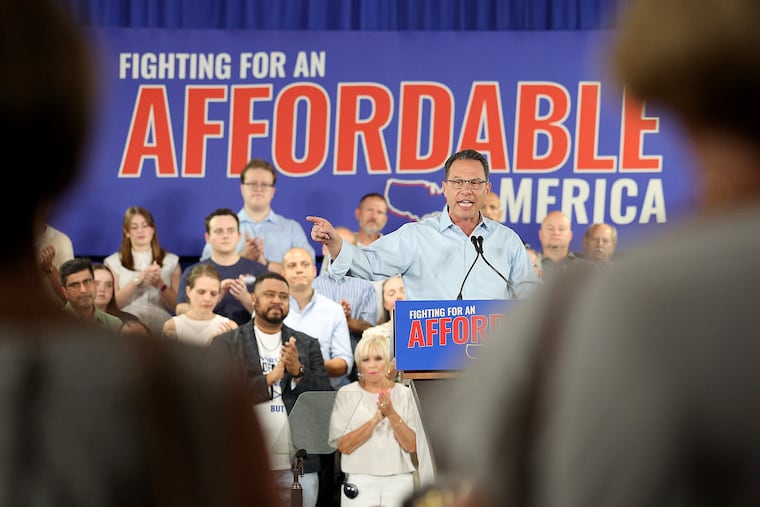
The story behind New Jersey Gov.-elect Mikie Sherrill’s landslide victory last month can be understood by looking at her strong performance in the city of Camden.
The young, diverse, and working-class city exemplifies trends that played out across the state as Sherrill reversed rightward shifts among the voter groups Democrats desperately need to rebound with nationally.
An Inquirer analysis of municipal-level data shows that Sherrill outperformed both former Vice President Kamala Harris in 2024 and outgoing Democratic Gov. Phil Murphy in 2021 across New Jersey’s 564 cities, boroughs, and townships, winning 300 — about 53% — of them as compared with Harris’ 252 last year and Murphy’s 210 four years ago.
She reversed gains made by President Donald Trump last year that gave Republicans false hope that Jack Ciattarelli, who was aligned with and endorsed by Trump, would do much better in November than he actually did as Sherrill outperformed expectations.
Camden’s population is more than 54% Hispanic and nearly 38% Black — Democratic-leaning voter groups that had shifted toward Trump nationally in 2024. Sherrill’s campaign had outreach operations geared toward both Black and Hispanic voters.
Every demographic group in the state swung toward Democrats this year, but Sherrill’s most striking improvement over Murphy and Harris seemed to be among Hispanic people, who make up more than half of Camden’s population.
She similarly made gains in areas across the state that have high populations of young voters, lower-income voters, and voters without college degrees — like Camden.
Voters in Camden turned out for Sherrill resoundingly with 92% of the vote, more than 10 percentage points better than Harris performed in the city during her presidential run last year, and Sherrill outperformed the former vice president in every one of the city’s 40 precincts. The larger the Hispanic share of the voting district, the larger it shifted toward Sherrill.
This was reflected statewide, with the state’s 10 largest Hispanic-majority cities moving an average of 18 points to the left while other New Jersey municipalities moved just about four points toward the Democrat.
Latino outreach in Camden fueled Hispanic support
Outreach to Hispanic voters was driven by a coordinated campaign between Sherrill’s campaign and the state Democratic Party, as well as independent expenditure groups. It seemed to pay off.
In Camden’s most heavily Hispanic precinct, for example, voters gave Sherrill 92% of the vote, 12 points more than they gave to Harris.
Sherrill’s campaign and its backers knew how important it was to win over these voters who had felt taken for granted by the Democratic Party.
Sherrill had limited time to introduce herself to voters coming out of a six-way competitive primary in June — which she won big but with less success in some heavily Black and Hispanic areas. To many voters, especially in South Jersey, she was just another candidate.
UnidosUS Action PAC experienced that unfamiliarity with Sherrill when its canvassers first started knocking on doors in Camden in September, said Rafael Collazo, the executive director of the PAC.
“The question that Latino voters and voters that we spoke to had wasn’t if they were going to vote for Ciattarelli or not, because they were clearly against anyone associated with Trump,” Collazo said. “But they honestly weren’t sure if they were going to vote for Sherrill, because they didn’t feel like they knew her.”
Sherrill’s campaign and backers tapped local leaders like pastors, nonprofit executives, and elected officials, and held events specifically catered to Latinos, said Vereliz Santana, the coordinated campaign’s Latino base vote director, who grew up in Camden.
They spread the message through Spanish-speaking door knockers and Spanish-language ads, which Camden City Councilman Falio Leyba-Martinez, a Democrat, called “beyond impactful.”
“She made it normal for people to understand that you don’t speak English,” he said.
That was not always the case for New Jersey Democrats, according to Patricia Campos-Medina, a vice chair of Sherrill’s campaign and senior adviser for Sherrill’s Latino and progressive outreach. Democratic operatives in the state justified saving money on bilingual messaging over the last decade since most Latinos speak English, she said.
“But the problem is that Latinos have to hear that you are talking to them … otherwise they feel like you’re just ignoring them,” she added.
And it’s not just speaking Spanish. Showing cultural competency — such as using Puerto Rican slang or phrases like “reproductive healthcare” instead of “abortion rights” — is also critical, she said.
Latino organizers in Camden said that community members who supported Trump or did not vote in 2024 have become frustrated by the high cost of living, slashed federal funding, and Immigration and Customs Enforcement’s tactics. Even those for whom immigration was not a top priority or who supported Trump’s plan to deport people who committed crimes have been dismayed, they said.
Camden City Council President Angel Fuentes said videos circulating of immigrants being detained locally have been particularly resonant.
“You can see the tears of these individuals,” he said. “You know, it’s so inhumane. I mean, I really want to use the f-word, but it’s so inhumane how they’re treated. Latinos … we are all family. We should not be treated like this.”
Turnout increased compared to last race for governor
Turnout is typically lower in cities with large numbers of lower-income voters and voters without college degrees, like Camden. But Democratic investments in the city seemed to make a difference this year.
Camden saw a 63% increase in turnout compared with 2021. The jump in the city is more than double the 28% turnout increase statewide compared with the last race for governor.
The city still has relatively low turnout compared with the full state, however, with only 26% of voters casting ballots in Camden compared with 51% statewide.
Camden County as a whole was closer to the statewide turnout rate at 50%, but the county’s increase of 32% from 2021 was smaller than the city’s growth.
Sherrill visited the city of Camden in July — early in her general election campaign — for a visit to CAMcare, a federally qualified health center that treats underserved communities, and went on to discuss it on a national podcast the next day.
She did not return until October, at which point she visited the city three times in the lead-up to Election Day. Her campaign also held a rally outside city lines at the Camden County Democratic Party headquarters in Cherry Hill that Santana said was planned to feel “authentically Latino.”
As part of their “scientific” strategy, Sherrill visited less-Democratic areas in the summer and early fall to try to win over swing voters before pivoting to bluer places like Camden, where they needed to motivate already-registered Democrats to cast their ballots, said Om Savargaonkar, the coordinated campaign director for Sherrill’s campaign and the New Jersey Democratic State Committee.
As Sherrill zigzagged the state, a massive coordinated effort was underway to draw a strong Democratic turnout, bolstered by national funding from the Democratic National Committee.
Sherrill’s coordinated campaign — the state party operation that worked with the campaign — made at least 19.5 million phone calls, door knocks, and text messages statewide, which was roughly 13 times more than the 1.5 million made for Murphy’s coordinated campaign in 2021, Savargaonkar said.
Out of a roughly $12 million statewide investment, about $2 million to $3 million went directly to county parties to supplement the statewide turnout efforts, Savargaonkar said of the coordinated campaign.
Sherrill did even better than previous Democrats in lower-income municipalities
Democrats routinely score landslide wins in New Jersey’s working-class municipalities.
Both Murphy and Harris posted double-digit margins in these communities, but Sherrill took that strong base and supercharged it. She won nearly two-thirds of the vote in the lowest-income municipalities and in places where fewer voters have college degrees — improving on Murphy’s and Harris’ performances by as much as eight percentage points.
In Camden, fewer than one in 10 adults have a college degree and the typical household has an annual income of $40,000. That’s in a state where nearly 45% of residents are college-educated and with a median income of about $100,000.
Sherrill’s campaign reached Latinos in Camden who voted for Trump last year because they believed he would make life more affordable but were having buyer’s remorse, organizers said.
Her campaign spoke with locals about the negative impacts of Trump’s tariffs, engaging with everyone from distributors and manufacturers to local business groups, Santana said. Local surrogates also discussed Trump’s cuts to benefits and programs that help the community, said Camden Mayor Victor Carstarphen.
And Sherrill’s focus on affordability and Trump resonated more broadly.
She also won among voters in wealthier places, including the middle 50% of towns by median household income — places where Ciattarelli won four years ago and where Trump fought Harris to a near-draw last year. Like Harris before her, she managed to win the very wealthiest areas comfortably.
While the city of Camden saw Sherrill’s biggest improvement over Harris in the county, her second-largest improvement came in nearby Runnemede, a borough in Camden County, where the typical household’s income is virtually identical to that of the state.
Sherrill reversed losses among the youngest voters
Trump made gains last year among younger voters across the country, and New Jersey was no different. The president won about 37% of the vote in the state’s youngest 25% of municipalities, beating Ciattarelli’s 2021 performance with that group by more than three percentage points even as he lost the state by nearly double Ciattarelli’s 2021 margin.
This year, Sherrill reversed those inroads, improving on Harris’ performance by nearly eight points in places, including Camden, where the median age is 33. (New Jersey’s median age is 40.)
Sherrill’s campaign made partnering with social media influencers a key part of her strategy as more young people focus their attention online. She appeared on national podcasts and in TikTok videos, on Substack, Reddit, and Instagram — often with Democratic-friendly hosts. Her team provided special access to influencers and held briefings with them.
Sherrill appeared on 18 podcasts from January to October 2025, according to Edison Research, while Harris appeared on only eight during her campaign from July to November 2024.
» READ MORE: Mikie Sherrill sponsored the TikTok ban. Now she’s on the app. Here’s why.
Her coordinated campaign’s statewide Latino effort also had its own social media, spearheaded by Frank Santos, a 33-year-old Camden resident of Puerto Rican and Nicaraguan descent. Santos and other staffers on the Latino outreach team represented different sub-demographics of “the larger Latino monolith,” Santana said.
Organizers also catered their conversations to different sub-demographics through smaller and more “organic” events, she said, noting that younger voters were generally more progressive.
“If you’re trying to connect with a community, knowing that you yourself reflect and represent that community, I think it makes the world of a difference,” she said.

The Inquirer compiled results from each of New Jersey’s 21 counties. Roughly half of New Jersey's counties use a Clarity Elections system to report their election results, which breaks down results by precinct. The remaining counties released results in either PDF or Excel spreadsheet format. Precinct names are based on municipalities, and were combined to get results by municipality. Results from some precincts with very few voters were not made available due to New Jersey election privacy laws and are excluded here but were not enough to limit the analysis.
To perform the analysis, The Inquirer combined the municipal-level election results with data from the Census Bureau's 2019-23 American Community Survey on age, income, educational attainment, and race. For age, The Inquirer used a location’s median age; for income, a location’s median household income; for educational attainment, the share of a place's residents 25 years or older with at least a bachelor's degree. For race, Hispanics may be of any race while Asian, Black, and white are non-Hispanic.
When analyzing results by age, income, and educational attainment, The Inquirer split New Jersey's 564 municipalities into quartiles — four equal groups into which a population can be divided — of about 141 municipalities each. With age, for example, The Inquirer measured the share of the vote each candidate received in the 25% of towns with the youngest median ages, then the next youngest 25% of towns, and so on.
For race, The Inquirer measured the share of the vote each candidate received in towns where a particular demographic group constituted the largest share of the population.
For the precinct-level analysis in Camden, The Inquirer combined the precinct-level election results with 2019-23 ACS data at the census tract level (relatively compact and homogenous areas of about 2,500 to 8,000 residents). In cases where multiple tracts overlapped with a single precinct, data from the tract with the largest overlapping area was used.