Republicans have little chance against Sen. Cory Booker. Why bother running?
Here's why four Republicans are competing to face Sen. Cory Booker in the New Jersey primary on Tuesday.
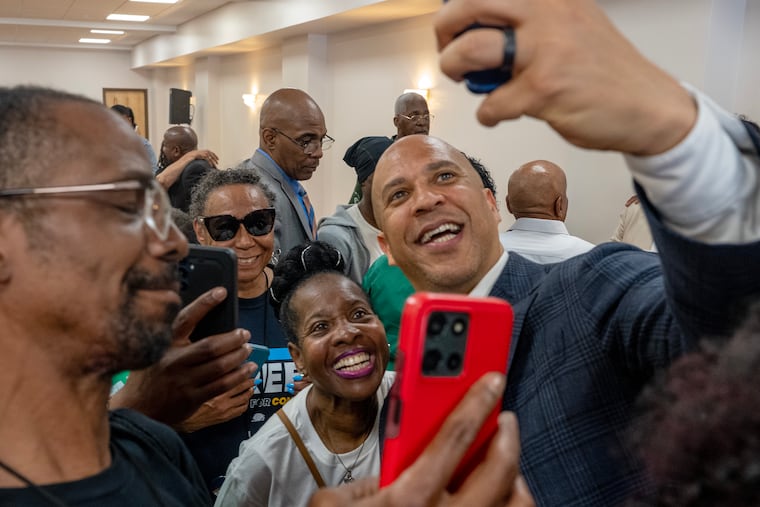
Four Republicans are vying to face U.S. Sen Cory Booker, despite his popularity in New Jersey and his campaign’s massive bank account.
New Jersey has not elected a Republican to serve in the U.S. Senate since 1972 — two were appointed in 1982 and 2013 — and Democrats outnumber Republicans by about 859,000. Meanwhile, President Donald Trump’s approval rating has plummeted, and voters who remain concerned about the high prices of gas and groceries blame Republicans for their woes.
But the GOP candidates say they largely stand by Trump. If Republicans can win enough independent voters, they argue they have a shot against Booker, who they see as more focused on a potential presidential run than serving New Jersey.
Surgeon Robert S. Lebovics; attorney Justin Murphy; Richard Tabor, who worked as a New Jersey State Police trooper before being suspended in April amid an internal investigation; and writer and broadcaster Alex Zdan will compete in the GOP primary on Tuesday to face Booker in November.
The odds are stacked against Republicans in a state that has sent Booker to Washington with well over 50% of the vote three times since he was first elected in 2013. As of May, Booker also had a stockpile of more than $32 million — the third-largest amount of money for the 2026 elections for U.S. House and Senate, and an intimidating figure for challengers to face.
“Look, I know exactly where we are as a party in New Jersey,” Murphy, of Burlington County, said. “We’re outnumbered, we’re outspent, but we still have an opportunity, I think, to pull off a major upset here. If I didn’t think that, I would not be here.”
And some New Jersey Republicans believe the party may have a chance, pointing to Republican Jack Ciattarelli’s close race with former Democratic Gov. Phil Murphy in 2021 and how Trump improved his margins in New Jersey by about 10 points from 2020 to 2024 and flipped five counties. They argue that the state is more purple than blue, even though Democratic Gov. Mikie Sherrill defeated Ciattarelli in his second run by more than 14 points in November and flipped back all the counties that went to Trump in 2024.
Zdan, of Mercer County, for one, believes Sherrill’s victory was driven by last fall’s 43-day government shutdown.
“The government shutdown was weaponized by Democrats in our state and nationally to drive the vote against Republicans and obviously, God-willing, that’s not going to be a situation in 2026,” he said.
The role of Trump
In addition to Booker’s financial war chest and popularity, Trump is facing dismal approval ratings that trickle down to candidates across the country. According to a recent poll from The New York Times, 59% of voters disapprove of how Trump is handling his job as president.
Only 26% of New Jerseyans have a favorable opinion of Trump, according to a late March Rutgers-Eagleton poll.
But Eric Arpert, a Republican political strategist who managed Ciattarelli’s campaign, makes the case that there’s still a “lifetime” between now and November in politics.
“Increasingly we are impacted by national mood, but nevertheless, candidates can and should put forward a positive argument for New Jersey, and voters respond to that,” he said.
Murphy refers to himself as “a pro-life [Ronald] Reagan Republican,” but said he still doesn’t “run” from Trump.
“We’re the Republican Party, and he’s our president,” he said.
Tabor, who lives in Union County, said he plans to lean into Trump’s accomplishments like his immigration crackdown, especially as New Jersey Democrats condemn it.
“At the end of the day, this is our president, and we have to support him,” he said. “We might not agree at times on everything, but he does some positive things. Why aren’t we highlighting those things?”
Tabor said his strategy is to focus on urban communities that he said Republicans have largely ignored. Drumming up support in the larger cities can help knock into Democratic margins.
“That’s where the Republican Party has failed time and time again, but that’s where I’m different,” he said.
But even Tabor admits that’s a tall order. For example, in parts of Newark — the most populous city in the state — then Vice President Kamala Harris won in 2024 with upward of 90% of the vote.
Offense on Booker
Republicans are hoping to lean into the speculation that Booker is toying with a 2028 presidential run. The Democrat said he’s focused on his reelection but has not ruled out the idea.
“At a time when life in New Jersey continues to get more and more expensive … there is a consensus, and I think a growing concern amongst voters, that his focus is elsewhere,” Arpert said.
For that reason, Zdan said he’s not concerned with Booker’s fundraising figures.
“The bank account only tells a piece of the story,” he said, adding that he suspects most of Booker’s money will be spent on a future presidential run for 2028.
Reaching for the middle
The candidates hope to reach the state’s roughly 2.4 million unaffiliated voters, who make up about 36% of the electorate, even though they did not show up in the numbers Ciattarelli’s team was hoping for last year.
“The good news is, we do not need to out fundraise. We need to get more votes than him,” Murphy said. “If we can inspire some of those people that sit home, that we can change the dynamic of the entire political race by getting more people to come out to vote, that’s where I think we can squeak by.”
The primary candidates said they plan to appeal to voters by talking about issues that affect people’s quality of life and resonate across partisan lines, such as property taxes, data centers, and healthcare.
Lebovcis, of Bergen County, said that he considers himself a “true centrist, moderate centrist, right of center” as politics in the country have gotten so extreme.
“At the end of the day, you have to talk to the people in the middle who are persuadable, I call the reasonable, rational people. I say, ‘Look, you can continue the status quo, or you can get change’,” he said.
Even if the nominee sorely loses to Booker, the primary still serves a purpose for the state’s GOP as it navigates its path forward. It will be an early statewide test of the weight local GOP establishment endorsements hold after the state abolished its county line ballot system — which favored party-backed candidates — since the candidates are all relatively unknown.
“I’ll be looking to see where the candidates have invested their time, their energy, and their resources, and what result, if any, that has on the actual outcome,” Arpert said.