Cape May Mayor Zack Mullock wins Democratic primary to challenge U.S. Rep. Jeff Van Drew in the fall
The Jersey Shore mayor defeated a candidate with more than double his fundraising.
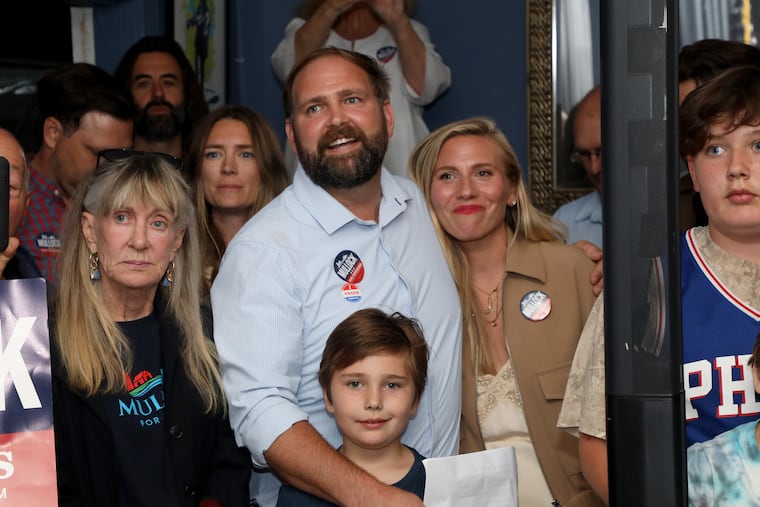
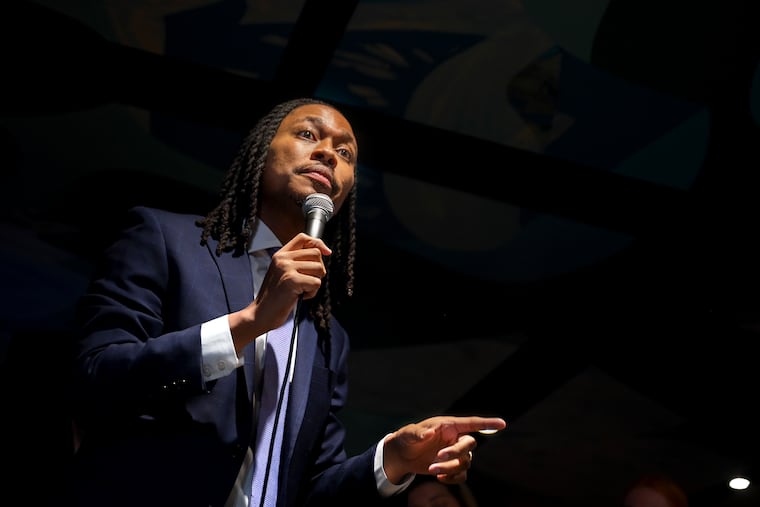
CAPE MAY — Cape May Mayor Zack Mullock won the Democratic primary to face U.S. Rep. Jeff Van Drew in New Jersey’s 2nd District, the Associated Press has projected.
Mullock, 40, defeated Bayly Winder, the best-funded candidate with experience in the federal government; civil rights attorney and former nominee Tim Alexander; and grassroots candidate Terri Reese to become the Democratic nominee for the congressional district.
“We will fight for South Jersey,” he said to a crowd of supporters Tuesday night at Cape May’s Chalfonte Hotel, which his family owns. “What happens next is bigger than one candidate, bigger than one election. This is about whether South Jersey will finally have the representation that it deserves.”
When he took the stage around 9:45 p.m., Mullock joked that he had had a concession speech written.
“Give it to Van Drew!” a supporter shouted.
As of early Wednesday afternoon, Mullock had about 37% of the vote, comfortably ahead of Alexander (25.7%), Winder (20.5%), and Reese (10%).
The Jersey Shore mayor raised nearly $200,000 and lent his campaign $110,000, leaving him with the second-highest amount of money in his coffers — though Winder still had more than double that along with a super PAC supporting him — as of May 13.
The sprawling South Jersey district includes parts of the Philadelphia suburbs and covers farmland, shore towns, and Atlantic City casinos. Van Drew was first elected to the seat in 2018 as a Democrat, but he became a Republican one year later and declared loyalty to President Donald Trump.
“For the last eight years, I’ve been working across the aisle to accomplish things, and, frankly, speaking the language of people that we’re going to need to talk to to win this election,” Mullock said in an interview last month, referring to his time on the local city council and as mayor in the nonpartisan local government.
Quanette Vasser-McNeal, the head of the Cape May County NAACP who attended Mullock’s election night party, said his local experience would give him the tools to compete with Van Drew in November.
“How does he beat Van Drew?” Vasser-McNeal continued. “By actually being authentic to who he is, being consistent. He’s already the mayor of Cape May and being a true people person and for the community.”
Mullock dominated the polls in his home Cape May County and its bordering counties, Atlantic and Cumberland. His victory suggests that his deep ties to the district were more powerful than Winder’s deep campaign coffers.
Joseph Viso, 21, the president of Stockton University Democrats, supported Winder and was surprised by the results, but conceded that the race came down to who had more roots in the district. Winder had moved to South Jersey only shortly before launching his campaign last year.
“It became a big question towards the end, of whose roots are truly invested in South Jersey,” said Viso, the grandson of former U.S. Rep. Frank LoBiondo, a Republican who represented the district from 1995 until Van Drew replaced him in 2019.
Mullock was born and raised in South Jersey and wife Justine have three children, ages 12, 10, and 7. The candidate and his family are well known in the historic shore town.
With his family, Mullock helped found the Harriet Tubman Museum and the Cape May Point Arts and Science Center. His family also owns the Cape May National Golf Club, where he works as vice president. He also serves on the Atlantic Cape Community College Board and as a general contractor.
At Our Lady Star of the Sea Parish Hall, where Mullock voted earlier that day, Barbara Hughes, 84, said she voted for her mayor.
“You bet I did,” said Hughes, a descendent of the prominent Hughes family, whalers with roots in Cape May dating to the 17th century. “He’s done a good job.”
She recalled this winter’s near-blizzard when Mullock came around people’s snowed-in homes on his own tractor to help. The retired school counselor said she found Republican Van Drew “generally acceptable,” but preferred Mullock.
National Democrats haven’t prioritized the district compared to more competitive races — including several in Pennsylvania and Central Jersey’s 7th District — but local Democrats see a strong opportunity to flip the seat — and the U.S. House — as part of an anticipated blue wave.
U.S. Rep. Madeleine Dean (D., Pa.), who represents Montgomery County in the Philadelphia suburbs, supported Mullock in the race, as did Amy Kennedy, the Democrat who came the closest to beating Van Drew in 2020 but still lost by nearly 6 points.
To win in November, Mullock will have to appeal to voters outside of the Democratic base. More voters in the district are registered as Republican than Democratic, though the largest group of voters is unaffiliated.
Andrew Ratliffe, 40, of Woodstown, cast his vote for Mullock on Tuesday because he believes the mayor would focus more on places like his home Salem County, the least populous county in the state. Ratliffe, who works in food management, criticized Van Drew’s “bait and switch” to the Republican Party.
“We’re under-represented and need someone to do things like filter more tourism down here to help businesses,” he said.
While Democratic voters cast their ballots thinking about the best way to oust Van Drew in the fall, Republican voters were glad to keep supporting him.
Helene Denafo, 98, a Republican who retired from the Ventnor Board of Education, said at the polls that she has been happy with Van Drew’s constituent services.
“If you had a problem, he helped you,” Denafo said. “He always spoke to you.”
Van Drew, whose nomination was uncontested in the Republican primary, said in a statement before the Democratic race was called that the fall election would present a “clear contrast” in visions for the country, saying he believes “we’re the engine that drives the world rather than the caboose.”
The Cape May mayor was the last Democrat to join the race. Mullock said he had been thinking about the lack of economic investment in South Jersey, and ultimately ran because of how dismayed he had become with Van Drew, whom he’s known for decades.
Mullock said he maintained a good relationship with the representative until a meeting a few months ago, when he said he “legitimately didn’t recognize the person that I was talking to.”
Around the same time, the Trump administration was pushing for the removal of a slavery exhibit at the President’s House in Independence National Historic Park in Philadelphia. Mullock said Van Drew’s silence was that final push he needed.
“To think that by the decree of one man, they would take down the history of slavery, and our representative just stood silent, and that just bothered the heck out of me,” he said.
But the soft-spoken Mullock said after his primary victory that he would best Van Drew “not with anger but with “neighbors talking to neighbors.”
Staff writers Al Lubrano and Dana Munro contributed reporting.