Why there’s less controversy — and less money — in this year’s school board races in Central Bucks and elsewhere
Massive spending campaigns, controversy, personal attacks and political division plagued suburban school board races in 2023, but not this year.

Personal attacks, political division, and culture wars have defined school board races in the Philadelphia suburbs in recent years.
But 2025 feels different.
Even as national politics are more divided than ever — and amid a federal shutdown and state budget standoff — local school board candidates from both parties are shying away from partisanship in favor of focusing on local issues like taxes and full-day kindergarten.
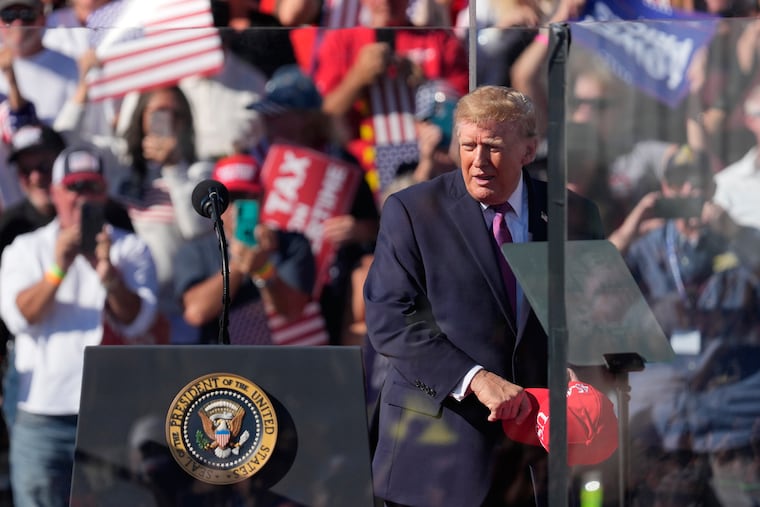
The change in posture can be attributed to several factors — Republicans who ran on culture-war issues largely lost in 2023 and, while the GOP is now tackling those priorities from the federal level, local candidates said they cannot control what President Donald Trump does. Schools are also facing pressing fiscal issues amid state and federal budget cuts.
There are some exceptions. In Souderton, candidates on the Republican slate say they want to maintain the district’s current policies that prevent transgender girls from playing sports and prioritize “parental rights” — stances Trump has also embraced. Some Democratic candidates, meanwhile, say Trump’s education policies, including plans to dismantle the federal Department of Education, motivated them to run.
Still, those issues are not taking center stage across the Philadelphia collar counties.
“School districts are struggling financially,” said Brittany Crampsie, a Democratic consultant. Parents “don’t want to have a debate about DEI [diversity, equity, and inclusion] anymore, they want to make sure their kids are getting a good education.”
Moving on from ‘culture wars’ — for the most part
Culture-war debates reached a fever pitch in the aftermath of COVID-19, as conservative parents voiced frustration over pandemic protocols and classroom curricula. Republicans in districts like Central Bucks won contentious races focused on those issues in 2021.
Two years ago Central Bucks was again among the most closely watched races in the region, with spending surpassing $600,000. Democrats swept every open seat, ousting a conservative majority that had banned books and Pride flags in the district. Other suburban districts flipped to Democratic control as well.
Now, candidates are steering clear of those hot-button topics.
“My campaign is focused on academics, school taxes, and safety….these are the current issues of concern in Central Bucks,” Betty Santoro, a Republican, wrote in an email.
Culture wars were a “distraction” from priorities for the district, said Daniel Kimicata, a Democrat running for reelection. Four of nine seats are on the ballot this year; Democrats will maintain their majority regardless of the outcome.
Andrew Miller, a Republican running in Central Bucks, wrote in an email it’s good that things are quieter. “People are tired of the shouting and want results,” he wrote. “They want candidates who listen, not lecture and candidates who build bridges, not walls.”
In Souderton — where Democrats say they are optimistic about their chances of gaining representation on the all-Republican board — the Republican platform also includes parental rights and student safety.
Republican board president Stephen Nelson, who is running for reelection, said that culture-war topics are not an issue in the district, but that it would not allow transgender athletes to compete on girls sports teams should the situation arise. (The Pennsylvania Interscholastic Athletic Association this year changed its transgender athlete policy to comply with President Donald Trump’s executive order on “Keeping Men Out of Women’s Sports.”)
“Why is that a question? It’s always been that way and we don’t quite understand why it has to be any different,” Nelson said.
In Pennridge, where the board is Democratic-controlled, Republican candidates, in a statement, pushed back on the idea that school board races in the past centered on issues promoted by Republicans. Instead, they argued, GOP candidates were responding to Democratic-initiated policies and questioning some DEI policies and whether they were best for students.
“Our intent was never to divide but to ensure that schools serve all students equally and that classroom priorities remain rooted in education, not ideology,” they said.
Money, money, money
This year, there is far less money flowing into school board races, though Central Bucks continues to attract outside fundraising.
The 1776 Project PAC, a group supporting Republican school board candidates that has drawn ire from Democrats, has spent more than $86,000 on mailers and text messages in Bucks County. Approximately half that has gone toward supporting Central Bucks GOP candidates, with the rest going to candidates in Centennial School District and Pennridge, according to Bucks County campaign finance reports.
The PAC has also spent more than $20,000 supporting candidates on Republican slates in Perkiomen Valley and Lower Merion, according to Montgomery County campaign finance filings.
Democrats are also getting support from an outside group — Red Wine and Blue, a national group of suburban women that promotes Democratic candidates. The group has spent approximately $260 in Bucks County and $104 in Montgomery County school board races, according to county filings.
In Bucks County, other races like district attorney and sheriff have drawn money and attention that might have otherwise gone to school boards, said Guy Ciarrocchi, a GOP analyst.
“There’s a certain amount of fatigue that’s hitting a place like Bucks,” Ciarrocchi said.
The Trump factor
Democrats in suburban districts said they need to maintain majorities to best address the impacts of Trump administration policies.
“When I realized the threat that public education was under, I decided now was the time that I had to run,” said Katrina Filiatrault, a Democrat running in Central Bucks.
Judy Lofton, a Democrat running in Perkiomen Valley, said of her slate: “Our central unifying message is that we want to protect public education, that public education is currently under attacks from a variety of different stakeholders.”
Republicans are striking a different tone.
“We’re not focused on anything that’s going on outside of something that we don’t control,” said Jason Saylor, a Republican running for reelection in Perkiomen Valley. “We don’t control the federal government. We don’t control what might happen with the Department of Education. We don’t control issues at the state legislature.”
In Souderton, controversy flared last year when Republican school board member Bill Formica made lewd comments about former Vice President Kamala Harris. He is still on the board and is not up for reelection this year.
“We’re talking to every voter who might be a Republican or an independent, and they’re sharing concerns at the doors about how they can’t vote for certain people anymore,” said Corinne DeGeiso, a Democrat running for the board.
Nelson, the Republican school board president running for reelection, said Formica was protected by the First Amendment.
His comments, Nelson said, were “rude, lewd, and unacceptable,” but there was nothing the board could do about it.
Even in a less contentious election cycle, Chris Lilienthal, a spokesperson for the Pennsylvania State Education Association, which tends to endorse Democratic candidates, said school board elections are more important than ever this year.
“They’re holding the line right now in this budget impasse,” he said, “and that alone should merit the attention of voters.”
This suburban content is produced with support from the Leslie Miller and Richard Worley Foundation and The Lenfest Institute for Journalism. Editorial content is created independently of the project donors. Gifts to support The Inquirer’s high-impact journalism can be made at inquirer.com/donate. A list of Lenfest Institute donors can be found at lenfestinstitute.org/supporters.