Government shutdown: What’s been affected so far and what could be next
As the government shutdown continues, here's what services could affect you.

As the federal government shutdown enters its second month, there’s no sign the impasse will end anytime soon.
It’s already the second-longest shutdown on record, trailing only a partial shutdown during President Donald Trump’s first term that lasted 35 days. Yet Republicans and Democrats appear no closer to reaching a compromise on reopening the government.
The core issue remains expiring tax credits for the Affordable Care Act, known as Obamacare, which threaten to cause insurance rates to spike across the country. Democrats have refused to back a Republican bill that would fund the government without guarantees on negotiating an extension of the tax credits.
On Pennie, Pennsylvania’s official health coverage marketplace, premiums are set to rise an average of about 21%, according to the Pennsylvania Insurance Department. That increase takes into account the Republicans’ budget bill, which let enhanced tax credits expire at the end of 2025.
Open enrollment begins Saturday.
In the meantime, House Speaker Mike Johnson (R., La.) has kept the House out of session since the middle of September, preventing one newly elected member of Congress — Adelita Grijalva (D., Ariz.) — from being sworn in.
The Trump administration has also used the shutdown to permanently lay off more than 4,000 federal workers, an unprecedented move being challenged in court. The administration has also canceled several projects in Democratic-led states, most notably the $16 billion Gateway Hudson River tunnel project in New York and New Jersey.
In Pennsylvania and across the country, the shutdown is making its impact felt. Here is what’s happening now — and what could happen if the impasse continues.
Food stamps and WIC could be cut off
Two key antipoverty programs are set to run out of funds, threatening nearly 50 million vulnerable Americans with the loss of food assistance and childcare.
SNAP (Supplemental Nutrition Assistance Program), also known as food stamps, will be cut off for 42 million Americas beginning Nov. 1, including nearly 2 million in Pennsylvania and 500,000 in Philadelphia. Most recipients of federal food assistance are elderly people, families with children, and disabled people.
The average benefit for a SNAP recipient is about $187 a month, according to the U.S. Department of Agriculture. The program has a $6 billion contingency fund, but the Trump administration claimed it cannot use that money to keep benefits flowing because it is intended for disaster relief.
The Special Supplemental Nutrition Program for Women, Infants, and Children, or WIC, could also run out of funds around Nov. 1, depending on the state. The program is currently being propped up by a temporary infusion of $300 million, which came from unspent tariff revenue and leftover funds from other programs, the Associated Press reported.
According to USDA data, nearly 7 million people receive WIC benefits, which includes food, breastfeeding support, and other nutritional services for low-income mothers and their young children.
— Rob Tornoe
» READ MORE: Federal shutdown may bring a halt to food assistance for half a million Philadelphians
Heating bill assistance delayed
Due to the continued shutdown, Pennsylvania is delaying the opening of this year’s Low-Income Home Energy Assistance Program, or LIHEAP, until at least Dec. 3.
The program provides funds to more than 300,000 vulnerable Pennsylvanians who cannot afford their heating bills.
The shutdown is preventing the federal government from distributing about $3.6 billion in assistance to states, which typically receive the funds in late October.
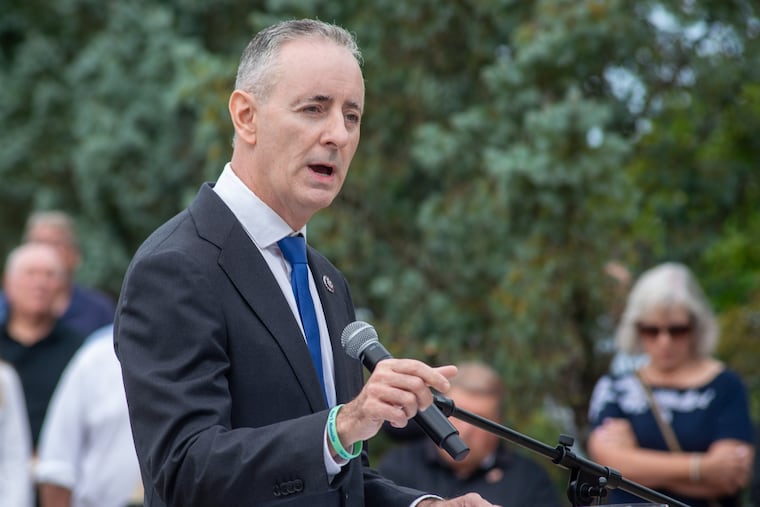
“No household should have to choose between keeping their homes safe temperatures, basic health care, or having food on the table,” Rep. Brian Fitzpatrick (R., Pa.) wrote in a letter sent to Health Secretary Robert F. Kennedy Jr.
» READ MORE: More than 300,000 Pennsylvanians need help heating their homes. The federal shutdown has delayed that assistance.
— Rob Tornoe
Missed pay for federal workers
Federal employees have been grappling with instability and chaos during the government shutdown, with some furloughed and others working without pay.
Nationwide, more than 670,000 federal employees have been furloughed, while approximately 730,000 are working without compensation, according to the Bipartisan Policy Center.
Trump administration officials have signaled that they could forgo disbursing to workers back pay that is legally obligated, which federal workers’ unions have pushed back on.
Once the shutdown ends, employees who are put on furlough for their absences, or who do not provide proper documentation, will be denoted as AWOL and “appropriate action may be forthcoming at that time,” officials said in a memo.
At the Social Security Administration and the Department of Veterans Affairs in Philadelphia, workers have said they are pausing their mortgages, cutting back on expenses where they can, and applying for SNAP benefits.
» READ MORE: Some Philly federal workers are working through the shutdown. It’s ‘awful’ and ‘depressing.’
— Fallon Roth and Ariana Perez-Castells
Closures and staffing issues at national parks and museums
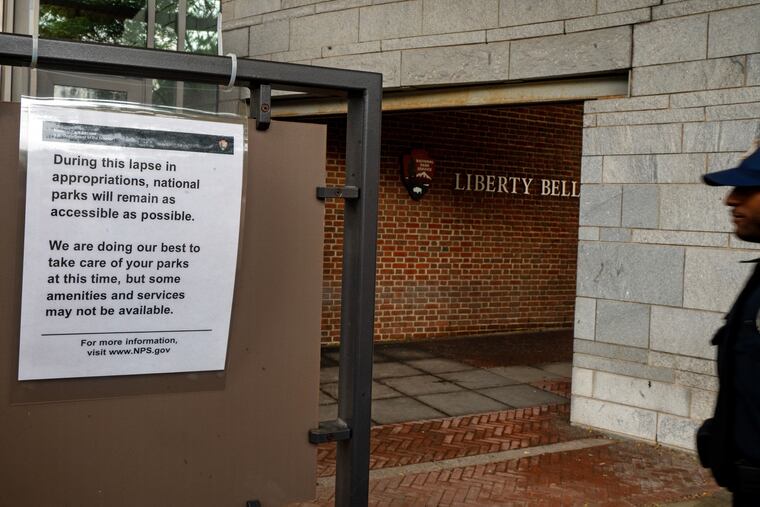
A number of sites in Philadelphia under the purview of the National Park Service remain closed amid the shutdown, having gone dormant at the start of the impasse. Among them are several Independence National Historical Park attractions, including the Liberty Bell Center, Independence Hall, and the Benjamin Franklin Museum.
Visit Philly, the city’s main tourism agency, said earlier this month that it had no plans to step in and keep popular historical attractions running, as it did during the 35-day government shutdown seven years ago. A number of popular attractions remain open, including the National Constitution Center, the Museum of the American Revolution, and the Betsy Ross House.
Just outside Philadelphia, Valley Forge National Historical Park remains generally open, but features such as its visitor center, theater, restrooms, and other attractions are closed. Overall, national parks are to “remain as accessible as possible” as the shutdown drags on, according to a message on the park service’s website.
Nationwide, the service oversees more than 400 sites, about 63 of which are designated national parks. In a contingency plan released ahead of the shutdown, the Department of the Interior, under which the service operates, indicated that “park roads, lookouts, trails, and open-air memorials will generally remain accessible to visitors.” Parks lacking “accessible areas,” however, were to be closed, and many park staff members were furloughed.
While the full impacts of this shutdown are not yet clear, the National Parks Conservation Association estimated that during the 2018 shutdown, the service lost roughly $400,000 daily in entrance fee revenues.
— Nick Vadala
Air traffic controllers miss their first paycheck
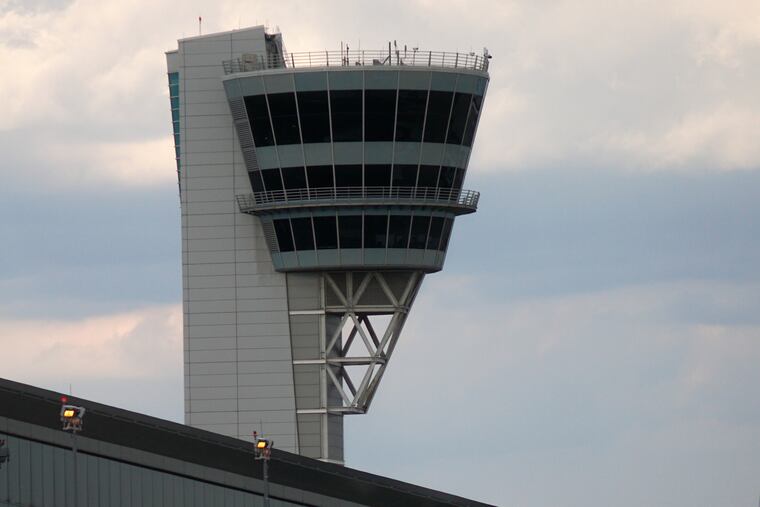
Nearly 11,000 air traffic controllers missed their first full paycheck this week as the shutdown threatens to affect the safety of air travel.
“America’s air traffic controllers are now having to focus on how they put gas in the car, how do they take care of their children, how do they pay for childcare,” Nick Daniels, president of the National Air Traffic Controllers Association, said during a news conference earlier this week. “That makes the system less safe.”
While flight delays have continued to pile up across the country, there have not been any staffing-related delays at Philadelphia International Airport and security wait times are normal, according to a spokesperson.
On Wednesday, the Federal Aviation Administration listed warnings for insufficient staffing levels at two air traffic control facilities, including one in Philadelphia that handles traffic into and out of Newark Liberty International Airport.
During a news conference Tuesday, Transportation Secretary Sean Duffy said 44% of all flight delays Sunday were caused by air traffic controller staffing issues, up from a daily average of 5% before the shutdown.
“It’s safe,” Duffy said. “It’s just that you may not be traveling on the schedule that you anticipated because of this government shutdown.”
On Day One of the shutdown in Philadelphia, 800 TSA officers continued to screen luggage and staff checkpoints at Philadelphia International Airport. By Thursday, Day 30, federal workers at PHL were turning to a food pantry at the airport. TSA workers missed their first full paycheck on Oct. 24.
It also appears that the Department of Homeland Security is placing workers, including TSA officers, on furlough if they do not “report for duty as directed to perform that excepted work,” according to a memo obtained Wednesday by The Inquirer.
» READ MORE: Food pantry opens at Philadelphia International Airport for federal workers amid government shutdown
— Rob Tornoe, Fallon Roth, and Ariana Perez-Castells
Weather forecasts continue
The shutdown is affecting the lives of National Weather Service meteorologists, who are working without pay — but evidently not the forecast operations at the field offices or the National Hurricane Center.
Locally, the only evidence things are a bit different these days is a headline atop the homepage of the Mount Holly office that says, “This site will remain updated during the shutdown.”
The office has continued to issue forecasts on schedule, along with warnings, advisories, and special briefing packages for significant weather events.
The National Hurricane Center also has been issuing forecast updates and graphics on schedule.
Back in June, the National Oceanic and Atmospheric Administration issued a statement asserting that the hurricane center was fully staffed with forecasters.
The statement also said NOAA would be taking measures to see that forecast offices would be staffed adequately.
— Anthony R. Wood
No impact on Social Security, Medicaid, and Medicare payments
As has been the case throughout the shutdown, payments to Social Security, Medicaid, and Medicare will continue uninterrupted.
While Social Security checks will not be affected, roughly 12% of the agency’s workforce has been furloughed and a number of services provided by the agency — including benefit verifications, record corrections, and card replacement — have been halted.
Medicare and Medicaid are fully funded through the end of December, according to the Department of Health and Human Services.
— Rob Tornoe