Partisanship, divisive Trump presidency hang over 250th celebrations in Philadelphia and Washington
Philadelphia Democrats say Trump’s impact on what could be a historic, unifying moment is “tragic.”
WASHINGTON — Fifty years ago this week, President Gerald Ford’s helicopter arrived at Valley Forge in a dense fog.
After a speech to 15,000 people, he designated the Revolutionary War landmark as a national park before heading to Philadelphia, where an estimated crowd of 1 million gathered outside Independence Hall. Ford spoke soberly, recounting the story of a nation that, on its 200th birthday, should find confidence in its ability to both celebrate its founding ideals and ask “hard questions” in the pursuit of something better.
“The American adventure,” Ford said on July 4, 1976, “is a continuing process.”
Philadelphia’s 250th anniversary celebrations this week are set to feature no appearances from the president. No reflections on self-improvement from the commander-in-chief at the birthplace of American democracy, no luncheons with the Philadelphia mayor near City Hall, as Ford also did after his speech.
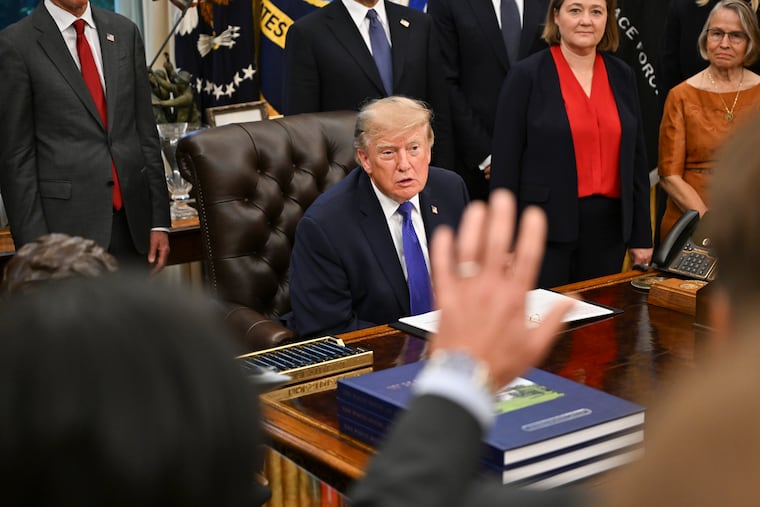
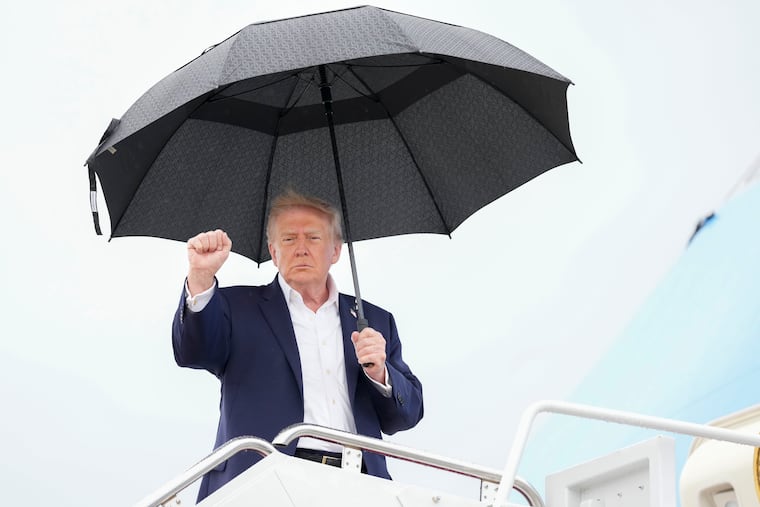
President Donald Trump has said he will instead use the occasion to throw “the most spectacular TRUMP RALLY” on the National Mall — one of several ways the president’s critics have said he has injected partisanship and self-serving events into what should be a unifying moment.
Trump’s stamp on “America 250” has been clear.
A UFC fight on the White House lawn branded as “Freedom 250” overlapped with the president’s 80th birthday and featured adulations directed at him. The Great American State Fair, which some Democratic-led states declined to participate in, opened last week with a campaign-style speech in which the president railed against DEI and transgender athletes. It also featured the U.S. Marine Band playing the Village People’s “Y.M.C.A.,” a Trump campaign rally staple. Transportation Secretary Sean Duffy, using an offensive term that combines liberal with a slur for people with intellectual disabilities, said the band was better than the “libtards” who canceled their performances because of concerns over Trump’s partisan behavior.
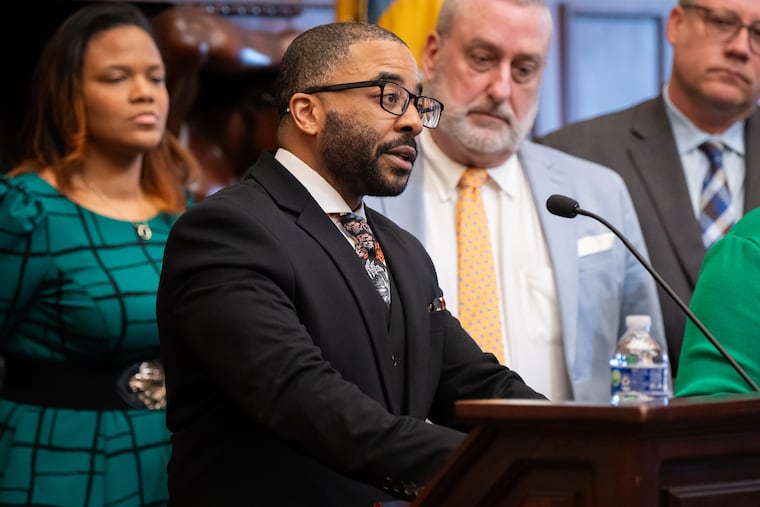
“This is really, more than anything else, an opportunity to attempt to bring us all together as Americans. That’s what past celebrations have done,” said U.S. Rep. Brendan Boyle, a Democrat whose district includes Independence Hall. “It’s just so tragic that for this anniversary, the president we have is Donald Trump, someone who is completely not capable of doing any sort of national unity-type event.”
Boyle worked for years to arrange a ceremonial gathering of Congress at Independence Hall for the 250th, which is set for Thursday. Though not officially a joint session outside of Washington — which has only occurred two other times since the capital relocated from Philadelphia — the event will mark the moment on July 2, 1776, when the Second Continental Congress voted to adopt a resolution for independence.
The commemorative moment “just gives me chills to think about it,” said U.S. Rep. Mary Gay Scanlon, a Delaware County Democrat who represents part of Philadelphia and plans to attend Thursday. Scanlon said she was hopeful the event will be bipartisan at a time when the president’s divisiveness was “taking an edge off the celebratory aspect” of the 250th.
Both Scanlon and Boyle described the president’s lack of plans to mark the moment in Philadelphia as disappointing. The White House did not respond to questions for this article, including whether it made any attempts to plan an event with the president in the city.
“I always just kind of assumed that the president of the United States would, at some point in the days leading up to the Fourth of July or even on Fourth of July itself, be in Philadelphia,” Boyle said. “But obviously this president has different priorities.”
Injecting polarization into apolitical events
Matthew Levendusky, a University of Pennsylvania political science professor who has studied how July Fourth celebrations affect sentiments about national identity and polarization, said previous presidents participated in “patriotic, but not political,” events like concerts, fireworks, and parades.
Trump has taken a distinctly different path since his first term, Levendusky said, noting the military parade in 2019 and a speech at Mount Rushmore in 2020 when, after the murder of George Floyd in Minneapolis, he used the moment to criticize the removal of monuments that symbolized racial oppression.
The 250th events are an example of how Trump, a “conflict entrepreneur,” makes such events more political at a time when American society has already become more partisan, Levendusky said.
“There’s more debate over the meaning of American identity than there was a decade or 15 years ago — in part because there’s been more polarization,” said Levendusky, the director of Penn’s Institutions of Democracy at the Annenberg Public Policy Center. “But he’s also done things that inject polarization into that process.”
Those actions appear to have affected how voters feel about America’s democracy 250 years in — at least among Philadelphia’s largely Democratic electorate.
According to a new Suffolk University/Philadelphia Inquirer poll that surveyed 500 city residents, 70% of Philadelphians believe Trump’s presidency has made them feel less confident in the country’s democracy. The answers were strongly correlated to political party, with more Republicans than Democrats saying that Trump’s presidency made them feel more confident in democracy or that it made no difference.
Tourists flocking to the city have reflected those ideological divides but also a bipartisan desire to set politics aside for a historic milestone.
“We’re all Americans, I don’t care who the president is,” said Greg Sage, 55, a Republican from Michigan who voted for Trump and toured the city’s historic sites this month. “I try not to politicize it, you know? But I believe we’ve been around 250 years. Maybe we’ll make another 250.”
Phyllis Ahnberg, 68, a Democrat from California, said that it was “empowering” to visit Philadelphia’s sites and that she would not let one person or administration change how she celebrated a moment for unity. Still, it was hard to ignore Trump’s impact during a recent trip to Washington.
“We were up at [the] Washington Monument, and we were looking, and it was disgusting to see the White House and this, like, fight thing,” Ahnberg said, referencing the towering structure built to host the UFC fight on June 14. “And to see the East Wing torn down … I mean, it was disgusting. Nobody hired this man to do that.”
U.S. Sen. Dave McCormick, Pennsylvania’s highest-ranking Republican and a close Trump ally, attended the fight and posted on social media that it was an “incredible evening” that honored “the strength, resilience and spirit of the American people.” His office did not grant a request for an interview for this article.
A debate over past and future America
Other Republicans on Capitol Hill have defended Trump’s role in the anniversary while using the moment to say they believe left-leaning Democrats are the primary threat to America’s democracy.
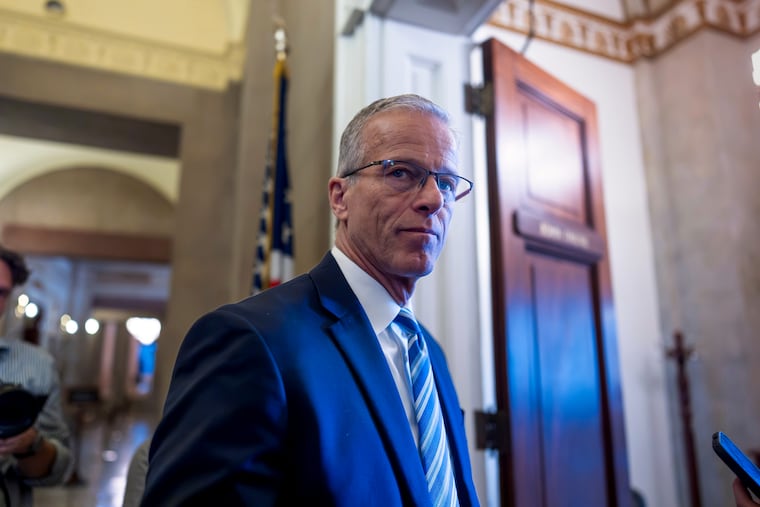
“We are in a fight right now to save the republic, and every American needs to take this seriously. You need to wake up,” an animated House Speaker Mike Johnson (R., La.) said at a news conference last week after three insurgent candidates backed by New York Mayor Zohran Mamdani, a democratic socialist, won competitive congressional primaries.
“Are we going to maintain our status as a constitutional republic on our 250th anniversary?” Johnson continued. “Or are we going to make a new choice and go down some road toward a communist utopia?”
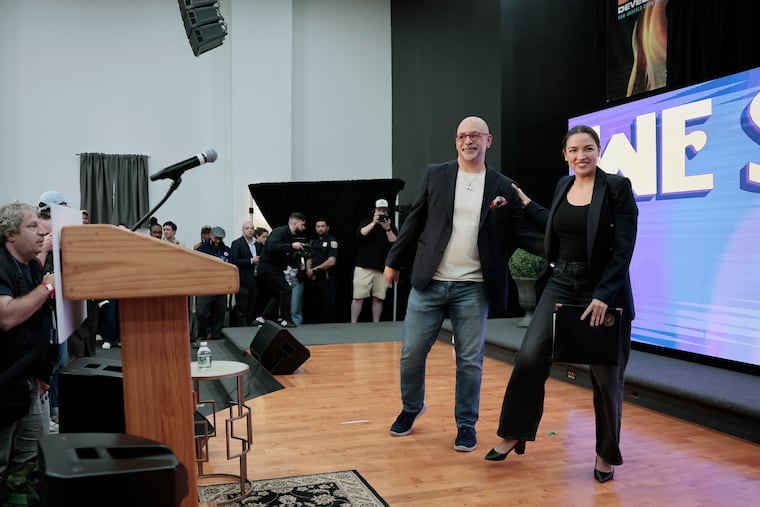
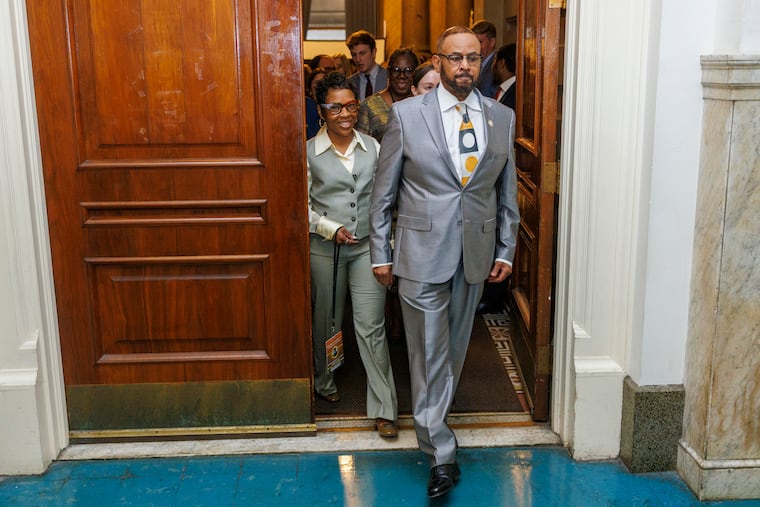
Chris Rabb, who won Philadelphia’s competitive primary in May to succeed retiring U.S. Rep. Dwight Evans (D., Philadelphia) next year, endorsed two of the candidates Johnson criticized and is likely to join them in the most progressive bloc in Congress next year.
A democratic socialist and state legislator, Rabb has been adamant about what he sees as a need for “radical” change. After speaking at an event titled “The Next American Revolution: Breaking Oligarchy and Making a New Democracy” in Washington last week, he said in an interview that Trump’s presidency has in some ways been a “valuable distraction.”
Instead of celebrating the anniversary in traditional — or what Rabb called “milquetoast” — ways, Trump is creating an opportunity for more critical, nuanced discussions about American identity and history, he said.
It is a particularly meaningful opportunity for him personally. A longtime family genealogist, Rabb has spoken often about his heritage as the descendant of both a signer of the Declaration of Independence — the slave-owning Philip Livingston — and Black abolitionists.
“I am an embodiment of the hypocrisy and the complexity of choices and systems that have never really been addressed … [and] that are very similar to what we had 250 years ago,” Rabb said. “Unless and until we have a real public, ongoing, and substantive conversation, it will be more of the same.”
Staff writer Andrea Padilla contributed to this article.