Philly lawmakers continue to slam Trump as Mayor Parker avoids confrontation | City Council roundup
City Council condemned Trump's deployment of the National Guard to other American cities and his administration's efforts to remove content related to slavery from historical sites.

Philadelphia lawmakers formally slammed President Donald Trump in two separate votes Thursday, taking action to condemn his administration even as Mayor Cherelle L. Parker has avoided loudly criticizing the president.
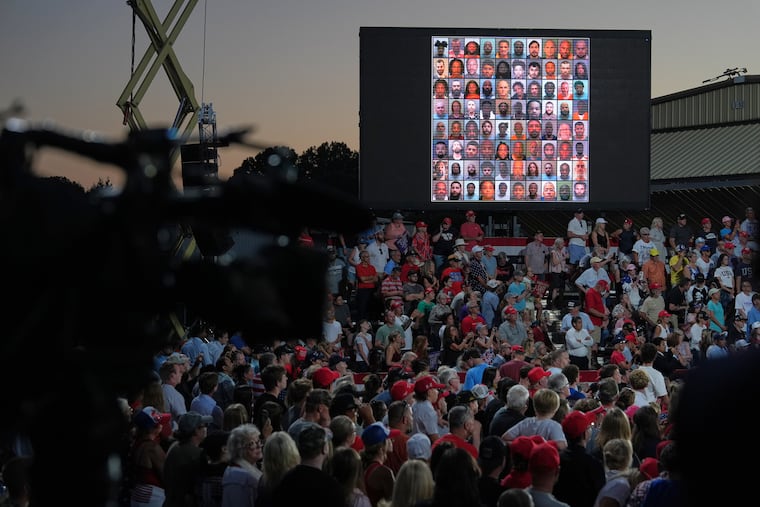
City Council, where Democrats have long held a supermajority, passed legislation opposing the federal government’s deployment of the National Guard as a crime-fighting measure in major American cities. The guard was deployed in Los Angeles and Washington, D.C. this summer, and Trump has threatened to send the military to other cities including Chicago and New York, but he has not publicly mentioned Philadelphia.
Lawmakers also voted to back a resolution condemning the administration’s attempts to “whitewash history” by seeking to remove some slavery-related content from historical sites, including in Philadelphia.
The resolutions are largely symbolic, and the mayor does not need to take a position on them by signing or vetoing them.
Still, Council has repeatedly passed resolutions opposing the Trump administration. And the legislators’ strategy to publicly criticize the president stands in contrast to Parker, a Democrat who has largely sought to avoid confrontation with the White House.
Parker’s office declined to comment Thursday.
» READ MORE: Pa. is braced for Trump to send National Guard to Philadelphia, Gov. Shapiro says
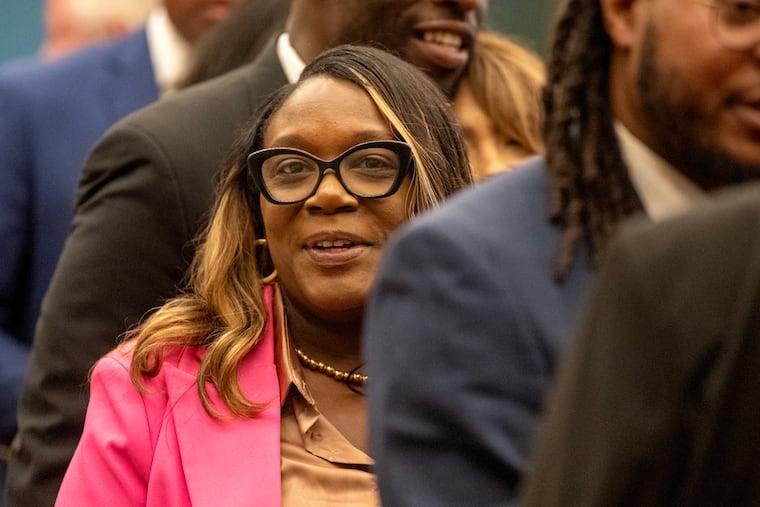
City Councilmember Kendra Brooks, of the progressive Working Families Party, said her goal is to proactively condemn the potential deployment of the National Guard in Philadelphia and that she’s “concerned” about the city’s approach to the Trump administration broadly.
“What we do in this moment will be judged by history,” Brooks said. “We need to be more outspoken, because it’s the right thing to do and because it’s the best way to keep us safe from this administration.”
One member opposed the resolution: Brian O’Neill, Council’s lone Republican, who represents parts of Northeast Philadelphia.
More Council pushback on Trump: Parker’s Democratic allies in Council were critical of the president and suggested local lawmakers should be doing more to oppose his agenda.
“We shouldn’t be doing this kabuki dance with this guy. He’s a bully,” said Councilmember Curtis Jones Jr.
And Council President Kenyatta Johnson himself championed the resolution condemning the administration’s reported plans to alter the President’s House Site at Independence National Historical Park. An exhibit at the site memorializes people George Washington enslaved.
That resolution passed unanimously, including with O’Neill’s backing.
Trump signed an executive order earlier this year directing his Department of the Interior to review and consider changing or removing materials that “focus solely on challenging aspects of U.S. history, without acknowledging broader context or national progress.” In practice, that has meant reviewing exhibits about slavery and Native Americans.
Johnson said the city owns the land where the President’s House sits, and leases it to the federal government. He suggested that could provide the city with some leverage, and he said Council would “exhaust all of our options from a legal standpoint.”
Asked if the mayor is involved, Johnson said he’s currently working “only with my team.”
Here’s what else happened in Council Thursday.
New regulations for hiring people with criminal convictions
Banning the box 2.0: Council passed a bill that updates the city’s Fair Chance Hiring Law, which is more commonly known as “ban the box” and was first passed in 2011. It prohibits employers from asking about criminal records on job applications, and restricts them from rejecting an applicant based on a criminal record more than 7 years old.
Councilmember Rue Landau, a Democrat who represents the city at-large, authored the legislation that makes a handful of changes, including shortening that “lookback” period for misdemeanor offenses to four years.
The bill also prohibits employers from considering convictions of some minor summary offenses at all, bringing city law in line with state law.
“A mistake should not be a life sentence to unemployment,” Landau said, noting that about 300,000 Philadelphians have a criminal record. “We cannot afford to leave talent on the sidelines when the city needs every worker to power our economy.”
The legislation was backed by both advocates for people who were formerly incarcerated and the Greater Philadelphia Chamber of Commerce.
Curtis Jones giveth...
New apartments moving in: Last spring, Jones declined to introduce a resolution releasing city property from the Philadelphia Land Bank so that drug rehabilitation nonprofit Gaudenzia could build a couple dozen affordable apartments.
Municipal law requires a resolution from City Council to release publicly held land for development, effectively giving district Council members veto power over the land bank.
In June, Jones said his district was already overburdened with thousands of recovery beds. Residents of West Philadelphia’s Cathedral Park neighborhood — where the apartments would be built — were opposed.
But Gaudenzia insisted that the units would not go to people in recovery. Over the summer, the group convinced Jones of that. Last week he introduced a resolution allowing the land bank to finally release the property to Gaudenzia.
“They made assurances that it would be more related to senior citizens than it would be for others,” Jones said, adding that “they promised they would build it beyond my expectations, that it wouldn’t be some ill-thought-of architecture.”
And Curtis Jones taketh away…
Hold his beer: On the first day of City Council’s fall session, Jones introduced and passed a resolution that authorizes him to appeal a Zoning Board of Adjustment (ZBA) ruling in the Court of Common Pleas.
The resolution gives him the authority to represent Council in contesting a ZBA ruling that allows a beer distributor to open at 5052-56 City Avenue.
The property in question is on the edge of Wynnefield, a middle-class neighborhood where many city officials live. Democratic Majority Leader Katherine Gilmore Richardson is the ward leader for the area.
Jones, Richardson, and the Wynnefield Residents Association opposed the beer seller moving in. But a different neighborhood group — Wynnefield Community Neighborhood Association — signed a community benefits agreement with the developer. That was enough for the ZBA, which allowed the distributor to open.
Not on Jones’ watch. This month, all of Council approved his appeal of the board’s ruling, and the developer is considering giving up in the face of the controversy. (In this intergovernmental dispute, the Law Department hired outside counsel to represent Jones against the ZBA.)
“ZBA does what it does, and sometimes that flies in the opposition of neighborhoods, and that’s why they elected me,” Jones said in an interview earlier this month. “Developers probably won’t like this, but there has to be somebody who protects the community and somebody who creates that balance so that you just don’t do whatever you want.”
Council appeals of ZBA decisions used to be exceedingly rare, but in recent years, the legislative body has become more aggressive in testing its authority over zoning matters.
This is the second time in the last four months that Council has appealed a ZBA decision. In June, Councilmember Jeffery “Jay” Young Jr. challenged a ZBA ruling that allowed affordable senior housing in his North Philadelphia district.
The developer said the delay would effectively kill the project, which had the support of Parker, the rest of the area’s political leadership, and the building trades unions.
Quotable
Trump opposition abounds: That was Tim Brown, an activist with Philly Neighborhood Networks, who testified in Council Thursday in support of Brooks’ resolution condemning Trump’s deployment of the National Guard in other cities. He was one of more than a dozen people who spoke in favor of the legislation.